Like hawks spotting their prey, unmanned aerial systems are helping more producers target “prey” such as forage-robbing weeds and diseases.
The use of unmanned aerial systems – aka drones – has increased in row-crop production in the past decade. And it’s now starting to increase in forage production. This is the case for both types of drones – those equipped with cameras to take images of crops and those used for applying seed, fertilizer or crop protection products, says Douglas Houser, digital agriculture specialist with Iowa State University Extension and Outreach.
He adds that camera-carrying drones enable producers to monitor forage health. Multispectral imagery allows them to see differences in forage color (chlorophyll content) to gain greater understanding of yield potential.
He also has seen more crop scouts and farmers using imagery drones for early season weed and crop scouting.
“There’s no more zigzagging across fields on foot,” says Houser.
Houser and his colleagues have noted that drones are becoming a reliable tool for quickly and efficiently identifying problems in the field.
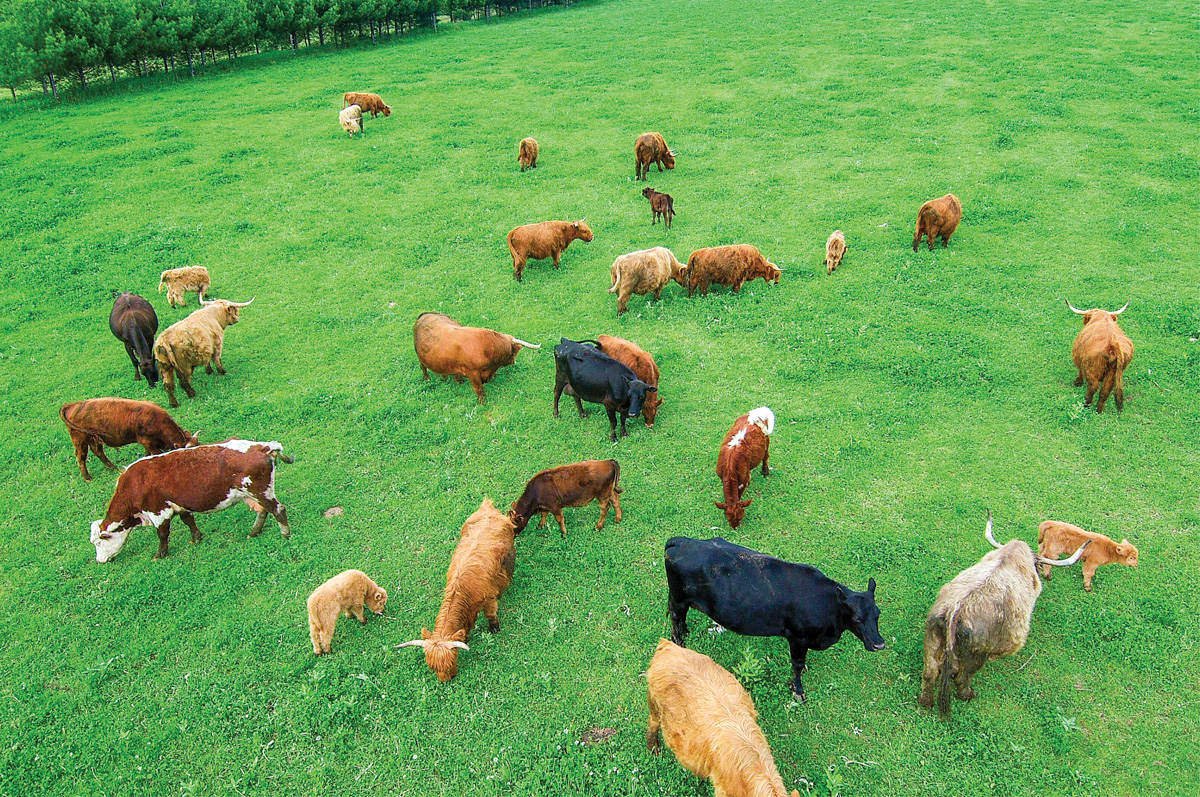
An imagery drone provides a closer look at beef cows and their calves at Pigeon River Farm. Robert Braun frequently monitors his herd to detect any calving issues. Image provided by Robert Braun.
Monitoring livestock
Livestock producers also can use drones to monitor calving in the pasture, ensure water tanks are filled and quickly spot gaps in fencing or punctures in plastic-covered hay bales, for example.
“That saves a lot of legwork,” says Houser.
Robert Braun uses imagery drones to monitor livestock at Pigeon River Farm near Clintonville, Wisconsin. He flies the drones year-round to monitor pastures, then records and saves on his computer the imagery and data he has captured.
“This helps me keep track of my pasture from season to season,” Braun says. “Pasture growth this year was one to two weeks behind what it was last year, for example.”
He evaluates data in the winter when making plans for the coming year.
Braun owns 40 acres of pasture and will soon expand to 45 acres. He leases an additional 15 acres. Currently, he is raising 15 head of Scottish Highland cattle and more than 40 goats. This summer, he is also custom grazing 50 head of sheep.
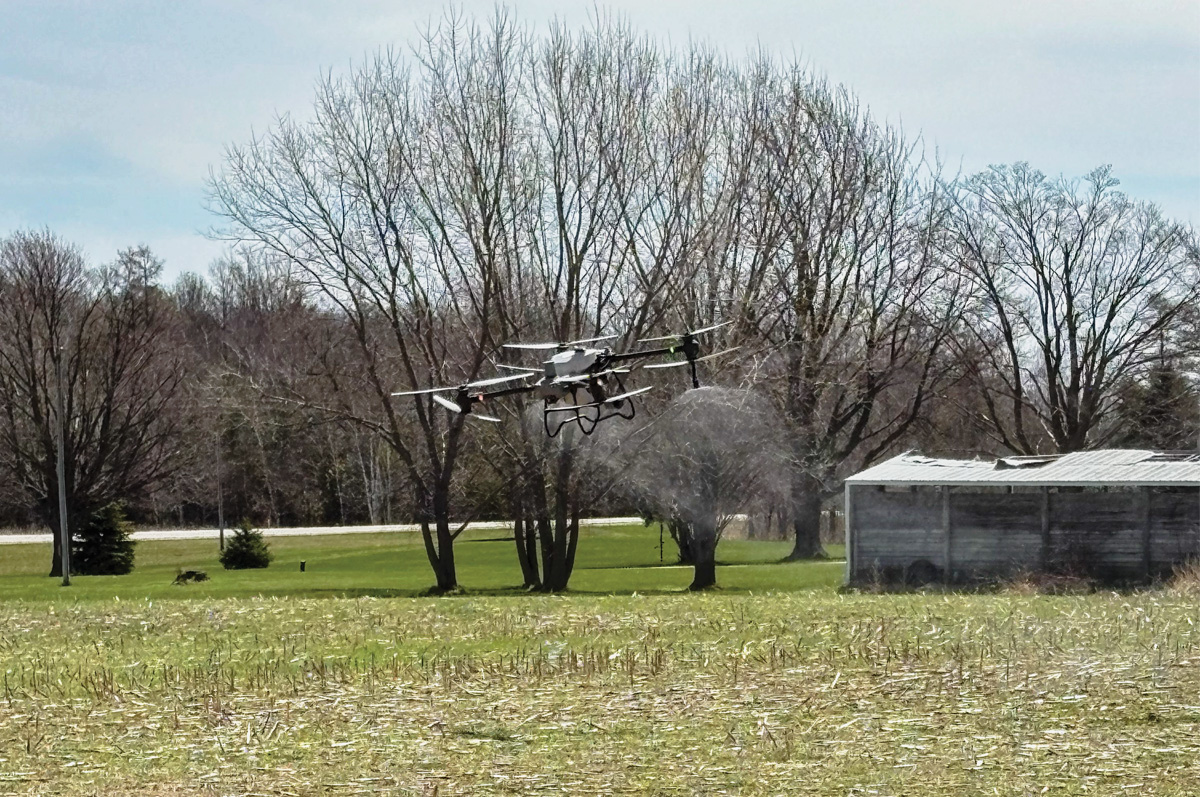
A drone at Heim’s Hillcrest Dairy near Algoma, Wisconsin, is used to spray off rye before planting corn the following week. Image provided by Ben Heim.
Spray drones
More forage producers also are using spray drones to apply fertilizer and crop protection products into standing forage.
Eric Ringer is the vice president of partnerships at Rantizo of Iowa City, Iowa. Rantizo connects demand and supply for agricultural spray drone services with a turnkey service platform. Ringer also is the president of the American Spray Drone Coalition.
“Spray drones are used on many different crops for applying crop protection products, cover crops and fertilizers,” he says. “For forage producers specifically, drones are often used for fungicide application, weed control and fly control at dairies.”
Heim’s Hillcrest Dairy near Algoma, Wisconsin, began using spray drones in June 2024. The Heim family and farm team currently manage a 1,600-head dairy herd. They milk 900 cows and expect to double the herd in the next couple of years. They farm 1,800 acres, 900 acres of which are devoted to corn silage, 650 acres to alfalfa and 250 acres to wheat.
They own three drones to apply fungicides, herbicides and insecticides on corn and wheat. Each drone has a payload of 11 gallons of liquid product and 125 pounds of dry fertilizer. Turbulence from the drone propellers pushes fungicides, for example, into the corn.
“That has been beneficial,” says Ben Heim, and he adds that they applied urea on corn, 50 pounds every week to 10 days, and this spoon-feeding fertilizer has really helped crop growth. Last year, they started applying urea when corn was 3 feet tall, and this year they plan on experimenting and applying it when corn is 1 foot tall.
Last fall, the Heims also experimented with seeding 200 acres to cover crops. Due to dry conditions, the experiment didn’t work so well.
“We had better luck harrowing about 60 of those acres, using the drone to seed and then roguing in the seed,” says Heim. “We’re going to try cover-crop seeding again this fall.”
The plan is to seed the corn and wheat ground with cereal rye and a four-way mix of forage radish, turnips, wheat and rye. Also, they plan to plant triticale this year as a double crop.
“We need to produce more forage as our herd increases,” Heim says. “We may also be able to use a thermal drone to identify heat within forage piles. We’ve only been using drones since last June, so there’s still a lot of learning involved.”
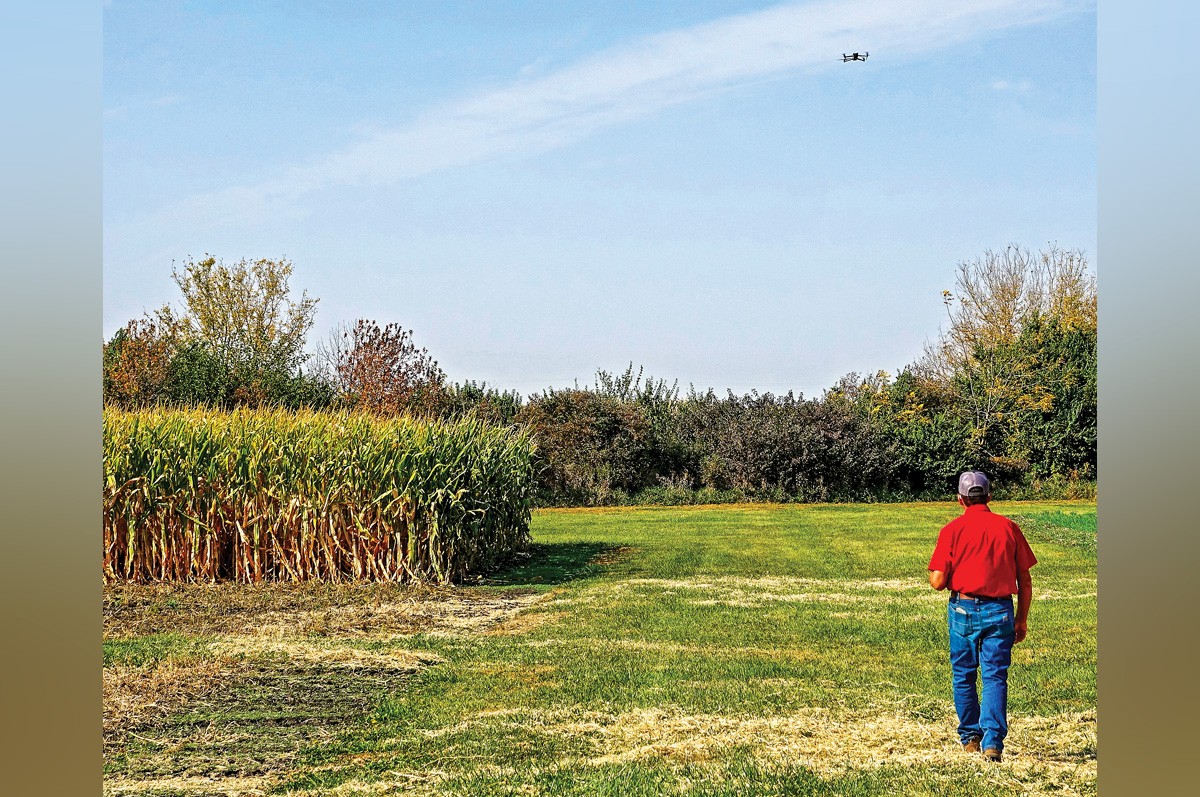
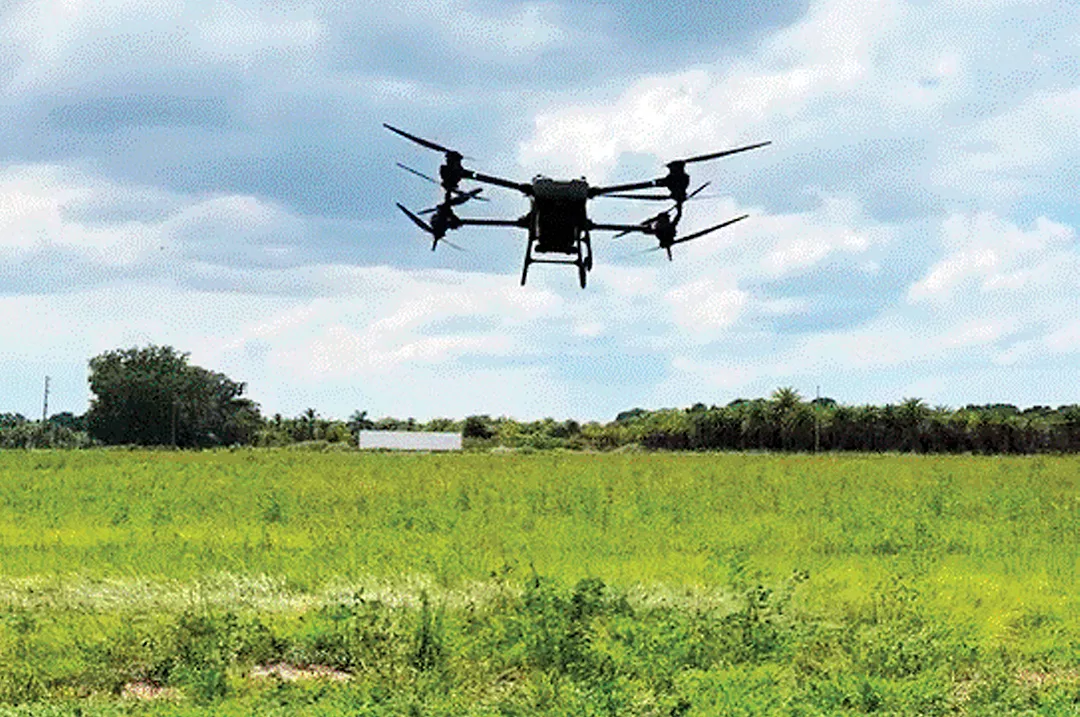
A spray drone is used for maintaining a forage field. Image provided by Douglas Houser.
Drone pros and cons
Producers considering the use of drones are advised to weigh the pros and cons.
One of the benefits of owning a drone is the convenience of being able to use it any time. Iowa State’s Houser likens it to having a tool handy in one’s shed. A drawback of using a drone service is getting on an applicator’s schedule, which can be very tight during busy seasons.
But the time and cost involved in earning a remote pilot certificate from the Federal Aviation Administration (FAA Part 107) is an obstacle to using one’s own drone. It’s required if a producer uses it as a business management tool, even if flying over one’s own land. The certification costs $175. One must also recertify every two years, but there is no cost for recertification.
Ringer adds that FAA Part 137 certification is required to apply pesticides by drone and may take three to six months to acquire.
Braun adds that he spent at least 15 hours studying for the test. Houser recommends taking training classes. Some universities, such as Iowa State, offer in-person or online training.
“Owning a drone requires more upfront investment in time and money than hiring a spray service since the licensing process can be quite lengthy,” says Ringer. He adds that in addition to needing FAA certification, a farmer planning to spray pesticides will need a state pesticide applicator’s license.
Using a licensed and insured spraying service, on the other hand, allows producers to become familiar with spray drone application and decide if they would want to purchase a drone in the future.
“Hiring a spraying service allows producers to leverage the expertise of the service provider and the latest technology,” says Ringer. “Because the service provider uses their drones throughout the season, they have expertise in applying pesticides, especially in tricky situations with trees, power lines or sensitive crops.”
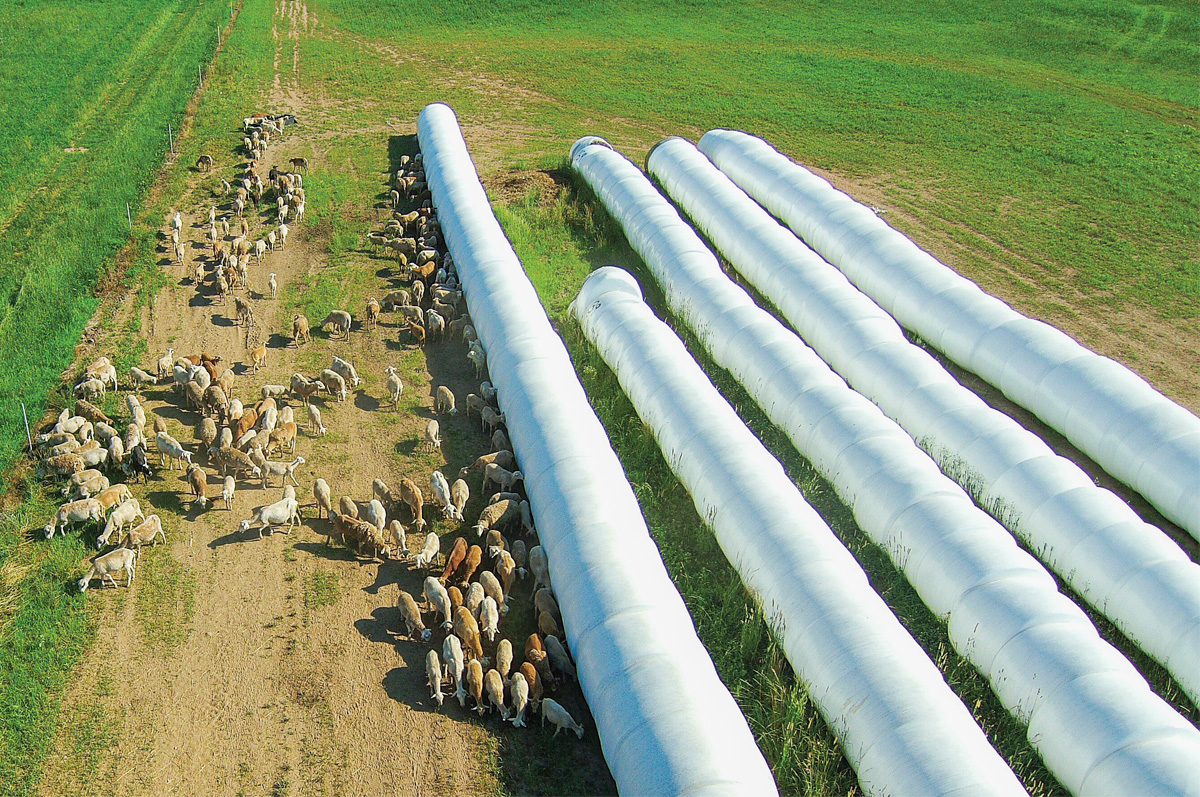
An imagery drone is used to monitor a flock of sheep at Robert Braun’s Pigeon River Farm near Clintonville, Wisconsin. He also uses a drone to spot any punctures in plastic-covered hay bales. Image provided by Robert Braun.
Investment considerations
Drone costs vary significantly depending on what the producer wants to do. A drone with basic red-green-blue (RGB) imagery capability, for example, would cost in the range of $800 to $1,000. More advanced systems with multispectral imaging capability and stitching software could run from $2,000 to $4,000, Houser says.
Spray drones can range in cost, again depending on payload capabilities. Braun has seen prices range from $10,000 and more.
Houser adds that small spray drones cost about $15,000. Mid-level drones average $25,000, and the most expensive ones can cost $75,000.
“Remember that an operator probably will also want to have additional battery capacity, chargers and so on,” says Houser.
In addition to the cost of a drone, a producer would need to buy batteries. Braun pays about $300 per year for lithium batteries, but he flies a drone almost every day of the year. He averages 25 minutes of flight time before the battery dies. He generally flies a drone at 8 to10 mph for inspecting pasture, he says.
For more information on drones, certification requirements, testing and more, visit these websites:
- Unmanned Aircraft Systems (UAS) – Federal Aviation Administration
- Part 107 Practice Exam – Drone Pilot Ground School
- FAA – Dispensing Chemicals and Agricultural Products (Part 137) with UAS
- FAA Test Centers – FAA Drone Registration Support Site
- ISU – Getting Started with Drone Technology on Your Farm
- AcreConnect – Find a Service Provider