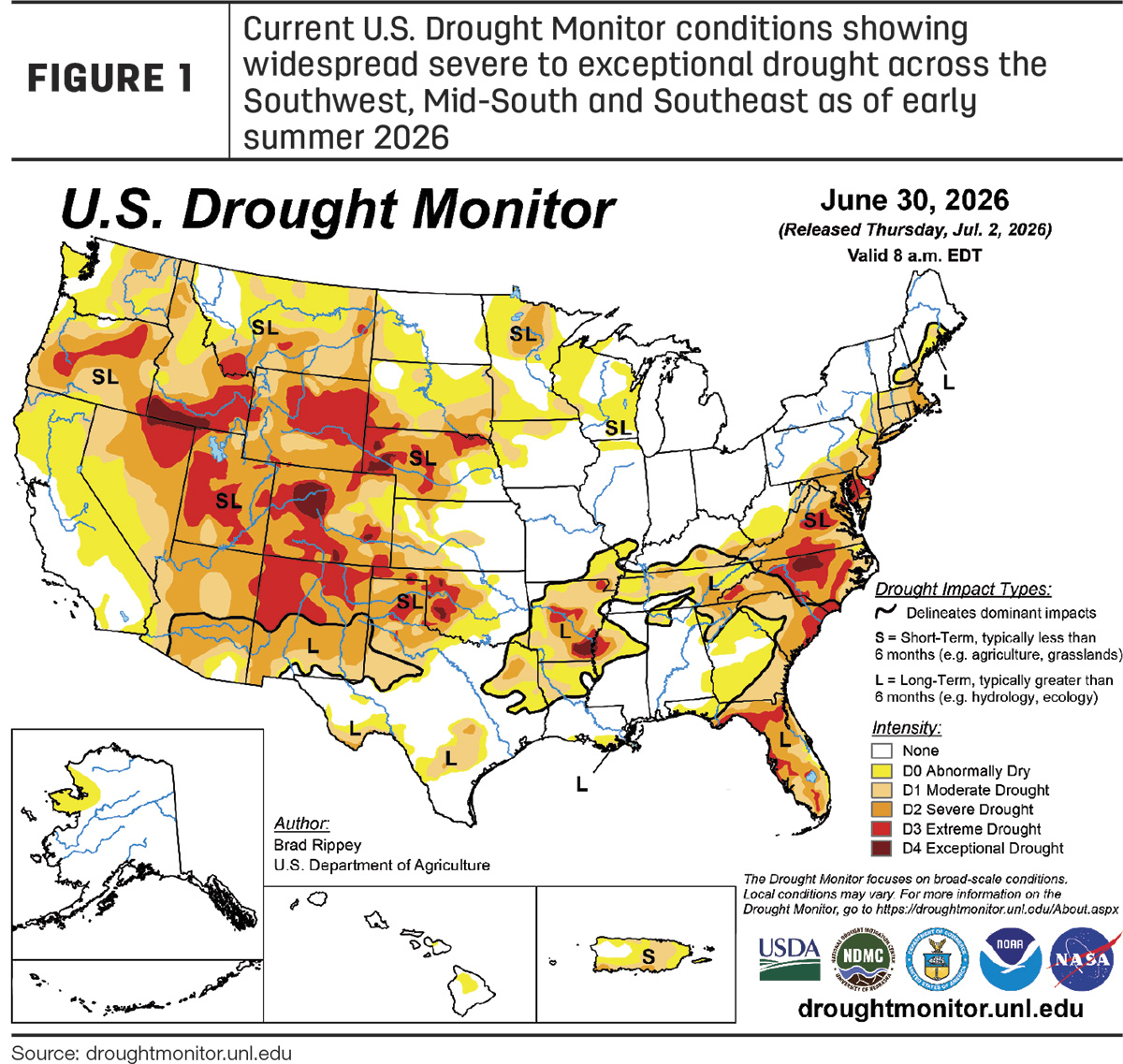
Summer’s arrival is marked by continued drought across much of the U.S., along with forecasts of an El Nino event that could worsen conditions. Most of the Southwest, Mid-South and Southeast are suffering from severe or extreme drought, with pockets labeled exceptional.

Meteorologists vary in their forecasts, with some calling for a super El Nino while others are less dire in their predictions (Figure 1).
Definitions are important
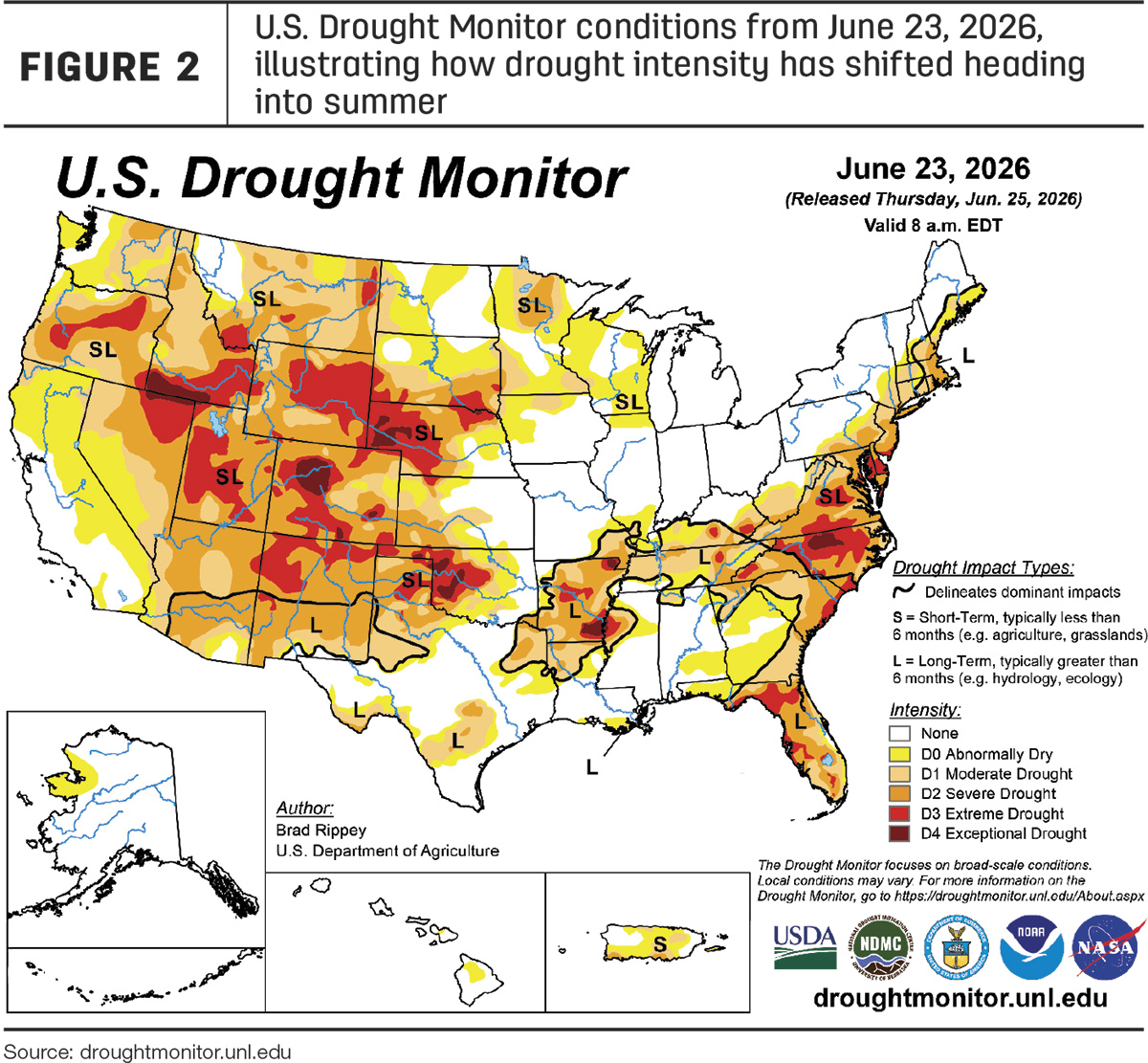
For forage producers, long-term drought has led to more research, development and awareness surrounding tolerant species such as sorghum-sudangrass and teff. But there are specific terms and uses to keep in mind (Figure 2).
- Grain sorghum – or milo, as it’s known to some – yields grain.
- When growing and using sorghum as forage, it’s forage sorghum – often a tall grain plant that produces a high stover-grain ratio. These varieties may or may not produce a lot of grain and are used primarily for silage production.
- Sudangrass is much leafier, narrower-leafed and has a smaller stalk diameter. It produces much less grain but more tillers than forage sorghum. It also regrows faster than forage sorghum when grazed or hayed.
“Sorghum-sudangrass is a cross between sorghum and sudangrass, and has traits that are intermediate between the two,” says Brent Bean, director of agronomy for the Sorghum Checkoff Program based in Lubbock, Texas. “It tends to produce a higher yield than sudangrass, especially in a one-cut hay systems. Used primarily for hay and grazing, there are a few varieties that make good silage.”
When comparing corn for silage to forage sorghum, Bean notes the cost per acre for corn, even with limited seeding rates, can range between $80 to $100. That compares to roughly $15 per acre for seed for forage sorghum, and fertility rates are considerably less compared to corn for silage.
When available moisture is factored in, the sorghum, sorghum-sudangrass and teff options are preferred at levels of less than 10 to 15 inches. Water-use efficiency is also higher, thanks in part to better root systems and stomatal closure, which are better than in corn.
For silage
When planting specifically for silage, forage sorghum produces a grain head similar to grain sorghum, adding valuable tonnage and starch. In arid regions, the forage should be harvested at the soft-dough stage – around 65% to 75% moisture – which is ideal for direct cutting. In more humid environments, harvest is a two-step process because the crop dries down more slowly. Windrowing will allow drydown below 75%, which is too high for ensiling.
Water availability is driving more growers to change their forage production habits. In regions where sorghum species were used strictly as a cover crop, producers are now terminating them with livestock, allowing them to capture higher-value feed and accelerate nutrient cycling.
“Water security is the largest driver behind the growth of forage sorghum acres,” says Jourdan Bell, associate professor and extension agronomist at Texas A&M University. “Producers are realizing that incorporating sorghum into their rotations provides a safety net against cyclical, late-summer droughts that can decimate cool-season forages.”
Bell notes that grazing forage sorghum can also add a direct economic return to regenerative practices, which is especially lucrative to today’s cattle market.
Lack of familiarity
Learning how to maximize sorghum or sorghum‑sudangrass carries several learning curves, depending on their usage. Cattle rations are one facet, but as Jackie Atim, assistant professor and cooperative extension specialist of abiotic stress at the University of California, notes, dairy producers – especially in areas challenged by precipitation – are cutting back on corn, either substituting these grasses or supplementing them with reduced amounts of corn or barley. Sorghum hybrids have improved digestibility, which allow producers to more efficiently utilize the energy and protein, but to do so, it’s important to match the hybrid traits with harvest timing and livestock class.
Given the long-standing reliance on corn in either cattle or dairy operations, it’s understandable, adds Atim, that there’s another learning curve beyond the farm. Despite saving on costs such as water, nitrogen and other sustainability benefits, nutritionists may not be convinced that sorghum or sorghum-sudangrass is a partial or wholesale manageable change.
“It would be good for dairy nutritionists to gain more experience and identify whether they see both value and good forage quality characteristics in the best sorghum on the market,” says Atim. “There have been a lot of improvements in nutrition and yield of forage sorghum. But the question and the gap remain with nutritionists to decide whether the diversity of improvements is good and focus on the best-yielding varieties that meet the desired quality parameters.”
She believes more work needs to be done to identify specific traits that dairy nutritionists are aiming for and coordinate those with researchers and breeders.
Something old, something new
Teff is a curious blend of an ancient grain that’s slowly gaining adoption among producers. Originally from East Africa, it’s mentioned in research papers and articles dating back 20 to 25 years, first as a forage crop. Oli Bachie is very familiar with teff: Born in Ethiopia, he grew up in a teff-farming family and grew it as a staple food for human consumption. When he moved to the U.S. and began work as a University of California Cooperative Extension agronomy and weed management adviser, he started work with this alternative crop.
“Some producers have used it for years, others are having difficulty for the first time,” says Bachie, who’s currently comparing six types of teff as forage for livestock and seed production and for human consumption. “It is agronomically new, not biologically new, as a forage crop. In Nevada, Idaho and California, there is the strongest adoption where water is limited and where alfalfa is sensitive and [a] huge consumer of irrigation water.”
Teff’s palatability is a key advantage, as well. It feathers, with soft leaves, and has good protein and digestibility.
Bachie adds that teff is built more for quality than sudangrass: Teff’s biomass per drop of water is more tonnage than sorghum or sudangrass, meaning teff’s water-use efficiency is lower.