There is no doubt that the use of routine cultures for mastitis pathogens, both contagious and environmental, is a powerful management tool for maintaining good udder health and milk quality in progressive dairy herds. As such, it remains a very powerful tool in achieving excellent udder health.

There has been little change to the fundamental reasons for using a milk quality laboratory service: Knowledge of causative organisms allows data-driven management decisions for troubleshooting high counts, provides awareness and monitoring of udder health, and assists with mastitis treatment, control and prevention of contagious outbreaks. This results in improved milk quality and animal health with lower bacteria and somatic cell counts (SCC).
Traditionally, mastitis cultures were done almost exclusively by veterinarians at an offsite lab or clinic. However, the landscape has changed in the last 50 years, and what was once conducted solely by veterinary practitioners is now being done with on-farm cultures or by professional milk quality labs (private or university), or some combination of the above.
Because many options now exist, the appropriate task is to determine what the goals of the dairy are and if the management team is committed to achieving them. Is the focus on firefighting, or are they looking for long-term solutions? The answers will help determine what level of diagnostic scope is needed and consequently, if on-farm culture, a professional milk quality lab or a combination is going to set them up for success.
However, we must begin at step one. Collecting samples can be a lot of work, and it’s important that it be done correctly, regardless of what type of lab will be doing the culture work. Sample quality is extremely important for producing useful results; the adage “garbage in, garbage out” is a good rule of thumb to keep in mind.
I believe an important step in appreciating the sample collection process is to understand the difference between quantitative and qualitative testing.
- Quantitative milk testing: Accurate, quantitative counts of bacteria or somatic cells per milliliter of milk. Includes processor quality testing for payment on bulk tank milk, official state samples to verify meeting Grade A milk requirements, and individual cow testing for milk weights, components and SCC. These types of samples do not involve pathogens or any bacterial identification, only counts. Individual cow samples are typically collected through meters and are not suitable for culture.
- Qualitative milk testing: Focused almost exclusively on detection of mastitis pathogens and typically semi-quantitative. Cow cultures may be reported as an approximate number of colony forming units (CFU) or as part of a “low, moderate, high” categorical system, often using a “+” symbol. Qualitative testing includes bulk tank cultures, individual cow cultures and environmental samples (water, bedding, towels), all focused on pathogen detection. Samples must be collected aseptically directly from the cow or bulk tank into sterile sample containers.
Of all the samples, collecting individual cow samples for qualitative culture is by far the most challenging and laborious. I am frequently asked if individual cow samples collected through meters on weigh day can be used for culture, and unfortunately, the answer is no. Although it is far easier to collect samples in this way, meters are not sterile, and the amount of milk residue between animals would produce highly contaminated results. Use of preservative pills, which is common with dairy herd information samples, is also not compatible with cultures because it is inhibitory to bacterial growth.
In a disease outbreak situation, it may be necessary to sample an entire pen of cows or even the whole herd, potentially thousands of animals in a single day. These mass sampling events run the risk of being rushed and chaotic if not done following a system and strict sampling guidelines, as outlined in Figure 1.
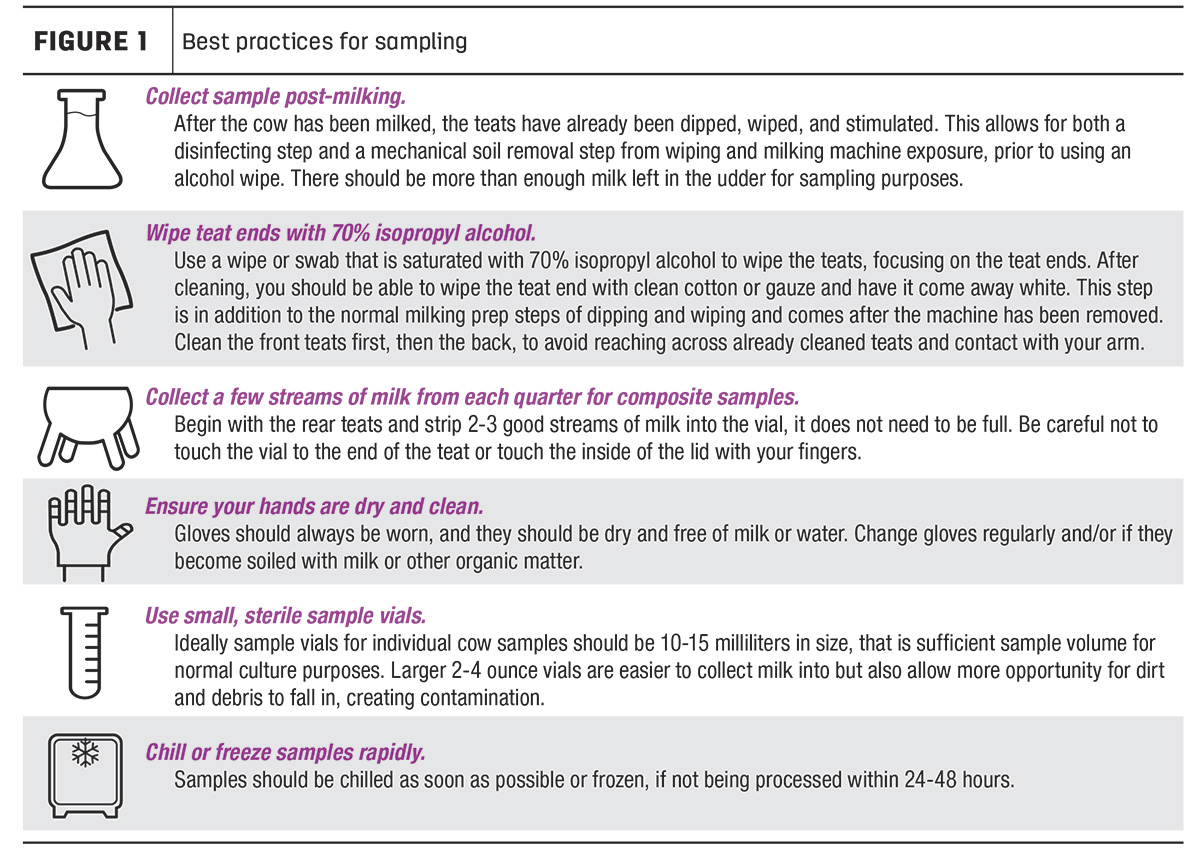
It is also critically important to ensure that individual cow IDs are aligned with each sample. At times this is the most difficult job, especially when working on a rotary parlor. Misalignment of just one cow ID can throw off hundreds of samples and render those results worthless or condemn the wrong animals.
Diagnostic tools are not universal; bulk tank samples, cow samples and environmental samples require different culture protocols, and the data will only be as good as the sample presented. The goal is to use the right tool and to ask the right question, at the right time, of an appropriate substrate.
For individual cow cultures, the focus should be on keeping contaminating environmental bacteria – which are readily available on both the cow and equipment surfaces – out of the sample. Delaying collection of samples to investigate or stop mastitis outbreaks can be very costly, but rushing the process can be equally costly, or even more so if it results in unusable data or an abundance of false positives from poor sample quality.
This applies to the collection of regular clinical and fresh cow samples as well, outside of an outbreak scenario. Data generated from routine monitoring of fresh and clinical animals are being used to make management decisions, such as antibiotic treatment or culling. Poor sample quality will result in increased and unnecessary use of antibiotics, but even more importantly, inadvertent culling of animals that are not truly infected.
It is important to work closely with a veterinarian and/or your milk quality lab to receive guidance and feedback on how the sample collection process is going.
On-farm culturing can be an excellent opportunity to test drive how the sample collection process is going, and it should begin with a simple “treat, no-treat” system, using a biplate or triplate. The foundation of a culture-guided treatment system is that a pure culture from a single clinical quarter will result in growth on only one side or section of the plate (or no growth at all). Growth on both sides of the plate is typically an indication of sample contamination, and efforts at collecting clean samples must be increased. On-farm culturing can be an excellent opportunity to empower herd managers, but also needs to be recognized as a dedicated project that must be administered carefully.
I like to compare the process to that of starting a new business, under the same roof, in terms of the attention it needs. Before jumping into purchasing equipment and beginning the process of an on-farm lab, owners and managers need to be asking themselves the question, “Is an on-farm lab right for my dairy?” The answer will depend on the bandwidth of the leadership team and the diagnostic scope. Some large dairies, with the space and resources necessary for a more advanced on-farm lab, may choose to invest in the equipment, dedicated personnel and advanced training required to be successful.
A logical next step for expansion of testing ability is to include the contagious mastitis pathogens Staphylococcus aureus and mycoplasma. This is a significant leap from a treatment-decision-only system, as the consequences of incorrect bacterial identification or sample contamination are now much higher, potentially resulting in culling healthy animals. Building a more advanced lab should be done working in close conjunction with a veterinarian or other milk quality professional experienced in mastitis diagnostics. This process should also have quality assurance steps built in – using an external professional lab for bulk tank samples and for confirming mycoplasma and S. aureus suspect samples is highly recommended.
Remember, the cost of a mastitis control program is more expensive than the cost of the disease itself if the program is successful. This presents a mental conundrum for many dairy operators, especially if the disease is currently not costing much. However, the cost of the disease will quickly outweigh the cost of prevention if certain pathogens go unchecked or undetected. This can be the true measure of success or failure in operating an on-farm lab. Increasing turnaround time on sample results and saving costs by bringing cultures in-house is negated if accuracy is lost.
Take-home points
- Sample collection and quality matter. Take the best quality samples to get the most usable results.
- Seek advice from a veterinarian or milk quality professional. Understand the different types of samples and how to best collect them, including what containers to use and collection practices to avoid.
- On-farm culture. Start simply and build from there. Ask the tough questions up front before investing in equipment. Work with a veterinarian or reputable milk quality diagnostic adviser.
- Quality control. Build in a system of checks and balances and a working relationship with a reputable external lab to check on-farm practices and results. On-farm lab failures are far more expensive than the quality control pieces.