The dairy cow is a wondrous thing – a living, breathing fermentation chamber fueled by forages and grains – that produces a wholesome, natural food that we enjoy in so many ways. At the center of it all is the rumen, where a dynamic interplay of microbial fermentation, enzymatic reactions and nutrient metabolism is hard at work. This intricate system converts forages and grains into energy and nutrients, supporting milk production and overall cow health. The most rewarding part of working alongside nutritionists is finding ways to understand, utilize and support this system.

What is the solution to advancing efficiency?
The drive for higher production and better efficiency continues to demand more nutritional precision to maximize herd production. To improve efficiency, start in the rumen first. When diets are formulated to enable the rumen to do its job better, dairy cows will be more efficient.
Innovative nutrients feed and support the activity of rumen microbes
One of those innovative ways is formulating with a new category of nutrients – such as branched-chain volatile fatty acids (BCVFAs, also known as isoacids). The industry has recognized the power of formulating with isoacids, and the ability to do so is now widely accessible to all nutritionists through the Cornell Net Carbohydrate and Protein System (CNCPS). Research has shown that isoacids are essential for the growth and activity of fiber-digesting microbes in the rumen. They are the fuel for fiber-digesting bacteria and are naturally produced in the rumen.
If the ration is deficient in BCVFAs, cows will be less efficient. The opportunity to fill this nutrient gap and provide the rumen with the right fuel can help dairies make the most of forage inputs and improve performance.
These BCVFAs act as carbon sources used in combination with highly digestible protein to produce much-needed microbial protein and energy. This microbial protein synthesis results in the key amino acids needed for the production of milk by the mammary gland, while the energy from fermentation supports overall rumen function and milk production.
When we directly feed the rumen bacteria, microbial efficiency improves. This, in turn, improves the overall efficiency of the cow, reduces the need for greater dry matter intake (DMI) and helps cows increase performance with fewer inputs.
Research and field experience indicate dairy cows fed isoacids are more energy-efficient. This means a cow can meet her energy needs faster and requires less feed for the same amount of production – improving feed efficiency (FE), a key metric for profitability. Fresh cows are also more energy-efficient and tend to maintain better body condition and achieve higher peak milk. Overall, on a herdwide basis, when isoacids are fed starting in the pre-fresh diet, we observe more energy-corrected milk (ECM) and better FE.
Herd experiences the benefits of isoacid supplementation
Improvement is exactly what we observed while working with the nutritionist on a 1,200-head herd. Curious to see the impact, the dairy incorporated isoacids into the ration in late 2022 (Figure 1). At that point, the herd ECM was 109.1 pounds. After just four months of incorporating isoacids into the TMR for the milking herd, the ECM had increased to 112.3 pounds, or nearly 2.24 pounds more milk.
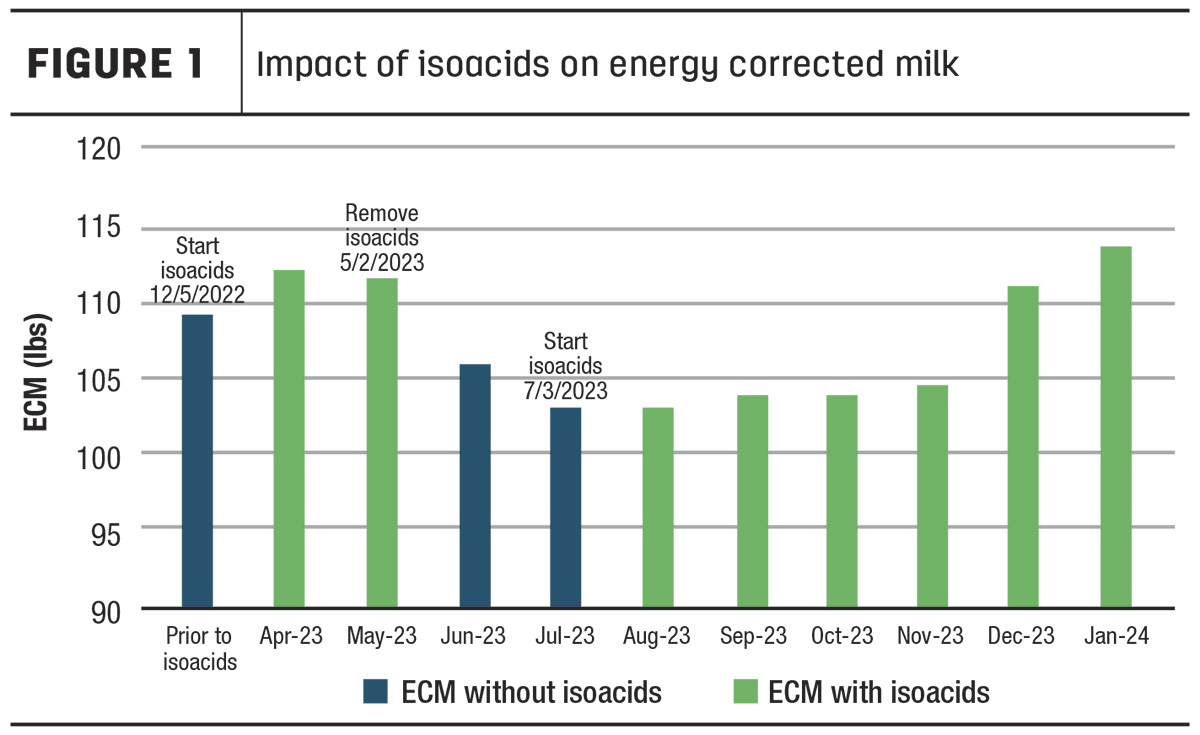
The benefits of investing in supplemental isoacids in the ration became evident when they were omitted from the ration in May 2023. By early June, just 60 days later, the ECM had dropped to 105.9 pounds, a decrease of more than 6 pounds. It didn’t take long to recognize the benefits of feeding isoacids, so in early July, the isoacids returned to the ration. While it took time for performance to recover, by December, the ECM rose to 111.3 pounds. The improvement in performance continued, with ECM reaching 118.1 pounds in April 2025. In summary, this is an 8.3% improvement in ECM production, with an over 11% improvement in pounds of milk components. The cattle remained extremely efficient at converting feed to milk, averaging a feed efficiency of 1.9 for most of the isoacid feeding period, without sacrificing body condition.
Keeping the herd’s milk protein at an acceptable level also had been a challenge before adding isoacids to the ration. In December 2024, the herd was 0.3% higher in milk protein than when starting isoacid supplementation.
Performance improvements without costs to the cows
Increased productivity sometimes comes with decreases in other areas, such as body condition score and timely breedback. Neither was the case for this dairy. This high level of milk production was reached without sacrificing body condition, and reproduction has remained strong. Fresh cow metabolic disease levels, which have always been below industry averages, remained unchanged and first-service conception rates also remained steady.
These results are not an isolated example. The ability to factor isoacid requirements into ration formulation has allowed numerous dairies across the country to improve herd performance. If you’re looking for ways to make the most of available forages and improve herd productivity, be sure to ask your nutritionist about including isoacids in your herd’s ration.