The 2025 Alltech Agri-Food Outlook report shows that global feed production rebounded in 2024 after a stagnant 2023, increasing from 1.38 billion metric tons (MT) (+1.2%) to 1.396 billion MT. This growth – which was achieved despite challenges that included highly pathogenic avian influenza (HPAI), climate fluctuations and economic uncertainty – underscores the resilience and adaptability of the international agriculture industry.

The report includes the results of the company’s 14th annual global feed production survey. The annual survey that serves as the foundation of the Agri-Food Outlook collected data from 142 countries and 28,235 feed mills in 2024. By analyzing compound feed production and prices – collected by our global sales team and in partnership with feed associations and official data-collecting organizations – the survey provides a comprehensive snapshot of global feed production. These insights serve as a barometer for the overall livestock industry, highlighting key trends across species, regional challenges and opportunities for growth.
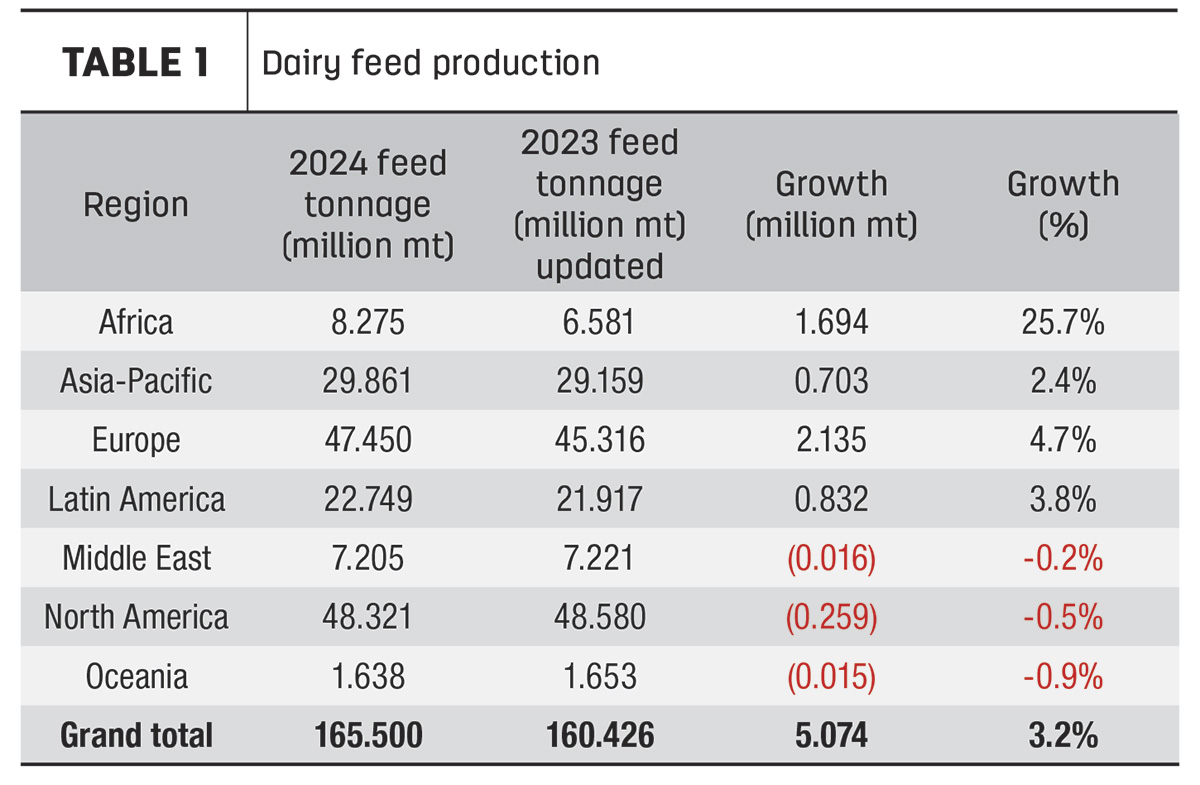
The global dairy sector made unexpectedly strong gains, growing by 3.2% (or 5.1 million MT; Table 1). Robust consumer demand, favorable milk prices and a shift toward more intensive farming practices largely fueled this expansion, with Asia-Pacific, Europe, Africa and Latin America all displaying growth. While dairy feed production remained stable in North America, Oceania’s reliance on abundant pasture led to a slight dip in its feed tonnage. Despite challenges ranging from disease pressures to volatile weather conditions, the global dairy sector continues to exhibit strong resilience and growth potential. The modernization and intensification of production and higher milk yields are expected to foster further increases – but low farmgate prices in China could limit gains.
A closer look at the numbers by region
North America: North American dairy feed tonnage stayed relatively flat, with a small decline of 0.5%. This can be attributed to regional variabilities, health challenges and economic conditions. Despite higher milk prices serving as an incentive to boost production, the potential economic benefits were outweighed by high costs for replacement cows and the ongoing impact of HPAI. Additionally, improved feed efficiency technologies and practices have allowed farmers to maintain or increase milk output without proportionally increasing feed input, contributing to stable feed tonnage. While the number of dairy feed mills in the U.S. is expected to decline as the result of improved efficiencies, the market is expected to do well due to higher milk prices, lower feed costs and increases in dairy consumption. The continued demand for dairy beef calves has also put pressure on the limited heifer replacements, which has impacted dairy expansion and milk production in the U.S. and has helped to keep surplus in check.
Latin America: Dairy feed production rose by 3.8% in Latin America thanks to improved milk prices and an increased reliance on supplemental feeds after droughts. Larger dairies in Brazil, Argentina and Mexico are making structural changes, with a focus on modernization and investing in concentrated rations for a higher milk output. There has also been a decrease in the number of smaller producers, leading to a shift toward more efficient farms using concentrated feed. The outlook for dairy feed production in Latin America remains positive for 2025.
Europe: Dairy feed production rebounded in Europe, rising by 4.7% after four years of decline. This recovery was driven by market incentives and strategic investments, which outweighed challenges like disease outbreaks and climate pressures. Milk production expanded in Eastern European countries, including Poland and Hungary, thanks to more efficient, larger-scale farms, offsetting declines in Western Europe. Rising milk prices have improved margins for farmers, and government subsidies for implementing sustainable practices help incentivize feed usage. The outlook for dairy feed production in Europe is cautiously optimistic, with farmers expected to prioritize feed quality as a way to continue maximizing yields with smaller herds.
Asia-Pacific: Dairy feed emerged as a resilient growth driver for all agri-food production in Asia-Pacific, with an increase of 2.4%. The region’s dairy sector has been experiencing structural changes, with growing domestic consumption and an increase in export potential driving demand. The intensification of the industry has led to a notable shift from smallholder, subsistence dairy farming to larger commercial operations. Countries across the region are increasing production to meet both domestic and export demands. The future is especially bright for dairy feed production in India, the largest dairy producer in the region, as the country’s domestic demand remains strong thanks to continued population growth, while exports are also on the rise.
Africa and the Middle East: While dairy feed was mostly static in the Middle East, the sector leapt up by 25.7% in Africa thanks to growing urban populations and improving cold-chain logistics. More smallholder dairy farms in the region are shifting from purely pasture-based systems toward commercial operations, which increases their reliance on formulated dairy rations and drives up feed tonnage. The African dairy sector has the potential to expand even further by boosting local production to reduce the region’s dependence on imports while still meeting domestic demand.
Oceania: While Oceania experienced one of its biggest milk production seasons in many years, the dairy sector still displayed a decrease of 0.9% – in light of strong grass growth and pasture management in New Zealand. When grazing is plentiful, farmers rely less on commercial dairy feeds, leading to decreases in commercial feed tonnage. Despite this downturn, Oceania’s dairy sector is expected to recover well due to growing demand from China and Southeast Asia.
What to expect in 2025
In addition to the quantitative feed survey data, a qualitative survey drew insights from 82 countries on themes such as optimism for the future, anticipated challenges and the factors expected to have the greatest impact in 2025. Based on these insights and other forecasts, the global agri-food sector is expected to maintain modest growth in 2025, with the pace and distribution of that growth varying by region and species.
Forecasts are cautiously optimistic for the dairy industry, which continues to exhibit its resilience and growth potential. Demand is expected to remain stable in Europe and to increase across Asia-Pacific, where rising incomes and urbanization in India and Southeast Asia are leading to rising levels of dairy consumption.