Back in January, Dairy Farmers of Canada (DFC) and the provinces coordinated on a pilot project testing a greenhouse gas (GHG) calculator called the Cool Farm Tool. This innovative tool was tested on more than 40 dairy farms across Canada, providing participating farmers with custom insights on how their farm can be more efficient – and how they stack up compared to their peers.
With the help of on-farm advisers, participants put the Cool Farm Tool – an internationally recognized GHG calculator developed in Europe – into action to understand how effectively it worked in the Canadian context.
“We wanted to compare the results from the Cool Farm Tool assessments to our 2021 lifecycle assessment [LCA],” said DFC Sustainability Advisor Connie McLellan. “We also wanted to determine the accuracy in Canada, when we're looking at soil types, climate and our cropping systems.”
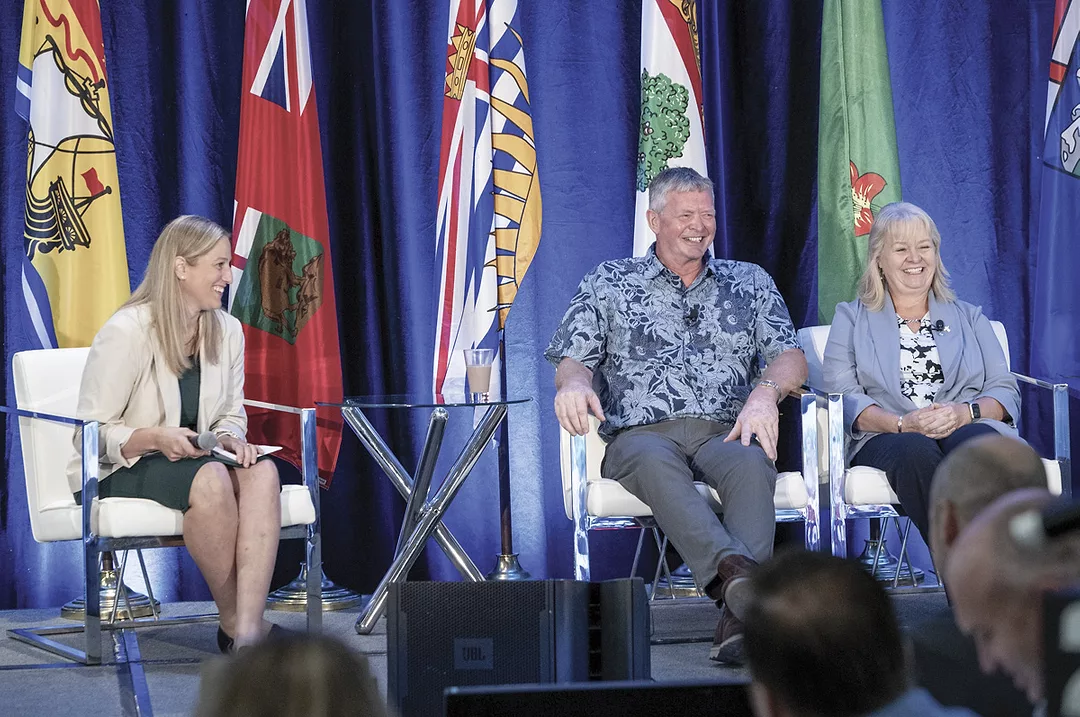
McLellan, who was joined by a participating farmer and farm adviser, presented the initial results at the 2025 DFC annual general meeting (AGM) in July.
On-farm advisers helped participants collect data on factors like herd size, breed, feed ratio, manure management, crops, fuel use, transportation and soil type. When the numbers were crunched, the national and regional results were very close to the LCA in terms of emission levels and their top sources – livestock management (the digestive process that naturally releases methane), feed production and manure management.
Unique to this project, however, was the farm-level results participants received. “This gives you an individual number for your specific farm with your specific practices that you implement each day,” said McLellan, adding that a GHG calculator can give farmers a benchmark and help identify opportunities to lower emissions.
For participant Wietze Dykstra, chair of Dairy Farmers of New Brunswick, the pilot was educational and simple. “It's been an educational process, and overall, for me, it was not that painful at all.”
Dykstra’s results showed his carbon footprint per litre of milk was similar to the Canadian average. “I'm average, you know, that's okay, but I'd like to be a little better than average,” he said.
And the Cool Farm Tool showed him ways to achieve that, such as improvement in manure management. “If I can lower my fertilizer bill by better manure management, that's good for everybody, right?” he said.
Janet Harrop of Ontario was one of the project’s on-farm advisers. She helped farms collect data, some of which came from existing sources like milk testing, automated milking systems, dairy nutritionists and the John Deere field management program.
Harrop said the tool provided insight into best management practices that could improve numbers, such as genomics and cover crops. “It's just another tool that we have to help us make decisions,” Harrop said. “It provides us, the producers, with tools to be able to have a bigger, different lens of the farm.”
What’s next for the Cool Farm Tool? DFC staff will work with the sustainability committee to make recommendations about whether to run the pilot again. But before that, McLellan will calculate the final stats – info farmers are excited to see.
“As farmers, we’re all competitive,” McLellan said. “Every farmer, almost, that participated asked me, ‘Where do I rank in my province? Where do I rank in Canada?’”
Dairy Farmers of Canada (DFC) is the national policy, lobbying and promotional organization representing Canadian dairy producers. DFC strives to create stable conditions for the dairy sector in our country. It also seeks to maintain policies that promote the sustainability of Canadian dairy production and promote dairy products and their health benefits. Visit DFC’s website for more information.