The markets for feeder and finishing cattle have recently reached record highs, but volatility in the market leaves some uncertainty about what the future may bring. No one can predict what the market will do, so it is important for cattle raisers to focus on factors that can be controlled.

Understanding the major factors influencing the profitability of a steer-raising operation is key to making good decisions that help increase the potential for greater profits. Let’s explore the top factors that impact profitability when raising dairy steers.
Like it or not, the selling price is one of the greatest factors impacting how much money will be made on a steer. Although markets fluctuate over time and can’t be controlled, how steers are marketed, whether or not they are contracted with prices being locked in and the quality of the steers sold all have major impacts on the price received for an animal.
The purchase cost of an animal also directly impacts potential profits. Understanding the costs of gain for a specific farm is necessary to determine how much can be paid to purchase an animal and whether there will be any profit potential. Just because someone is asking that price doesn’t mean it is a wise financial decision to purchase a feeder at that price.
The profitability of raising steers is determined by the difference between the selling and purchase price, minus the costs of raising the steer until it is sold. The costs associated with raising feeder or finishing cattle are often discussed using the term cost of gain (COG), where the costs to raise the animal are added together and divided by the weight the animal gained between purchase and sale (Figure 1).
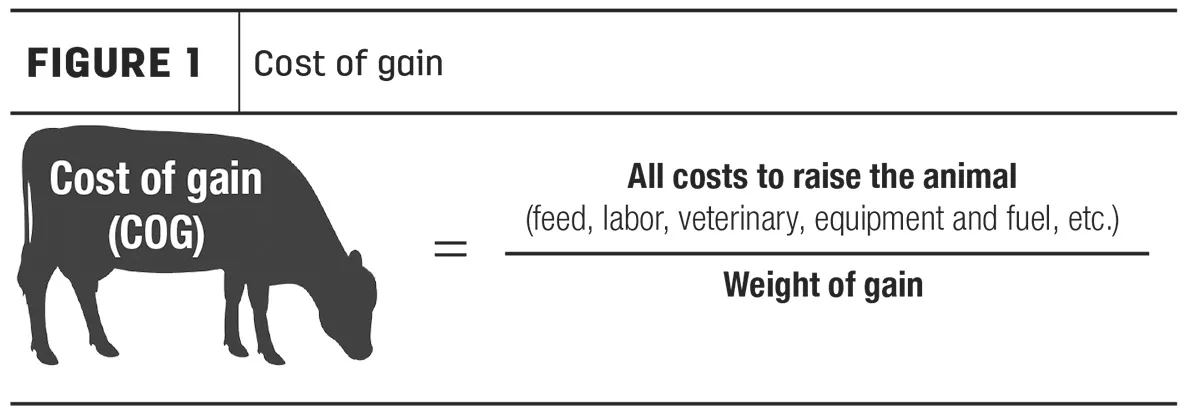
For example, if the total costs to raise a steer are $600 to put on 500 pounds of gain, the COG would be $1.20 per pound. The COG is an important factor to consider, as a lower COG increases the potential for profit. Also, knowing the COG is essential when deciding how much to purchase cattle for and when developing a marketing plan for selling them.
Determining what the breakeven COG needs to be for cattle can be quickly calculated using the equation for the value of gain (VOG) (Figure 2).
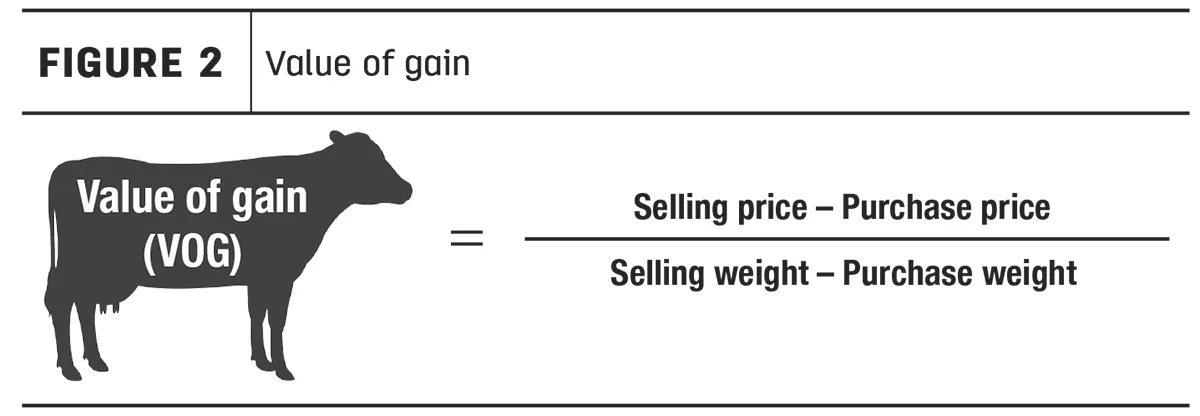
The VOG provides a target for the breakeven COG. If an animal is sold when it weighs 1,400 pounds for $2,800 and was purchased at 400 pounds for $1,600, the VOG would be 1.2, meaning the COG needs to be less than $1.20 per pound for that animal to be profitable.
Understanding the factors contributing to the COG and which have the largest impact on profitability is valuable in making better management and feeding decisions. For instance, some of the largest contributors to the COG when raising dairy beef cattle include (These calculations are based on a 400-pound feeder to 1,450-pound finished steer):
- Feed efficiency – A measure of how well an animal converts its feed into gain. Feed efficiency = feed consumed (on a dry matter basis) per pound of gain. Strategies improving feed efficiency will reduce COG and increase profitability. The use of implants, which increase feed efficiency, is one of the best ways to reduce the costs of raising a steer to market. They are a good management tool and have an excellent return on investment (ROI). Nutritional strategies have a large impact on feed efficiency, and having a well-balanced ration is essential to maximizing feed efficiency. There are also a variety of nutritional technologies, including ionophores and botanical extracts, that improve feed efficiency and offer a good ROI.
- Average daily gain (ADG) – How fast cattle gain has a large influence on the overall profitability. Even an increase of only 0.1 pound per day will increase the profit per head by $30 to $50. Evaluating management and feeding practices to ensure that ADG is being maximized will quickly pay dividends.
- Corn and feed price – Interestingly, feed prices are not at the top of the list when determining factors that can be adjusted to impact the COG, even though it is often the main focus when talking about raising cattle. The number one expense in raising cattle is feed, but it is an inevitable expense. The reality is that the animals must be fed a certain amount of feed each day to survive and grow, so it takes fairly substantial changes in feed prices to have a large impact on profitability per head. The price of corn (or other grains) is the greatest feed expense when finishing steers (on typical high-grain programs). An increase in the corn price of 50 cents per bushel will reduce profitability of a steer by over $50. The price of protein and mineral supplements have a lesser impact due to the lower feeding rates, and some fairly large changes in prices are needed to make a substantial change in profitability. For example, decreasing the price of a protein pellet by $50 per ton will only increase profitability by about $20 per steer, and decreasing the price of a mineral (fed at 0.5 pound per head per day) by $200 per ton would still only increase profits by $20 per steer.
- Interest – Although interest rates are hard to control, understanding the impact of higher interest rates is important. With current interest rates and the price of cattle, $100 per animal or more may be paid in interest on a loan taken for a feeder steer that will be fed for a year. If interest is also paid on the feed, this could add more than an additional $50 per head over the year. Determine if there is a way to reduce the amount of interest being paid. For example, utilizing feeder financing for feed supplements offered by some feed companies may be a way to reduce the amount of interest being paid. Also, check with various lenders to determine if there is an option to obtain lower financing rates.
- Death loss, trucking, veterinary expenses, facilities and yardage (including labor, equipment, fuel, etc.) – These additional factors may also contribute to the cost of gain or are other expenses that need to be considered. However, many of these costs, apart from major changes in the facilities or equipment purchases, are often less variable than the other expenses discussed previously. One cost becoming even more important to consider is death loss. The financial impact of death loss is greater as the value of cattle increase, and keeping animals healthy and alive is more of a financial incentive than ever before.
Maximizing profits when raising dairy steers comes down to understanding all the factors that impact the profitability of raising cattle and focusing on ways to manage these various factors. Many times, cattle raisers may lose focus on what strategies make them the most profit, such as switching to a lesser-quality feed to save $20 per ton on a protein supplement while ultimately losing 0.1 pound per day of ADG or more. Although a decision like reducing feed cost may have seemed like a good idea because it was “saving money,” the decision likely cost them at least $30 per head.
The beef market can be unpredictable and can’t be controlled, but understanding the COG is necessary to make the best buying and selling decisions possible. Continually evaluating the various factors contributing to the COG to capture efficiencies and make improvements in this metric is critical to long-term success.