We don’t hesitate to check a sick calf or fix a broken gate – but when the young people around us are hurting, too often we stay silent. Talking about depression and suicide with teenagers is not likely on your list of favorite chores. These are tough conversations to have, and the reality is that most agricultural youth leaders – such as extension staff, 4-H leaders and ag teachers – rarely discuss mental health issues such as depression and suicidal thoughts with young people, according to a University of Illinois – Urbana-Champaign study in the Journal of Agricultural Safety and Health.

We need to change that silence. The Anxious Generation, a book exploring the collapse of youth mental health, shows the mental health of adolescents plunged in the early 2010s after more than a decade of stability. This has been a growing issue in rural communities: Economic stress on farm families, long distances to services, loneliness and isolation and technology can sometimes deepen those feelings.
Talk early, talk often
Your willingness to have direct, open conversations with youth could be the only chance they have to feel heard. Only 30% of rural U.S. counties have a mental health facility serving youth, as compared to 60% of more populated areas.
It is crucial we learn to have the conversation when we see young people struggling or know they’re facing challenges, rather than letting them suffer in silence. McKayla Robinette with North Carolina Agromedicine Institute says, “Don’t shy away from having the conversation. Equip yourself to recognize signs and symptoms.”
She notes that training is imperative and accessible through Farm Assistance Networks across the U.S. After going through the training, many parents and leaders have told her, “If I had known this then, I would have responded a lot differently.”
Here are some tips to help you get the conversation started. Use car time, barn time or activities together to be a low-pressure environment to start the conversation.
- Good communication is key. Don’t wait for a crisis. Ask open-ended questions and really listen. Remind them they don’t have to do it alone and if they need a break, ask for help.
- Don’t avoid tough topics. If you’re worried about self-harm or severe depression, talk openly. Ask questions. Don’t wait for it to get better on its own.
- Start with the basics. If your child is resistant to therapy, begin with a doctor’s visit and bloodwork. Sometimes physical health issues contribute to mental health struggles.
Sarah Thomas, an assistant coach for the Ohio State University Dairy Judging Team and product support analyst for Select Sires, has openly shared her mental health journey and suggests using the phrase “I hear you” in response to concerns.
“That phrase – ‘I hear you’ – goes a long way,” Thomas says. “It’s so much more meaningful than saying ‘I understand’ or ‘I know’ because no one truly understands the exact feeling of someone else. To me, ‘I hear you’ tells me you’ve acknowledged my feeling or emotion without belittling it.”
Build relationships and community
How are you helping youth in your community? Spending time with the next generation in 4-H, FFA, community groups, church or local mentoring programs will give you perspective and provide them with a much-needed outlet.
Mentors make a difference. If you can, become a mentor through 4-H, FFA or similar organizations. These programs get kids talking, problem-solving and connecting with both peers and adults.
“Teenagers must find a trusted source to help lift that burden off them alone, e.g., pastor, ag teacher, trusted friend, et al.,” Robinette notes.
It takes a village, so don’t be afraid to ask for help – from other parents, friends or community leaders. Encourage young people to get involved in a community and encourage participation in leadership or team activities. However, it is important to not force it and to let your child set the pace. Modeling coping strategies for your kids teaches them how to manage stress in healthy ways. Agriculture needs to improve the culture of our business around stress – and how we handle it.
Compared to 20 years ago, there is less stigma around mental health in rural communities. Teens are more willing to talk about depression and anxiety, and many schools now offer mental health services on campus, making it easier for kids to access help – even when parents can’t or won’t get them to appointments. And yet, it remains a challenge for dairy families to admit they need help.
Minnesota therapist Monica Kramer McConkey, LPC, emphasized the importance of mentorship and communication.
“If you’re in a position to mentor in your community, do so,” she says. “It’s all about relationships; get to know them, what’s important to them, connect them to people and make a pathway.”
Know the warning signs and resources
Our sad reality is that suicide rates among rural youth are twice as high as their urban peers. Factors include geographic and social isolation, family economics, easy access to firearms, fewer resources and the lack of anonymity in small towns. For example, if a teen faces a crisis – like a breakup – they can’t just blend in. Everyone knows, making the pain feel inescapable.
Here are a couple tips to keep in mind.
- Watch for sudden changes in mood, withdrawal from activities, changes in sleep or appetite, drug/alcohol use and talk of hopelessness.
- If you see these signs, don’t wait – reach out for help with a health professional, family member, close friend, mental health provider or clergy.
Dr. Josie Rudolphi, University of Illinois and North Central Farm Stress Center, points to research she’s worked on in rural communities and observed across the country.
“Sixty percent of both farm adolescents and parents met criteria for mild depression,” Rudolphi says. “Forty-five percent of adolescents met criteria for anxiety. Farm and ranch families nationwide are not immune to the stress.”
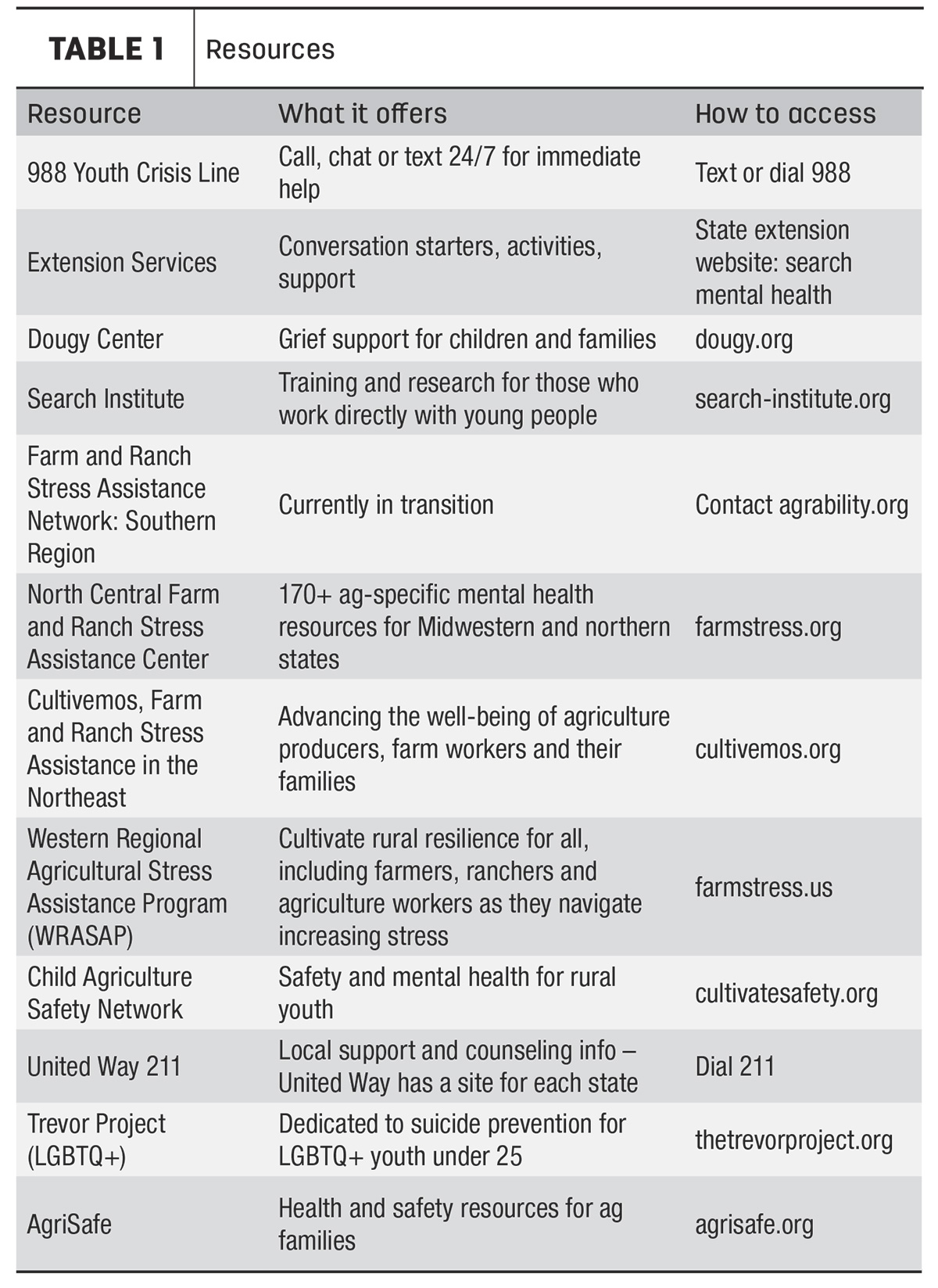
Resources vary by state. Robinette says North Carolina has a program to get youth into counseling by the end of a week with someone who understands agriculture. If you don’t know where to turn, she recommends dialing 211 – a service by United Way for navigating health and human service agencies in your state. Another example is Illinois’ vouchers for free professional behavioral health program to be used with partner providers. There are many resources to help you help others (Table 1).
You might feel like these problems are too big to tackle. But every conversation, every check-in, every moment of empathy makes a difference. Our rural youth need to know that their lives matter, help is available and their future is full of possibilities – even if they can’t see it yet.
We all need to do our part to ensure youth are not suffering in silence – even if you don’t understand mental wellness. Access to care is limited. Rural communities have fewer mental health providers, longer wait times, high insurance co-pays, healthcare professionals who lack a farm background and the burden of traveling long distances for appointments.
Several mental health professionals have pointed out that we also need a bipartisan approach to address the above issues. What can be done nationwide to improve mental and physical health access in rural areas? Some experts want researchers to think about real-world interventions – it’s not enough to crank out research – it needs application. I know there’s no singular solution; rural youth mental health is a complex problem that requires more than one solution.
Let’s keep talking, listening and showing up for our kids. Because in rural America, community isn’t just a word – it’s a lifeline. And it matters more today than ever.