When dairy farmers think about sustainability, feed efficiency is often the first thing that comes to mind. What goes into the bunk doesn’t just affect milk production, it also impacts the farm’s bottom line and its environmental footprint.


One area receiving growing attention is enteric methane, a greenhouse gas produced during rumen fermentation. While methane may not affect cow performance directly, it represents a loss of feed energy and contributes to agriculture’s climate footprint.
Our team, using data from the University of Wisconsin – Madison’s Arlington Research Station, explored a simple but powerful strategy to address this challenge: nutritional grouping. Instead of feeding every cow in a group the same ration, we asked, “What if we split cows into smaller groups based on their actual energy needs and formulate diets to match?”
The results showed promise: Modest reductions in methane emissions, improved efficiency and insights into how farms can feed more precisely without sacrificing production or milk income over feed cost (IOFC).
Why methane matters
Methane has received a lot of attention in recent years because of its role as a potent greenhouse gas. For dairy producers, methane isn’t just an environmental issue, it’s also an energy loss. When cows produce methane, they’re losing feed energy that could otherwise support milk production.
Reducing methane intensity – measured as methane per unit of milk produced – represents both an efficiency gain and a sustainability win.
How grouping works
Cows can be grouped in a variety of ways, including:
- By days in milk (DIM): Cows are grouped by stage of lactation, with those early in lactation needing higher energy, and those in later lactation doing well with lower-energy rations.
- By milk yield: Cows are grouped by how much milk they produce, separating high producers from low producers.
- By energy-corrected milk (ECM): Cows are grouped by both how much milk and its components they give, giving a clearer picture of overall energy output.
For many herds, the most practical approach is grouping by DIM, since it aligns closely with physiological stage and nutritional demand.
The UW – Madison herd study
Previous studies have demonstrated that nutritional grouping improves feed efficiency and milk IOFC. A recent project at the University of Wisconsin – Madison tested whether nutritional grouping could also reduce methane emissions.
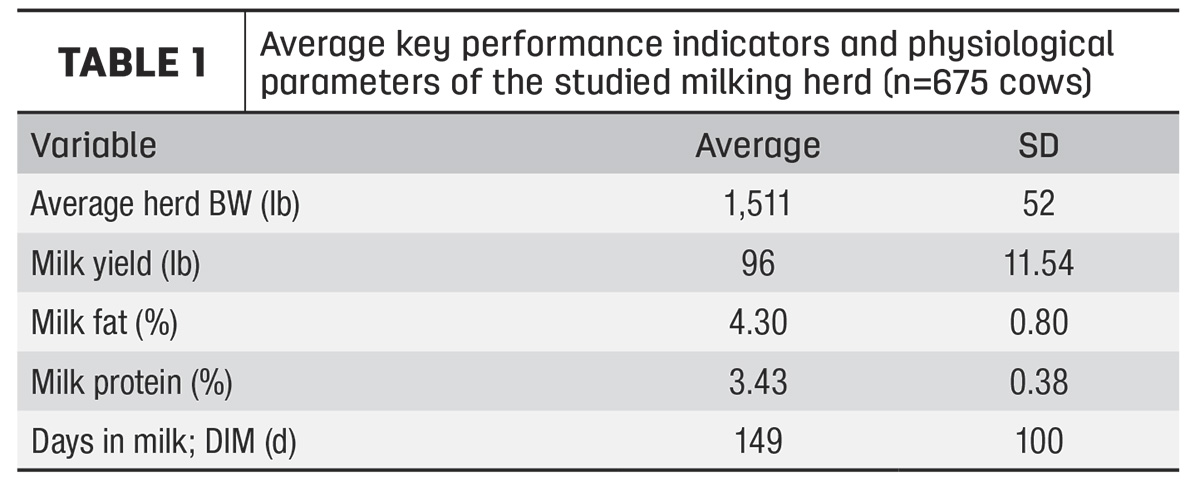
Researchers analyzed data from 675 Holstein lactating cows (Table 1) at the Arlington Research Station. Individual cow data included parity, bodyweight, milk yield, days in milk and dry matter intake. Using the Nutrient Requirements of Dairy Cattle: Eighth Revised Edition software (NASEM; Figure 1), the team predicted net energy requirements, dry matter intake and methane production for either all the cows or for generated nutritional groups.

They compared two scenarios:
- Baseline herd ration: One diet for the whole herd.
- Grouped diets: Separate rations for early-lactation and late-lactation cows (same-size groups).
What changed in the diets?
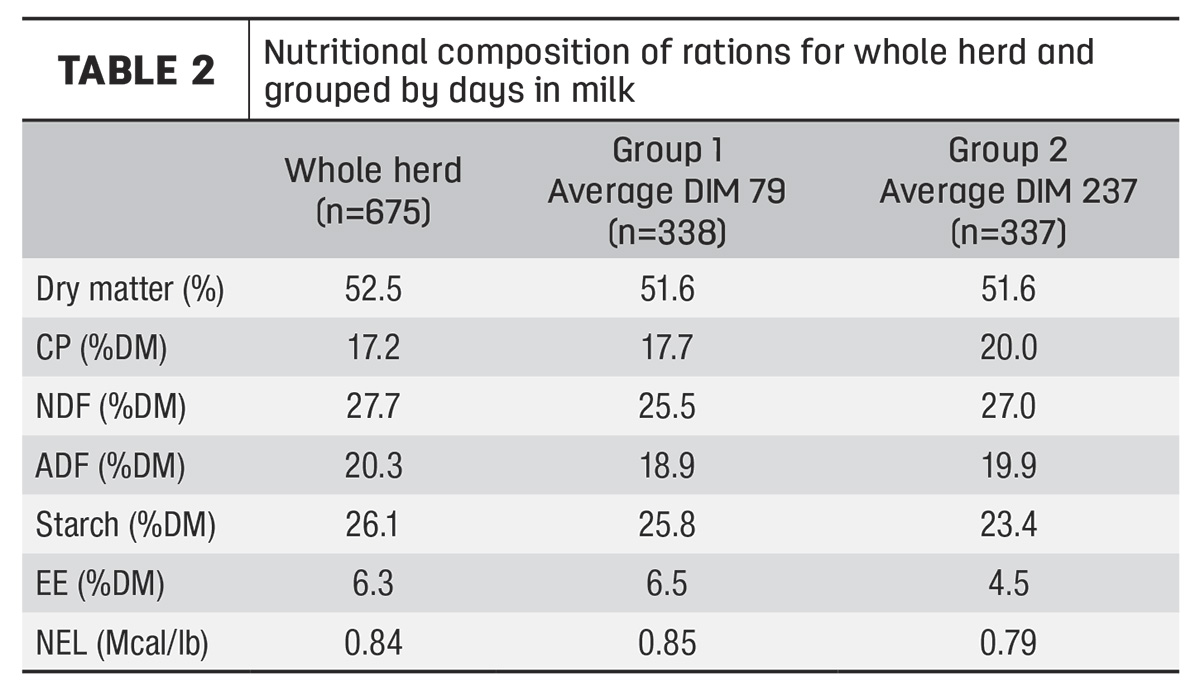
The baseline ration fed to all cows contained 0.84 megacalorie (Mcal) per pound of net energy for lactation (NEL). Group-specific diets (Table 2) better aligned with cow needs:
- First group cows (average = 79 DIM): 0.85 Mcal per pound of NEL, with slightly higher protein and lower fiber. This diet provided the extra nutrients high-producing cows needed.
- Second group cows (average = 237 DIM): 0.79 Mcal per pound of NEL, with more fiber and less energy. This avoided overfeeding cows producing less milk.
These differences may seem small, but they improved nutrient efficiency across the herd.
Results: Small change, big picture
At the individual cow level, methane reductions were modest (Figure 2):
- Baseline emissions: 474 grams methane per cow per day.
- After grouping: 469 grams methane per cow per day.
- Net reduction: 5 grams methane per cow per day.
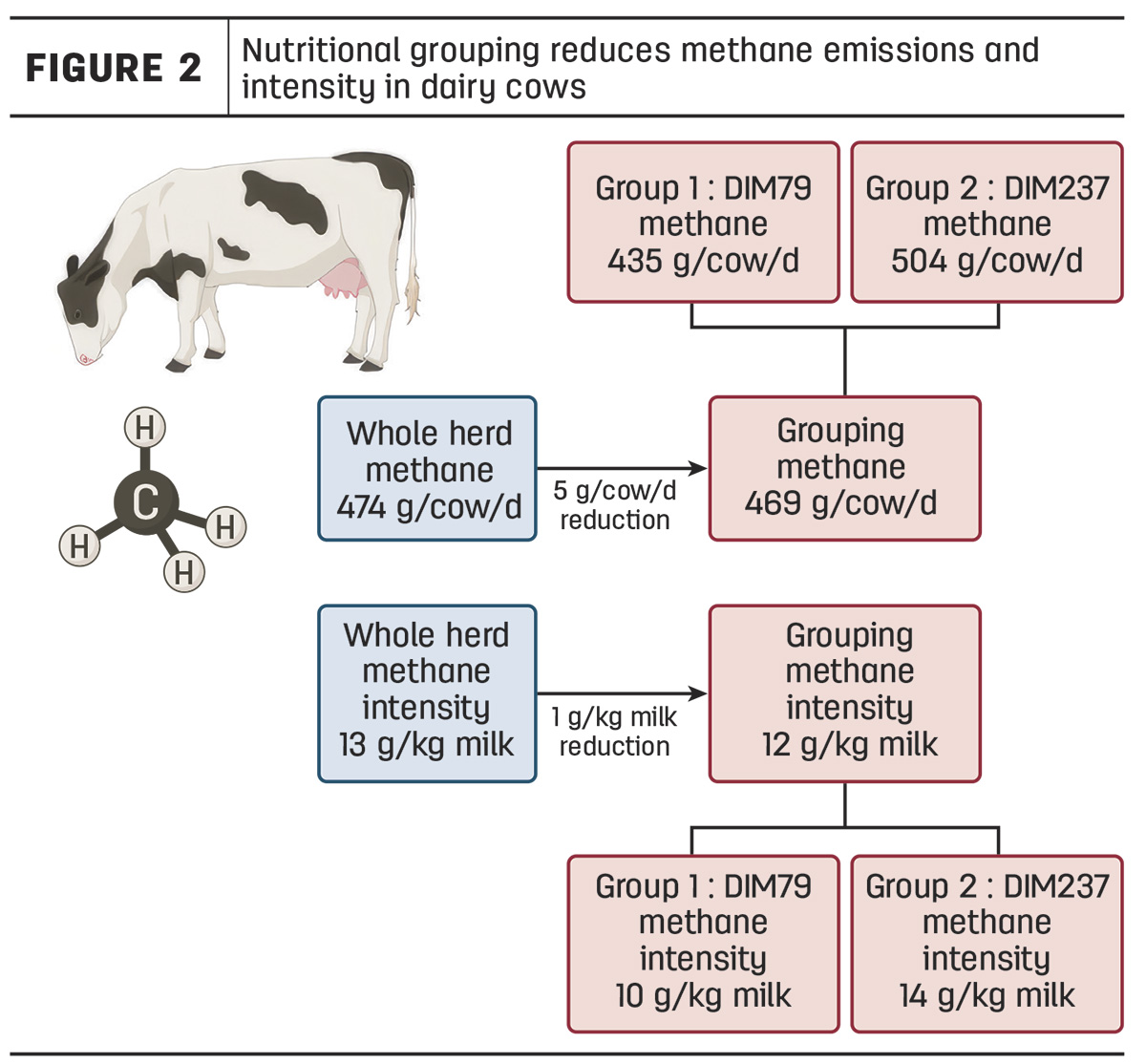
That’s about a 1% reduction per cow.
However, the methane intensity – methane per kilogram of milk – showed a more meaningful improvement:
- Baseline: 13 grams methane per kilogram milk.
- After grouping: 12 grams methane per kilogram milk.
- Reduction: About 8%.
Early-lactation cows were the most efficient, averaging about 10 grams per kilograms of milk.
At the herd level, the results add up. On a 675-cow dairy, nutritional grouping could reduce methane by nearly 1,230 kilograms per year. That’s roughly equal to taking two passenger cars off the road in terms of CO₂ emissions.
Beyond emissions: Efficiency and economics
The environmental benefits of grouping are important, but the economic side may be even more compelling for producers. Nutritional grouping means:
- Better use of feed dollars: High-producing cows get the extra nutrients they need to maximize milk output. Lower-producing cows aren’t overfed expensive ingredients.
- Improved nutrient efficiency: Less nitrogen and phosphorus excreted in manure means lower nutrient losses.
- Potential for higher milk income: By better supporting cows in peak production, dairies can capture more revenue from milk sales.
Even if methane reductions are small per cow, the combination of feed efficiency, production support and overall improved sustainability pay off.
Practical takeaways for dairy producers
Nutritional grouping doesn’t require a complete overhaul of management. Many dairies are already grouping cows for reproductive or health reasons. Adding a nutritional component builds on existing practices.
Final thoughts
One ration doesn’t fit all cows. Nutritional grouping offers a practical way to improve efficiency and IOFC, reduce waste and cut methane emissions, without adding major complexity to herd management. While the per-cow methane reduction may seem small, the improvement in methane intensity highlights a more efficient, profitable and sustainable dairy system. For producers, grouping represents another tool to balance the bottom line with environmental stewardship. In the end, feeding cows smarter means making the most of every pound of feed – and every pound of milk produced.
Chiung-Lun Huang is a master student at the University of Wisconsin – Madison and can be reached by email.
Steps to get started with nutritional grouping
- Work with your nutritionist: Review your herd’s DIM and milk yield distribution to see if two or more nutritional groups make sense.
- Start simple: Even just separating cows into early- and late-lactation groups can yield benefits.
- Use software tools: Programs like NASEM can help predict dry matter intake and nutrient needs for each group.
- Monitor efficiency: Track not only milk yield but also methane intensity or feed efficiency as performance indicators.
- Think long-term: Methane reductions may seem small, but over years and at the industry level, they make a difference.