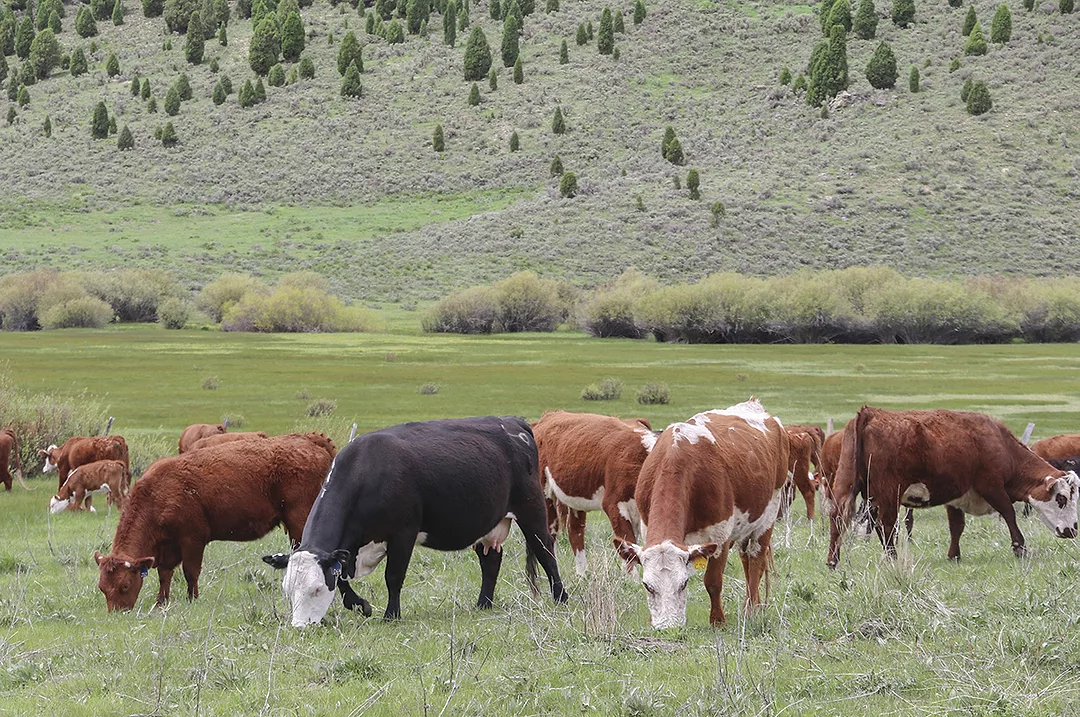
Good pastures don’t just happen. Ranchers rely on equal parts faith and science to have adequate grass to maintain their cow herd and ensure quality calves for beef. Faith comes through praying for the right growing conditions, while science implements good land and resource management to enhance the soil, grass types, moisture levels and more to get the most grass from each acre for as long as possible.

From an economic standpoint, ranchers will want to keep cows on pasture longer so they can consume as much grass as possible. Extending the grazing season helps avoid the need for supplemental hay and other feed supplements, which can be expensive even if they’re raised on the ranch. A longer grazing season can be possible through management decisions and changes over time to promote grass health that supports animal performance.
“If I have to feed my cow herd, I’m using overhead. So if I can extend the growing season and feed them less, I’m reducing overhead,” says Chris Stocks, who runs 250 cow-calf pairs on a ranch near Baker City, Oregon. “I basically save 500 dollars a day if I don’t have to feed hay and just let them graze good pasture.”
Implementing a systems approach
To keep grass growing and healthy throughout the grazing season, there needs to be an understanding of soil types, the variety of grasses that are present, water availability and animal performance goals. It takes a whole systems approach to optimize all parts of the process and a bit of trial-and-error research to identify best practices.
The Country Natural Beef cooperative’s Grazewell program focuses on helping ranchers identify pasture management goals tied specifically to soil health principles, grazing management protocols and ecosystem processes and work toward continuous improvement around those objectives. Each participant identifies areas on their ranch where they want to make improvements, then they develop a grazing plan with management goals in mind. Starting with baseline measurements, participants apply management practices to improve the targeted areas. Annual site observations monitor and document progress toward reaching goals.
Stocks has been involved with Grazewell since the process started several years ago. He’s identified six management learning locations on his ranch for analysis.
“We grow our own hay, and we use those hayfields for fall pasture,” says Stocks. “I’ve got four different management learning sites on pastures, and I’ve tried to use diverse locations. One is in an area that’s very alkaline, and another is in an area that has high salt. One is in a high-traffic area, and another is an old, burnt-out grass field.”
The last two sites are on hay ground where Stocks is looking at different cover crops and tillage processes.
All in, all out
On one of the sites Stocks did research with different rotational grazing systems. He worked with two paddocks, one at 240 acres and a smaller one at 130 acres. First, he put smaller groups in each paddock, with 100 pairs in the larger paddock and 60 in the smaller one. Each group had their own system within the paddock to optimize grazing throughout the summer. The next summer, they put the whole herd of 160 pairs in one paddock and then shifted them all over to the other paddock to finish the summer.
“Grazing the whole herd one paddock at a time extended our grazing season by about two-and-a-half weeks,” says Stocks. “I think we were able to give the paddocks full rest to allow for regrowth, which helped us keep cows on those pastures longer in the fall.”
Choosing difficult areas that need the most improvement seems to be the most desired approach among Country Natural Beef ranchers.
“We didn’t pick our best pastures to analyze,” says Mark Kerns, who runs about 600 cow-calf pairs not far from Stocks’ ranch. “The sites we identified had a lot of bare ground and invasive weeds like Russian thistle, bull thistle and so forth.”
To improve the areas, in the winter they feed cows a hay heavy with grain seeds in these bare spots. The cows stomped the grain hay into the ground, which created a “volunteer” patch of grass. That grass has grown quickly and outcompeted the weeds to fill in the bare spots with grass.
“This past spring, we had a little pasture that we feed heifers in that was completely destroyed,” says Kerns. “We’ve been trying to get it fixed the past two years. This year, before we started calving, I broadcast a pasture mix and then fed the grain hay on top of that and let them work it in. It came in nicely this summer with good growth.”
Tillage makes a difference
Another rancher in southeastern Idaho has analyzed pasture areas at different elevations.
“We’re working with several sites, and they’re all very different from each other,” say Mark and Wendy Pratt, who manage about 650 cow-calf pairs. Cows spend the summers on mountain pastures about 45 miles from the home base ranch, which is in a valley where cows spend the winter and calve in spring. “We have an irrigated site in the valley and a dryland site in the mountains with riparian areas. And then we have an old farm that has been worked, a CRP [Conservation Reserve Program] field, and a native range that’s been the same forever. So we have quite a variety.”
Mark Pratt says he selected those sites because of what they could learn from different management practices.
“It was interesting to look at the difference in soil carbon and water filtration between the sites and how well continuous grass helped that bare ground,” says Mark. “It has been a great learning experience, and we’re continuing to figure out, with the constraints we have, how to improve those areas.”
One of the more interesting things the Pratts have realized is just the difference in organic matter between the sites and how it’s impacted by tillage. One site is an old farm that has been in CRP that was tilled and farmed about 40 years ago. Across the road is native range that has never been touched.
“The farm was 4.5 percent organic matter and the native range was 7 percent,” says Mark. “Even though that tillage was 40 years ago – and we’ve grazed that ground the right way for 20 years or so with short grazing periods and long recovery – it still can’t compete with that native range. It goes to show that when you put a plow in native ground, you’re changing it drastically.”
These ranchers show that discovery and continuous improvement don’t need to be intensive or expensive. There just needs to be a willingness to try new programs and be patient for the results. The benefits can be significant and go beyond the ranch.
“We’re producing more forage per acre, and we’re using less inputs to do that,” says Kerns. “That’s desirable to the consumers of our beef, and it’s showing that we’re trying to achieve the same goals our consumers are trying to achieve.”