At the time of this writing, the government shutdown is now in its fourth week. While the shutdown has many USDA reports delayed and data unpublished, dairy insurance programs are available even if a prolonged shutdown could delay claim processing if indemnities are triggered. Additionally, the market outlook is being formed by minimal pricing data available, geopolitical news and industry chatter and analysis, which could translate to increased volatility as markets react to sentiment over data.

“This data gap comes at a time when milk supplies are seemingly large, preventing the industry from getting a clear picture of how much extra milk or dairy products are out there,” says Alex Gambonini Balistreri of HighGround Dairy. “Once the government reopens and delayed reports are released, participants will have to recalibrate expectations, potentially leading to sharper price swings as new information is digested.”
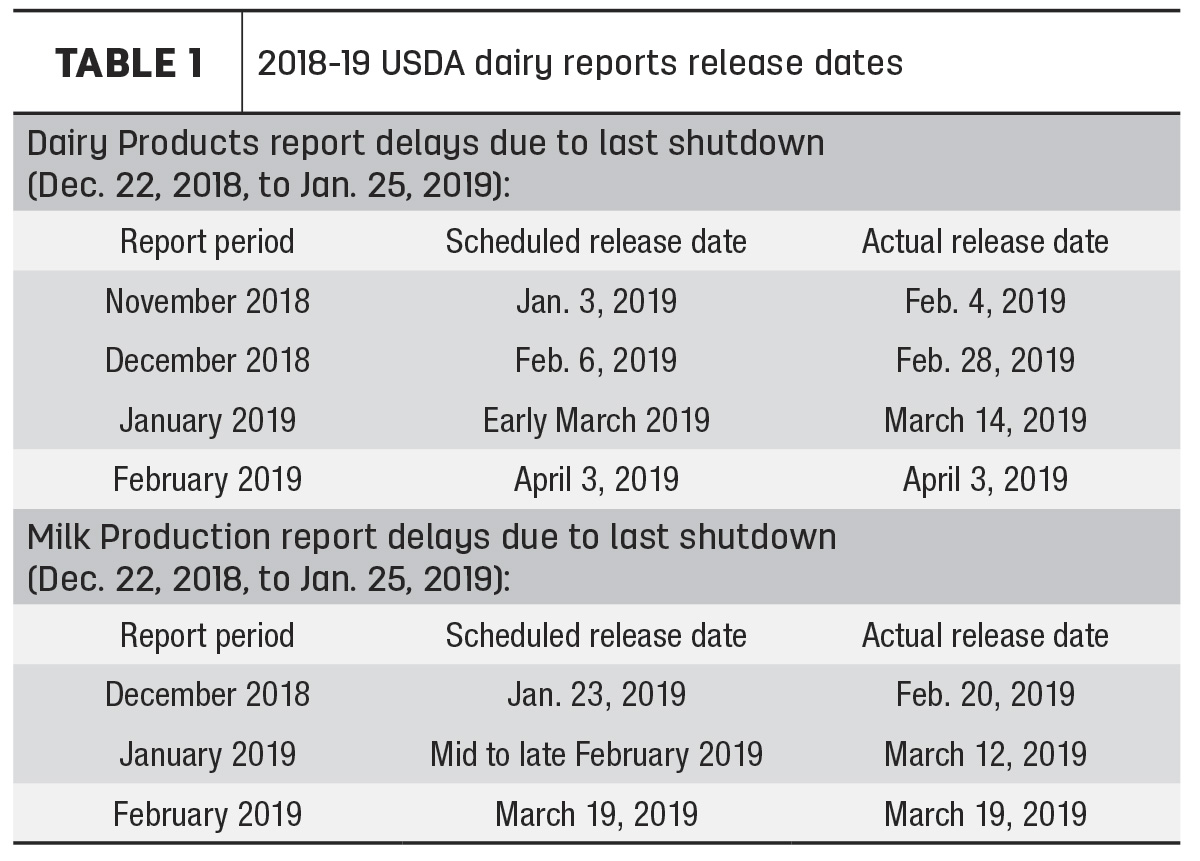
Balistreri says producers should keep an eye on when the government will reopen, as that will determine when key market-moving reports are released. During the last government shutdown (from Dec. 22, 2018, to Jan. 25, 2019), the Milk Production report did not return to its regular schedule until the third release following the shutdown, and the Dairy Products report did not catch up until the fourth release (Table 1).
Considering all of this, now may be the time for producers to evaluate their current risk management options and secure additional coverage.
Here’s Progressive Dairy’s look at important dates, reports and advice affecting risk management decisions, as well as information that will affect dairy producers.
Dairy Margin Coverage (DMC) program
Dairy margins through August rose month over month as milk prices were mixed throughout the month, but feed costs diverged as corn reached new contract lows and soybean meal prices were influenced by an optimistic USDA World Agricultural Supply and Demand Estimates (WASDE) report. As a result, August’s margin was $11.52 per hundredweight (cwt). The margin did not trigger any indemnity payments for the month. (Read: August Dairy Margin Coverage margin regains strength at $11.52 per cwt)
The story seems to be relatively unchanged when looking at September. There continues to be an oversupply of milk in the marketplace weighing prices down, and an expected high crop yield is putting greater pressure on margins. As of Oct. 21, the September DMC margin forecast is at $10.42 per cwt with the all-milk price forecast falling to $20.44 per cwt and the feed cost forecast rising slightly to $10.02 per cwt. The September DMC margin should be announced Oct. 31, pending data availability with the government shutdown.
Most government employees overseeing the DMC program, and other Farm Service Agency programs, are furloughed. If indemnities are triggered, payments will likely be delayed.
There were no details available for 2026 program enrollment at the time of this writing.
Dairy Revenue Protection (Dairy-RP)
Dairy producers managing risk through Dairy-RP are eligible to cover revenue quarterly, up to five nearby quarters. In November, Dairy-RP coverage is available for the first quarter of 2026 (January through March) through the first quarter of 2027.
The market changes daily and Dairy-RP endorsements must be purchased between the Chicago Mercantile Exchange (CME) market closing and the next CME opening. Dairy-RP is also not available on days when applicable futures contracts move limit-up or limit-down, or on days when CME trading is closed due to holidays.
Also, typically Dairy-RP coverage cannot be purchased on days when major USDA dairy reports that could impacts markets are released. This includes Milk Production, Cold Storage and Dairy Product reports (see Calendar). During the government shutdown, quotes will be posted and more available due to the lack of USDA reports that usually keep them closed.
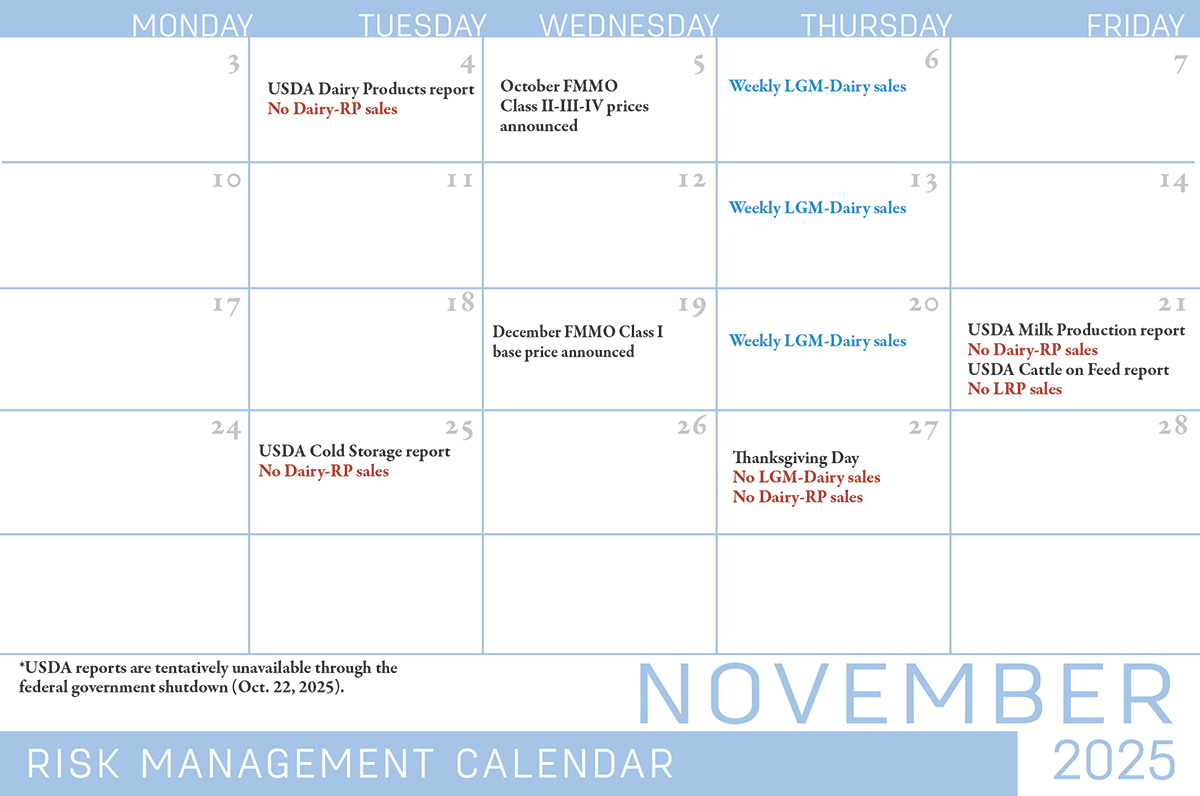
In November, third-quarter Dairy-RP claims could be delayed as the September Production report has not yet been published, warns Balistreri.
Livestock Gross Margin for Dairy (LGM-Dairy)
LGM-Dairy is a subsidized insurance program administered by the USDA Risk Management Agency (RMA).
LGM-Dairy provides protection when feed costs rise or milk prices drop and can be tailored to any size farm. The program uses futures prices for corn, soybean meal and milk to determine the expected gross margin and the actual gross margin. LGM-Dairy is similar to buying both a call option to limit higher feed costs and a put option to set a floor on milk prices.
Coverage for LGM-Dairy can be purchased on expected milk marketing over a rolling 11-month insurance period. So the coverage period during November 2025 includes the months of December 2025 through October 2026. Sales periods for the LGM-Dairy program are open on a weekly basis. Unlike Dairy-RP, LGM-Dairy is available even if a sales period falls on the day of a USDA report.
Livestock Risk Protection (LRP)
LRP is another subsidized insurance program administered by the RMA. The program is a valuable tool for dairy producers as beef-on-dairy and strategic culling decisions are key parts of herd management and business decisions. For dairy producers, LRP coverage is available as LRP-Feeder Cattle (beef-on-dairy calves) and LRP-Fed Cattle (cull cows) with four additional options to select the appropriate coverage, including head count, targeted marketing weight and coverage length and level. No more than 12,000 head can be covered in a specific coverage endorsement with an annual limit of 25,000 head per farmer per crop year (July 1 to June 30).
The sales period for LRP coverage is open each afternoon after futures prices are settled and closes the following morning. Similar to Dairy-RP, LRP is not available on days when CME trading is closed due to holidays or when major USDA reports impacting prices are released such as Cattle on Feed. RMA also has the right to close sales at their discretion. As is the case with Dairy-RP, quotes for LRP are still posted and more available during the government shutdown due to the lack of the Cattle on Feed USDA report.
“Even without new data being released, this is not necessarily a bad time for producers to evaluate and secure additional coverage,” Balistreri says. If current prices align with an operation’s risk management goals, it may make sense to layer in protection rather than wait for market updates that could shift sentiment one way or another.”
Balistreri encourages dairy producers to work with an agent who is closely connected to stakeholders across the dairy supply chain during this time, as real-time insights are the most valuable for informed decision-making.
Production and price outlooks
- Statistically uniform milk prices fell in nine of the 11 Federal Milk Marketing Orders (FMMOs) from August to September with the average milk price at $19.60 per cwt, down 69 cents. (Read: September uniform milk prices reach new lows for 2025)
- The FMMO reports for September Class and Component Prices indicated another month of sinking prices in Class II and Class IV with the latter taking the biggest hit, down $2.33 per cwt from August at $16.17 per cwt. (Read: Class IV milk prices drop again in September)
- The U.S. average prices received for cull cows in July 2025 averaged $157 per cwt, up $15 per cwt from July 2024, setting a new all-time high for cull cow prices. (Read: Cull cow prices hit record $157 per cwt in July)