As a basketball fan, I always had great respect for Mike Krzyzewski (Coach K), former coach of the Duke University Blue Devils. I especially valued how he paid attention to the right things. At the end of a crazy close game when the referee made a call and everyone was going hysterically crazy, including most coaches, Coach K was generally quiet, calm and in deep thought.

He was not focused on anger or frustration over the event (referee's call) that just happened and instead he was strategizing how to ready his team for the next play. Further, Coach K spent the weeks and months before this critical moment preparing himself and his team for just such scenarios through practice, knowing his players and anticipating potential situations and solutions. There is a reason why his teams won five national titles and made 13 Final Four appearances. He focused on preparing himself and his team to be broadly resilient of any situations that would come their way.
You are the Coach K of your dairy. Have you prepared yourself, your team and your operation to be resilient of the many risks that may occur and/or prepared to be ready for the many opportunities that may present themselves?
It’s a two-sided coin. On one side, greater resiliency against the risks that may occur will enable the business to absorb the shocks that inevitably will come with minimal financial impact. Potential risks include falling milk/beef prices, production problems, weather, access to and cost of labor, lawsuits, milk buyer restrictions, policy changes, geopolitical events and more. Further, it is not just the risks that impact you directly, but as a commodity business you are subject to the risks that hit further along the supply chain as well that eventually roll back to you.
The other side of the coin is readiness, being prepared when opportunities arise. Opportunities for capital investment sometimes are fleeting and being ready for making an informed decision is paramount for future success. It may be an expansion opportunity with the dairy down the road, vertical integration opportunity, automation technology or new partnerships. The point is: We often hear about protecting our business against risks, but not being ready for an opportunity can be just as harmful to the long-term success of the business, maybe more.
The news is often full of forecasts of all the risks or opportunities that could happen. I believe that too often we focus our energies on the forecasts – or worse yet convince ourselves that we can time it right to beat the forecast. This is the basketball coach equivalent of getting caught up in the emotion of the referee’s call, rather than strategizing and preparing his team for the next play. Which type of coach are you? Are you reactive and are either trying to beat the forecast or even paralyzed by it, or are you proactive in preparing yourself, your team and your operation to be resilient and prepared no matter what ultimately occurs?
Building greater resiliency against risk and/or preparing our readiness for opportunities both involve proactive management. It is an adoption process, and the first step in the adoption process is being aware of the management practice or technology. This is followed by being persuaded through understanding relative advantage, compatibility, complexity, trialability and observability.
Thus, our coaching instincts should focus on being aware of potential management practices and technologies, and asking the right questions and doing the analysis to be ready to adopt. While we do not want to ignore the news forecasts, isn’t it better to focus on being prepared and ready for whatever ultimately results?
Resiliency Wheel visual tool
University extension, consultants and suppliers have many publications, field days and spreadsheets to help farm managers become aware of and analyze resiliency and preparedness. The Resiliency Wheel visual tool from the University of Wisconsin – Madison Division of Extension is an example. The Resiliency Wheel visual tool has been used for multiple applications.
One recent application was a self-evaluation of readiness for adopting automated technology. This application of the wheel was the subject of a previous Progressive Dairy article by Stephanie Plaster and can be found online.
Another application is mapping the operation’s overall resiliency to absorb future risks that may occur. All applications of the wheel begin with a self-assessment questionnaire. Table 1 shows one section of the overall Resiliency Wheel questionnaire – financial (see the website for the full questionnaire). Table 1 also shows a scale for self-evaluating awareness and preparedness. Example scores are shown along with the overall average for the financial section (3.0 in this example).
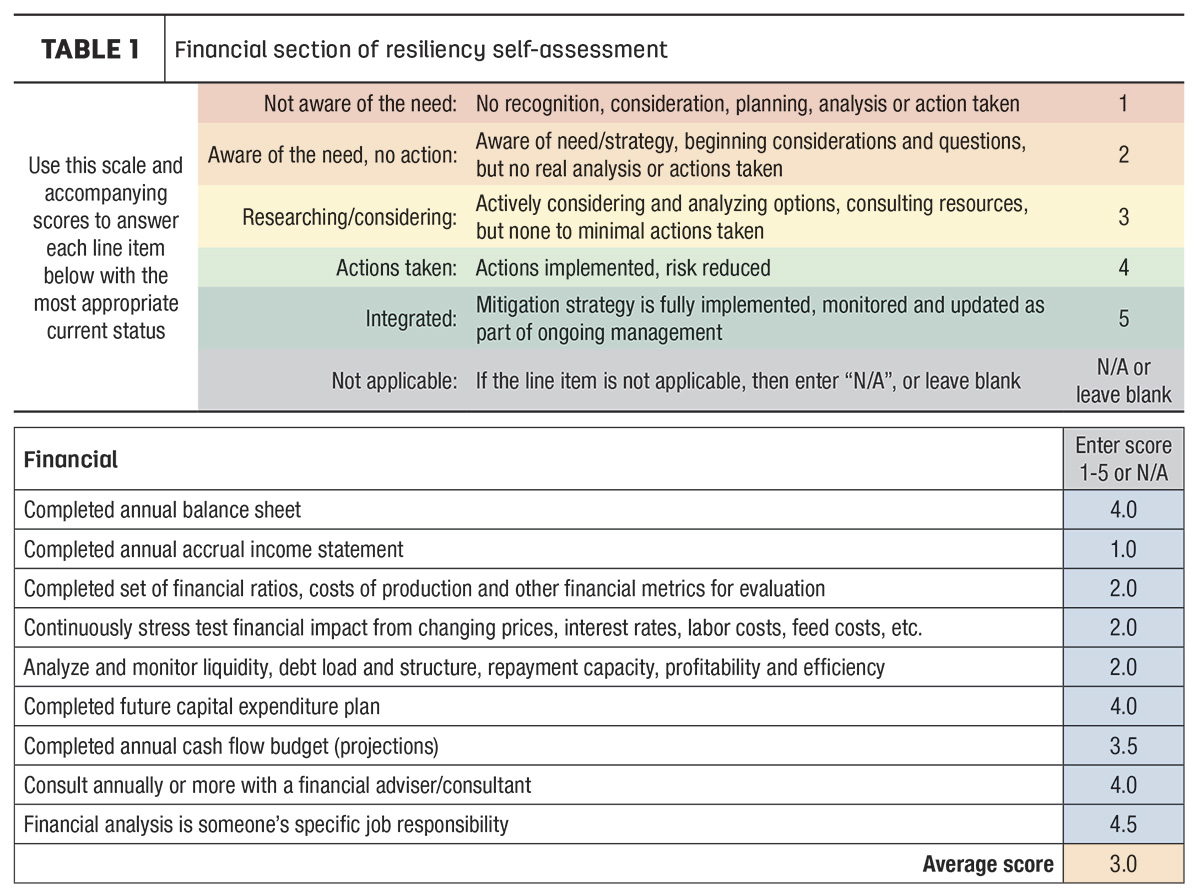
Figure 1 shows the resulting financial resiliency map for this operation and Figure 2 shows the overall resiliency map that includes all sections of the questionnaire including the financial section. The visual wheel (Figures 1 and 2) has concentric circles that follow the 1-5 scoring in the questionnaire with “1” being the inner circle and “5" the outer circle.
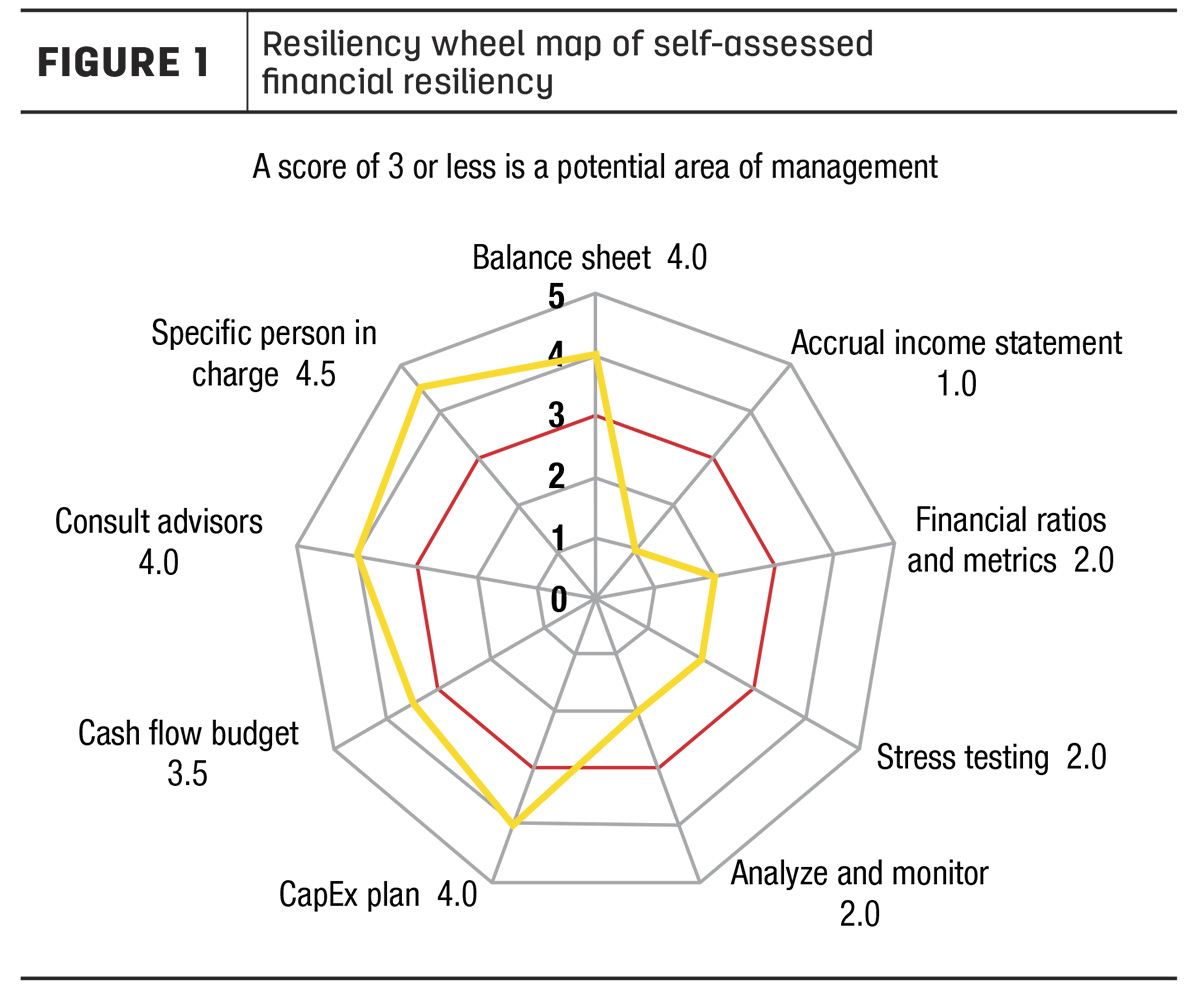
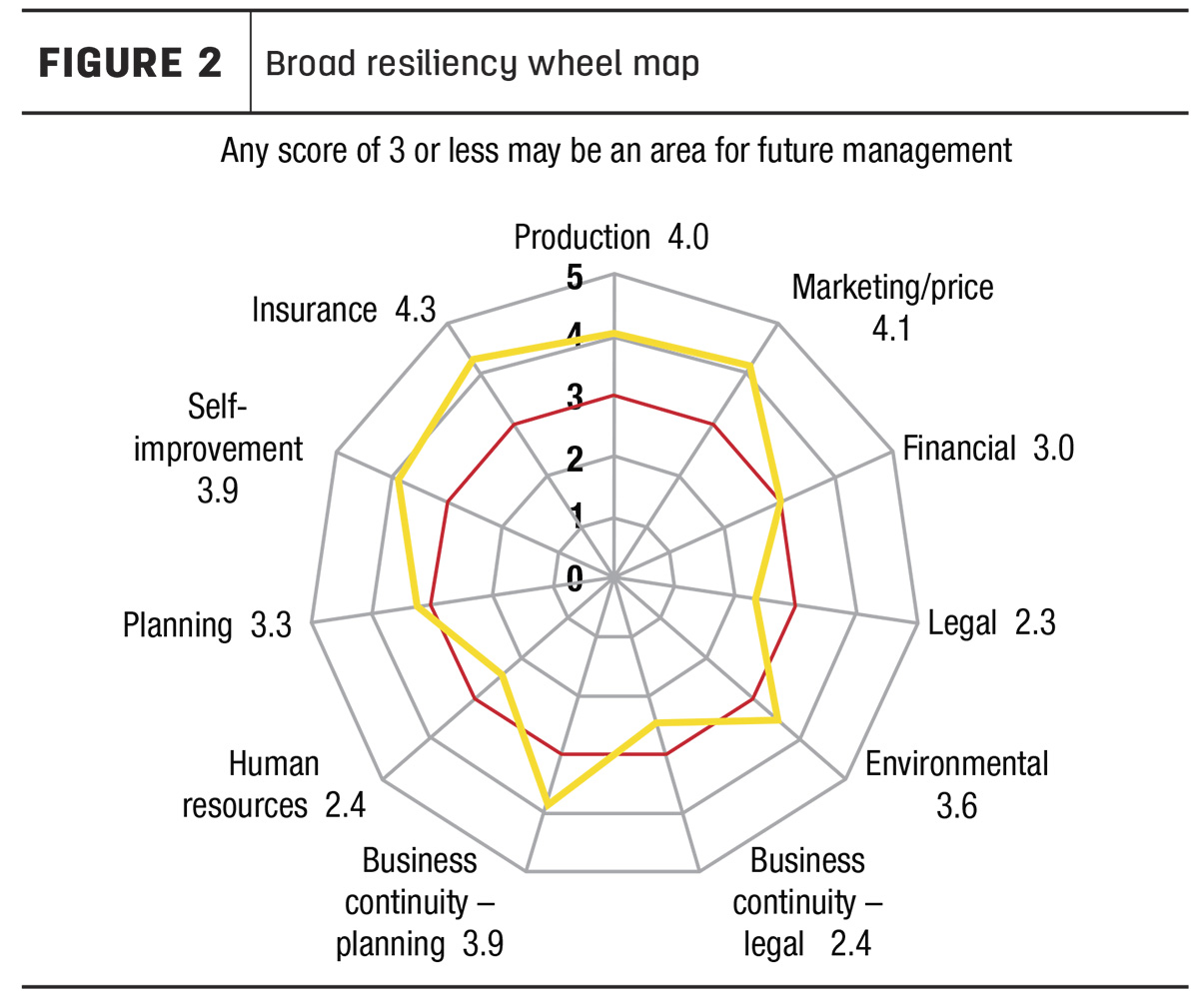
For the financial section by itself (Figure 1), having a competed balance sheet was self-assessed as a “4,” which is where the point is on the Figure 1 map. The overall average score for the financial section was 3.0, which is where the financial point is at on Figure 2. Note that there is a red circle at 3.0. This is a benchmark, as any item that has a self-assessed score of “3” or less may be an area needing management attention.
The wheel has a nice analogy to agriculture. We all have faced those muddy days where we want wheels that are big and round. Small wheels or flat wheels won’t cut it. The ideal resulting Resiliency Wheel map has a score of “5” for all areas, that is, a big and round wheel. Once the self-assessment is completed, the visual wheel quickly shows where management attention may be needed, which is any areas that score a “3” or less.
Inspection of the financial map (Figure 1) shows four areas that are at a score of “3” or less for financial resiliency – accrual income statement, calculated financial ratios and metrics, stress-testing financials, and analysis and monitoring of financials. If the goal is building greater resiliency, then this manager may choose to focus on these areas tomorrow morning after breakfast.
The overall resiliency map (Figure 2) shows that there is general weakness (score of “3” or less) in financial, legal, legal part of business continuity and human resources. These are potential areas for management to focus on in building greater resiliency to withstand the shocks of future events.
Coach K didn’t win five national championships because he focused on the current referee’s call; rather, it was the preparedness of watching film, practice and mentally preparing his team that created a broad resiliency to face with success any future event. In the dairy world, the equivalent may be not focusing on events such as current forecasts of low prices, increasing processor capacity, tariff changes, etc.; rather, focus on the mitigation steps and prepare yourself, your team and your operation for those events.
This article is provided for information purposes only. Readers should consult their own professional advisers for specific advice tailored to their needs. Information contained in this article may be subject to change without notice.
References omitted but are available upon request by sending an email to the editor.