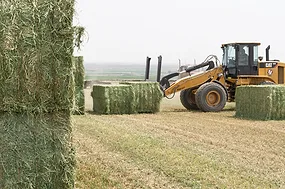
Farming in semiarid areas is not easy. You're dealing with limited water, plus challenges like salt-affected soil with low organic matter, wind and water erosion, and compacted fields. Planting perennial forages (grasses and legumes that come back year after year) isn't just a way to provide soil cover – it's also a long-term fix for these issues.



How perennials fix farm problems
Fighting salty soil (salinity): Perennial forages can help reduce salinity in semiarid regions by drawing water and salt from the soil through their roots and accumulating them in their leaves, which are then removed when harvested. Some species, like Kallar grass, can also improve soil structure, which helps facilitate the deep leaching of sodium ions.
Mitigating compaction and erosion: Perennial forages and grasses produce deep root systems that penetrate the soil, breaking through compacted layers, improving water infiltration and reducing erosion. The deep and extensive root systems of perennial plants hold the soil in place, making it much harder for wind and water to move it off the landscape. Unlike annual row crops, perennial forages offer year-round vegetative cover, which is a crucial method for controlling wind erosion.
Free fertilizer (nitrogen): Perennial forage legumes fix atmospheric nitrogen and provide good-quality hay and fodder, which are abundant in protein and other nutrients required by ruminants. Their potential is influenced by factors like the specific species, growing conditions and stand age, but species like alfalfa and red clover can fix between 100 to 600 pounds of nitrogen (N) per acre annually. This process benefits both the forage legume and nearby grasses, with much of the N being released to the subsequent crop when forage legume residue decomposes (also known as N credits). This means that including forage legumes can reduce the need for N fertilizer – also reducing cost of production.
Integrating perennials into your usual annual rotation offers immediate and future benefits – what are the benefits?
Drought defense: Once established, perennials are often naturally drought-tolerant. They have massive, deep root systems that can find and pull up water from deep in the soil profile where annuals can't reach, giving you more consistent yields. In addition, year-round ground cover can capture snowfall that would otherwise be blown away by wind, effectively increasing the amount of soil water available later in the season.
Natural weed control: Several studies have confirmed that perennials are better weed competitors than annual crops. Perennial forages can develop a dense canopy cover blocking sunlight from reaching the soil surface and reducing soil temperature, inhibiting weed seed germination and weed growth. In addition, multiple cuttings of perennial forages throughout the active growing season inhibit weed growth and survival and reduce potential weed seed production.
In a study conducted in Mandan, North Dakota, we observed that the ability of perennial forages to reduce weed competition increased over time compared to annual crop rotation. After three years, weed cover decreased threefold when perennial forages were included in the system (alfalfa-intermediate wheatgrass mix), and total weed counts were significantly lower compared to the annual cover crop system (winter rye/field pea rotation).
Boost soil organic matter: Inclusion of perennial forages into crop systems can increase soil carbon (C), which improves air and water flow through the soil profile, increases nutrient availability and nutrient cycling potential and mitigates greenhouse gas emissions, increasing long-term sustainability of agriculture. Perennial grasses, by producing large volumes of shoot and root biomass, contribute to an increase in soil organic matter levels and an improvement in soil structure. The benefits of integrating perennial cover crops into annual cropping systems are due to increased organic matter inputs from roots combined with limited soil disturbance.
For example, roots contribute 2.3 times more to soil C than plant material generated from shoots. Perennial forages contribute to improvements in soil aggregation. Research in Mandan, North Dakota, found that particulate organic matter, a fraction of organic matter composed mainly of plant residue, was greater under an alfalfa-intermediate wheatgrass mix compared with spring wheat.
Higher yields later: Perennial forages have the potential to diversify annual crop rotations and provide benefits to subsequent cash crops by increasing N availability and helping to suppress pests and weeds. In the same study at Mandan, North Dakota, mentioned above, total annual biomass production increased in systems with perennial forages. (It increased from 2,000 to 8,000 pounds of dry matter per acre.)
A more developed root system in the perennial species compared to the annual crops contributed to a greater water and soil nutrient uptake, while also helping perennial forages outcompete weed species for these resources. Moreover, the annuals struggled to establish because of the inconsistency in reliable moisture soon after planting. Some studies show that cash crops following perennial forages have higher yields than those that follow continuous annual crops.
For example, a study found that alfalfa or a mixture of alfalfa-perennial grasses provided the greatest subsequent wheat yields compared to a continuous fertilized wheat crop.
Boosting profitability: High biomass production and forage nutritive value for animal feeding are additional benefits for producers who include perennials. Grazing perennial crops can significantly reduce the need for hay or other purchased forages, so it has the potential to reduce production costs as an additional benefit. In addition, grazing animals increase nutrient cycling and soil microbial activity, returning nutrients to the soil through dung and urine, and stimulating root growth through defoliation, which may increase shoot and root crop biomass production.
Time is the key to observing the benefits of including perennial forages in your cropping systems
In a semiarid environment, changes to near-surface soil properties under perennial forages are gradual. It takes four to five years in length to observe increases in soil organic matter.
Additional resources
For more information, you can read the following publications:
Cardoso et al., 2025. Grazing and cover crop effects on soil health during transition to organic production. Agrosystems, Geosciences & Environment, 8, e70213.
Clemensen et al., 2021. Perennial forages influence mineral and protein concentrations in annual wheat cropping systems. Crop Science, 61, 2080-2089.
Franco et al., 2018. Spring wheat yields following perennial forages in a semiarid no-till cropping system. Agronomy Journal, 110, 1-9.
Liebig et al., 2018. Near-surface soil property responses to forage production in a semiarid region. Soil Science Society of America Journal, 82, 223-230.