Many dairy processors use ultrafiltration for cheesemaking. This technology ensures optimal use of the dairy proteins but generates a byproduct called UF permeate, a liquid consisting essentially of water (94%), lactose (5%) and minerals (1%).
In Canada, 528,000 tonnes of cheese are produced annually from milk produced on our farms. Making these cheeses generates some hundreds of millions of litres of permeate, which are valorized using approaches that generate little value for the dairy industry, especially if the permeate is dried for international markets. Pig feed is an example. In a circular economy context, identifying ways to valorize permeate on-farm could represent an interesting opportunity to increase milk production sustainability.
In fact, a few Canadian dairy farmers are already equipped to distribute liquid permeate in their herds’ rations. But under what conditions is this practice advantageous? And what impact is this likely to have on animal productivity, and on milk composition and its suitability for processing? Researchers from Université Laval, along with colleagues from Agriculture and Agri-Food Canada and the University of Manitoba, are currently studying these questions.
Trials on research farms
Two initial trials were carried out in Quebec and Manitoba, where increasing levels of permeate were included into rations typical of each region. In the experiment conducted at the Centre de recherche en sciences animales de Deschambault in Quebec, permeate was included at concentrations of 0%, 4%, 8% and 12% of ration dry matter, in place of corn. The same inclusion rates were used in Manitoba, but this time the permeate replaced barley.
Encouraging initial results
Although experiment data analysis has not yet been completed, initial results are promising. In both trials, the addition of permeate to rations did not lead to a decrease in voluntary intake of the animals. Milk production was also unaffected when permeate replaced barley in Manitoba. In the Quebec trial, where permeate replaced corn, milk production fell by 1.3 kilogram per day, but only when permeate was included at a rate of 12% and replaced all the corn in the ration.
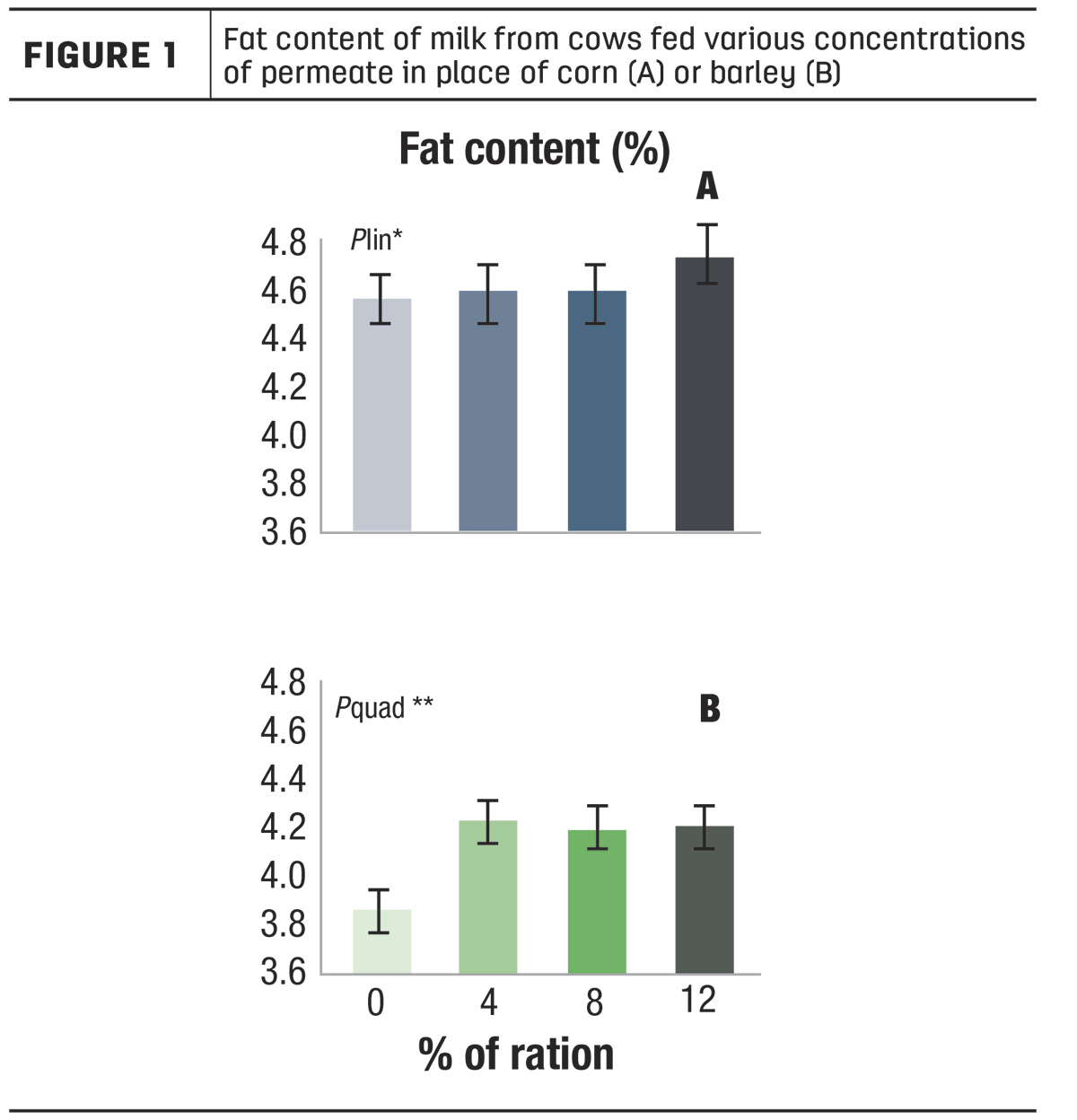
The most surprising effects observed were related to milk components. Firstly, when permeate replaced barley in the ration, there was a marked increase in milkfat content, starting at an inclusion rate of 4%. An increase in fat content was also observed when permeate replaced corn, but it was not as marked and occurred at higher inclusion rates (Figure 1). It is, however, important to note that the control animals in both trials (those not receiving permeate) produced milks with very different fat contents: 3.88% for animals receiving barley, compared with 4.6% for those receiving corn as an energy concentrate. Milk protein content was unaffected in cows fed a diet more typical of western Canadian herds, while it was increased by 0.1 percentage point when permeate replaced corn in typical eastern Canadian rations, but only at an inclusion rate of 12%. Surprisingly, in the Quebec trial, milk lactose concentration decreased linearly (from 4.64% to 4.54%) with the addition of permeate to the ration. Taken together, the changes in the concentrations of the various key milk components brought about by the inclusion of permeate into the animals’ rations led to a linear reduction in the solids-non-fat-to-fat ratio of milk (2.01 to 1.93).
What about milk's suitability for processing?
In the Quebec trial, the various experimental milks were collected in separate cooling tanks and then processed into mozzarella cheese. Why mozzarella? Well, in Quebec, almost half of the milk used to make cheese is converted into mozzarella, particularly as an ingredient for those pizzas we love so much. The results of this dairy processing trial showed that replacing corn in rations with permeate had no impact on cheesemaking process performance, nor on the stretching, melting, browning or oil loss properties of these cheeses during cooking.
What are the next steps?
While these results suggest that permeate could be an interesting ingredient to consider in the preparation of our animals’ rations, several questions remain. Research is continuing to better understand the impact of permeate on rumen microbiology, among other things. Future efforts by this multidisciplinary team will focus on establishing the conditions under which the use of permeate in cow feed could improve the sustainability of the dairy sector.
Collaborators on this project include: Renée Pétri, Agriculture and Agri-Food Canada; Kees Plaizier, University of Manitoba; Guillaume Brisson, Éric Paquet, Yvan Chouinard and Claude Robert, Université Laval; and Filippo Miglior and Débora Santschi, Lactanet.
Dairy Farmers of Canada (DFC) invests in scientific research to foster innovation in the Canadian dairy sector. DFC supports research initiatives that benefit all Canadian dairy farmers and works in collaboration with its members and other sector partners to address priorities outlined in the National Dairy Research Strategy. The goals of this strategy are to increase farm efficiency and sustainability, enhance animal health, care and welfare practices, and strengthen the role of dairy in human nutrition and health, as well as in sustainable diets. Visit DFC Dairy Research for more information.