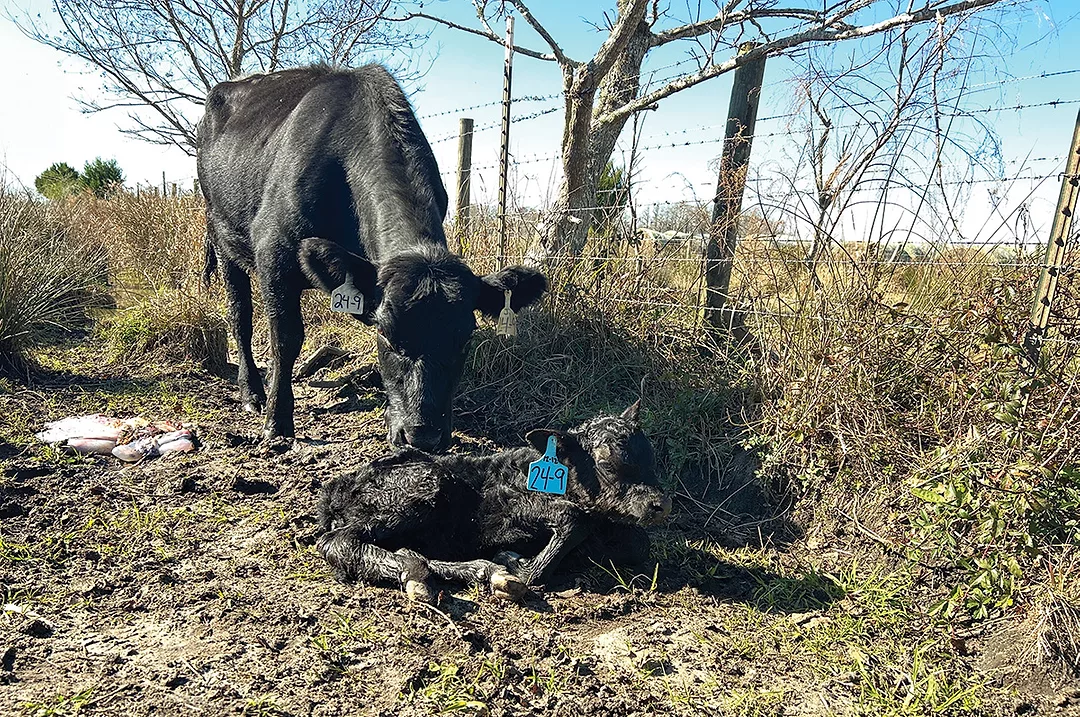
'Tis the season of one of the many seasons on the ranch. Many times, it seems like all the seasons run together. You have calving season, branding season, breeding season, hay season, weaning and shipping, and then before you know it, you’re into calving season again.

One of the standard benchmarks of a successful cow is to maintain a yearly calving interval. This means they must rebreed within 80 to 85 days following calving to allow for a 280- to 285-day gestation (283 gestation + 82 postpartum interval = 365 days). During cows' production year, the period from calving to rebreeding is referred to as the postpartum interval (PPI) and is the most challenging time for the females in our herd.
After calving, cows do not experience estrous cycles; their bodies are rebounding from the challenges of labor, lactation is beginning, and their reproductive systems are resetting from the hormonal and demand changes of gestation and calving. While this period of temporary infertility cannot be avoided, it can be managed. There are several physiological and environmental factors that affect the time it takes a cow to start cycling after she calves, with the two primary ones being the suckling effect and nutritional status. Here is a breakdown of what your cow must overcome following calving to rebreed.
Uterine involution
It is mind-blowing that a cow's reproductive tract will essentially fit in your hand when she is open, but during pregnancy, it expands to hold a calf, a placenta and all the fluids and such required for a healthy gestation. This is where the phenomenon of uterine involution comes in. Uterine involution is the process by which the uterus returns to a nonpregnant size, shape and position, shedding all fetal membranes and repairing uterine tissues. In healthy cows, this process can be completed in approximately 20 to 40 days following calving if no complications arise. Issues like calving difficulties, infections and cow age can play a role in the length of uterine involution.
The 'suckling effect'
Logic would say the biggest challenge of lactation is the high energy and nutrient demands required to produce milk, but science tells us otherwise. It is the actual/physical suckling and presence of the calf that has the most significant effect on the length of the PPI. Calf sucking triggers a complex neural response and hormonal feedback loops that result in reduced or impaired follicular development and ovarian function. Suckling has the greatest impact on females in poor body condition and first-calf heifers. While we can't avoid the calf suckling the cow (after all, that’s her job), we can help her overcome the suckling effect. In some cases, short periods of calf removal or in more intense situations, early weaning, can be used as a management tool to curb the effect.
Rick Rasby from University of Nebraska – Lincoln Beef does a great job breaking down the pros and cons of early weaning in his publication: Early Weaning Beef Calves Sometimes Makes Cents, and Oklahoma State University looks at short-term calf removal in Evaluation of Beef Cow and Calf Separation Systems to Improve Reproductive Performance of First-Calf Cows.
Body condition and nutrition
Body condition scoring (BCS) is a term that seems to get beaten to death in the cattle industry, but it is really the foundation of all production. Nutrition is essential for optimum performance in every aspect of beef cattle production, and overcoming the physical and physiological challenges of calving are no different.
Reviews of literature from the past 15 years conclude three basic observations of nutrition’s role in reproductive success:
- Nutrition before calving is more important than post-calving nutrition in determining the length of the PPI. This translates into – the BCS a cow calves at is the best indicator of her ability to breed back. The nutrition we provide, especially in the last trimester of gestation, is the key to getting her bred back.
- Inadequate dietary energy in late gestation will affect reproduction even when sufficient energy is supplied during lactation. This translates into – it is challenging in a ranch scenario to feed a thin, lactating cow enough energy to gain weight. This is why they need to be in good condition when they calve, before they start suckling that calf.
- BCS of at least a 5 or greater (on a 9-point scale) at calving ensures sufficient reserves to assist in overcoming negative nutritional balances associated with the PPI. This translates into – body condition is especially energy reserves for the cow.
How much does body condition impact the cow's ability to cycle and breed back? Data shows that 80 days after calving, only 62% of cows that were thin at calving (BCS of 4 or lower) were cycling compared to 88% to 98% that calved at a BCS of 5 to 6. Research in the 1980s by Dr. Selk demonstrated that cows with a BCS of 4 or lower had pregnancy rates of 61%, compared with 90% for cows that calved with a BCS of 5 or greater. I've heard it said about 44 different ways, but long story short, you can’t starve the profit out of a cow. Management of your cow herd's nutrition and body condition is the key to getting cows bred back and getting calves on the ground early in the calving season.
Setting your ladies up to overcome the challenges associated with calving is the first step in another successful production year, and that is not always the simplest thing. But then again, what is ever simple in beef production? Considering the insane challenges the cow is facing and managing your herd with the annual productive cycle in mind will help to ensure those cows are in tip-top shape before calving and will help keep the wheels on the bus as we roll into calving season!