Timing is everything
Annual forages are an attractive option for growers for many reasons. Barley and oats are increasingly being used as annual forages to fill feed gaps, stretch water resources and in crop rotations with other traditional forages. But when it comes to small-grain forages, harvest timing can make or break your bottom line. A recent University of Idaho study puts hard numbers to those trade-offs and offers clear recommendations you can use this season.





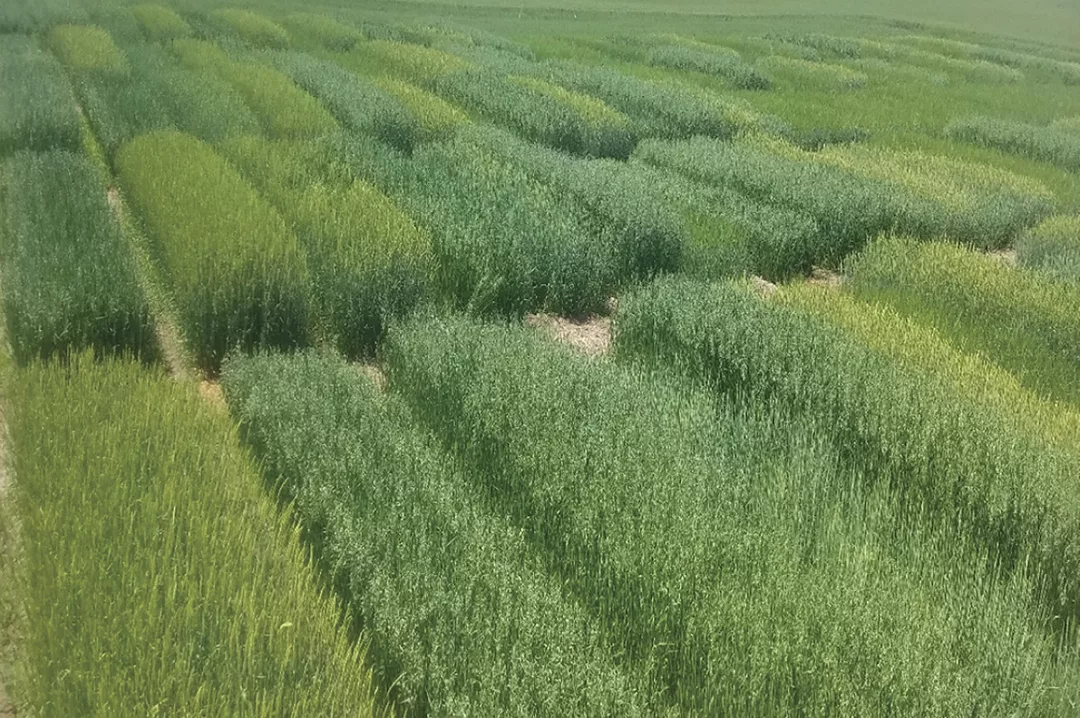
We evaluated three awnless forage barleys (Haybet, Hays, Lavina) and three forage oats (Monida, Otana, Ajay) under irrigation at Aberdeen (during 2021-22) and Rexburg (during 2021). We harvested at four growth stages – boot, heading, milk and soft dough – and tracked the following: yield; quality, which includes crude protein (CP), total digestible nutrients (TDN) and relative forage quality (RFQ); regrowth and economics using Idaho enterprise budgets and average hay prices.
Quality versus quantity
Across site-years and varieties, a simple pattern emerged:
- Earlier cuts (boot) produced Premium hay quality. Crude protein concentrations often ranged from 20% to 25% and RFQ ranged from 110 to 160. However, tonnage was low, and without a strong market premium, boot-stage harvests did not pay under average hay pricing.
- Later cuts (soft dough) delivered the highest yields and best net returns. Hay quality was generally classified as Good (not Premium) and is well suited to beef cow-calf, dairy heifers (18 to 24 months) and non-lactating cows.
- Two cuts rarely beat one late cut. The oats and some barley varieties regrew after an early cut, but combined yields and added operation costs typically underperformed relative to a single harvest at soft dough.
If you’re irrigated and selling or feeding into typical beef cow-calf and non-lactating dairy classes, target soft dough to maximize yield. If you have a reliable Premium-hay buyer who is willing to pay for high protein and RFQ, boot-stage cutting can be cost-effective – depending on the price, you will need that price premium to overcome reduced tonnage.
Species and variety: Barley and oats perform similarly
We saw comparable yield potential and feed quality between forage barley and oats when cut at the same stage. However, in our trials, we observed that Hays barley underperformed on yield and had seed viability issues. Monida and Otana oats are tall-statured, which may be more challenging to harvest compared to shorter-statured Ajay oats.
Regrowth results
When plots were cut early and irrigated, Monida and Otana oats regrew well, while Ajay oats and all barley varieties only regrew in some cases. However, the second-cut tonnage was always less than the first cut. Additionally, the combined first plus second cut usually had lower net returns than a single soft-dough cut, once we accounted for the additional harvest, irrigation and handling operating expenses. Depending on your farm operations, oat regrowth might be a good option to use as pasture instead of harvesting the oats for hay.
Economics you can bank on
We used the University of Idaho Idaho Agbiz enterprise budgets to estimate costs and net returns for forage barley and oats under each harvest scenario. We used the 2023 average “All hay” market pricing ($220 per ton) and input rates (seed, fertilizer, irrigation, operations). Some key takeaways from our economic analyses were:
- Early harvests at boot and heading stages typically had negative or marginal returns because the quantity of biomass was insufficient to cover the operating cost expenses.
- Harvesting at the milk stage generally yielded positive returns, but harvesting at soft dough was more profitable than harvesting at milk across varieties.
- In 2021, Haybet barley and Monida oats harvested at soft dough produced the highest net profits per acre.
- Aberdeen (2022) had a cool spring, lower nitrogen (N) availability and reduced solar radiation due to wildfire smoke, resulting in significantly reduced yields. In that year, no harvest timing or variety was profitable. This was a strong reminder of the importance of properly managing soil fertility and monitoring weather conditions, as mismanagement can easily make a forage operation unprofitable.
- In a related study using these same varieties, forage yield and quality were optimized when residual soil-nitrogen (zero to 2 feet) plus preplant fertilizer N was 180 to 220 pounds per acre.
Trade-offs at each stage of harvest
Boot stage (Feekes 9)
Quality: Highest of all cutting events. CP was typically 20% to 25%; RFQ was commonly 110 to 184; TDN was around 60% to 66%.
Yield: Lowest of all cutting events. In 2021, boot-stage single cuts ranged about 2.2 to 3.4 tons per acre versus 3.8 to 7.1 tons per acre at soft dough.
Regrowth: Oats consistently regrew after harvest but barley was less vigorous than oats.
Fit: Premium hay markets; dairy youngstock/stocker scenarios targeting high protein and intake.
Economics: Generally negative without a significant price premium because the biomass produced was insufficient to cover operating expenses.
Heading (Feekes 10.4)
Quality: Still strong but declining from boot; CP commonly 16% to 18%, TDN 55% to 58%.
Yield: Better than boot but less than later harvest events.
Regrowth: Oats regrew well, but barley regrowth was generally poor.
Economics: Mixed results depending on the variety. Single cuts at heading were often unprofitable, but some heading plus regrowth scenarios for oats resulted in a modest positive return.
Milk (Feekes 11.1)
Quality: CP 11% to 15%; TDN often 55% to 59%; RFQ tends to decrease relative to earlier cuttings.
Yield: Approximately 0.5 to 1.5 tons per acre less than at soft dough.
Economics: Most varieties were profitable at the milk stage in 2021 (Rexburg and Aberdeen), though overall returns were still lower than soft dough.
Soft dough (Feekes 11.2)
Quality: CP typically 9% to 14%; TDN values rebounded slightly compared to the forage cut at milk due to grain fill, but overall energy/fiber balance suits beef cow-calf, dairy heifers (18 to 24 months) and non-lactating cows.
-
Yield: The highest yields were achieved at soft dough.
- Aberdeen 2021 average (all varieties): 5.5 tons per acre
- Rexburg 2021 average: 4.6 tons per acre
- Aberdeen 2022: 1 ton per acre (insufficient available N and wildfire smoke reduced solar radiation, negatively impacting yield potential)
Economics: Delaying harvest until soft dough produced the best net returns in nearly every scenario. In 2021, a single soft-dough cut for Haybet barley and Monida/Otana oats generated the largest profits per acre.
Practical recommendations for Idaho and the Intermountain West
- Choose proven varieties known for reliable tonnage, disease resistance and that are suited to your growing conditions. Montana State University and other universities regularly conduct annual forage variety trials under irrigated and dryland conditions and are a good resource for identifying potential varieties.
- For spring-seeded forage oats or barley, target harvest at soft dough. Recognize that you will be trading increased yield and profitability with reduced forage quality from “Premium” to “Good.”
- Use forage regrowth as a contingency, not a strategy. If you are forced to cut early, you can expect oats to regrow more reliably than barley. Rather than harvesting a second cutting, it will probably be more profitable to graze off the regrowth.
- Pay attention to available water and soil fertility, including N. Our companion work indicates 180 to 220 pounds plant-available N per acre often optimizes yield for these forages under irrigation. Falling short on water, N or other adverse environmental conditions can delay stands and shrink yields, eroding profitability.
If you are interested in learning more about this study, the open access journal article can be found online. Or you can contact Jared Spackman.
Artificial intelligence was utilized to develop the article outline and edit the text for clarity. We have carefully reviewed and verified that the final content presented in this article is accurate and is the authors’ original work.