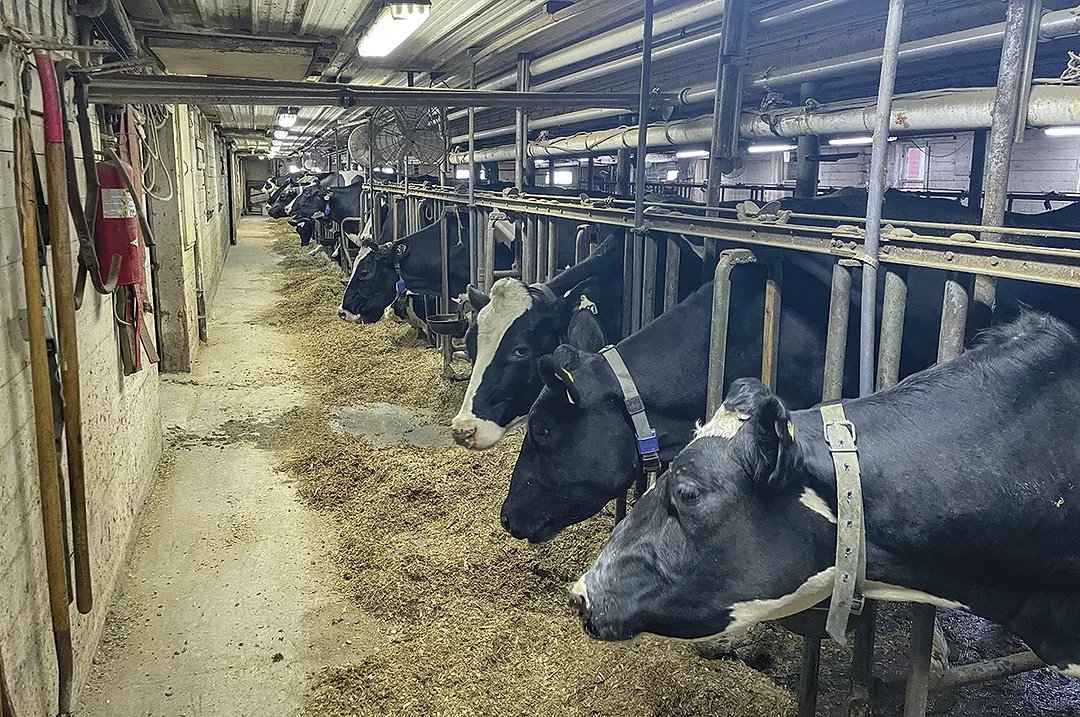
My transition away from milking in tiestalls came when I sold my cows in 2001. If you are keeping your cows, there are still good reasons to consider transitioning away from tiestalls. Maybe your motivation is herd expansion, higher production, regulatory compliance, aging facilities or labour efficiency. For Canadian farmers, regulatory compliance will limit the use of tiestall barns beginning in April 2027. If labour efficiency is motivating you, automated milking might be part of your plan.

One of the first questions to answer is whether to retrofit milking robots into your existing tiestall barn or start over with a new facility. Your answer will depend on your long-term plans and the features you want to include in your barn. The construction and transition process may also impact your decision.
Retrofitting a tiestall barn for milking robots usually involves installing the robot in a sidewall or endwall and sacrificing some stalls for the waiting area and fetch pen around the robot. It may involve replacing the alley floor to add headroom or facilitate manure removal equipment. The existing stall partitions might work if they are correctly sized and in good condition. Many retrofits continue to feed a partial mixed ration (PMR) in front of the stalls. Providing water at a central location near the milking robot will help motivate cows to leave the stalls and go to the robot.
Long-range plans
The cost per cow of a green (or new) site automated milking facility is estimated at $6,800 for milking equipment, and $10,700 for the barn and infrastructure. Adding in handling and the feed and manure storage, the total is over $24,718 per cow. The cost of milking equipment will be similar with a retrofit, but the rest of the costs might be much lower. Cost makes retrofitting robots into tiestall barns look very attractive.
How does the retrofit work with the long-term plan? The retrofit might be a long-term solution, or it might be the stepping stone to take the next generation from the current tiestall barn to a green site project in the future. Or maybe it is intended to extend the career of a farmer who is feeling the wear and tear of tiestall milking but could continue for another 10 to 15 years with robots. Who owns the existing facility and who will own it in 10 years?
The condition of the existing barn also needs to be considered. Evaluate the integrity of the structure and the upgrades that might be needed for ventilation and the handling of feed, bedding and manure. Are the traffic areas wide enough to give cows free access to the robots?
Barn features
A retrofit can reduce the cost of transition from tiestalls to automated milking, but it must incorporate certain features for efficient operation. These will vary between farms. What are the bottlenecks in the tiestall barn now? Will they be better or worse after the retrofit? Consider a new stall surface if cows are slipping in the current tiestalls. Map out the pathways for feeding and bedding, and make sure they don’t interfere with cow traffic. Think about the time you will spend in the barn. Breeding and treating in the tiestalls may have worked well. Workers could be in the alley whenever they wanted, for as long as they wanted. Once the robots are operating, time in the alley should be kept to a minimum, because workers will interrupt cow flow any time they are there. Make sure it is convenient to access the robots for service. Think about where cows will calve and how they will be handled for breeding and other management tasks. Does the existing facility have room for separation pens? Free-flow traffic is much easier to incorporate into retrofits than guided-flow traffic. It might be necessary to consider new construction if there is a strong preference for guided-flow traffic.
Think about the number of cows you want to milk and the number of milking robots you will need. It might make sense to increase or decrease the number of cows to match the robot capacity. Plan for 60 cows per robot. Some farms may milk more cows or fewer cows per robot, but 60 is a good starting point. Herd size and number of robots are easy to determine if you are already close to 60 or 120 cows. If the existing barn has 90 stalls, it might make sense to reduce the milking herd to 60 cows and use the extra space for cow flow, special needs and maternity. If quota or financial goals dictate that there will be at least 90 cows in milk, a green site facility for 120 cows might make more sense than adding both stalls and robots to the existing barn.
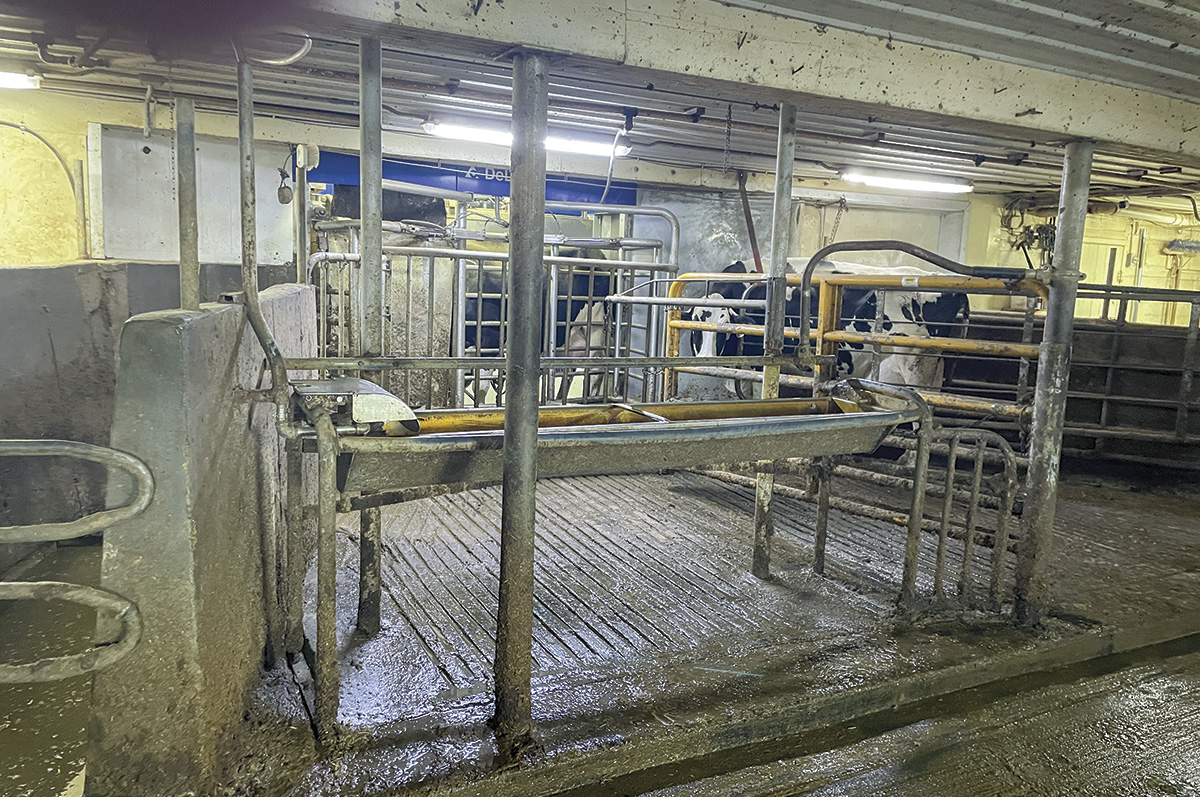
Here is an example of a retrofitted tiestall barn, with a robot placed at the end of the barn. Image by John Gerbitz.
Transition and construction
Think about the retrofitting process. It is a short-term concern, but it could be a deal-breaker just the same. Giving up a few stalls to install a milking robot on one end of the barn might interfere with daily milking chores during construction. The solution might be as simple as milking in shifts. It is possible to milk around gutters being filled with concrete. If the project involves more extensive construction, like lowering the main alley floor, it will probably be necessary to milk the cows somewhere else for at least a few days. Expect delays.
Plan for 45 cows per robot at startup. If there are already 60 cows per robot on the farm, it will be necessary to find a place to milk 15 cows until the first 45 are trained. It might work to milk them through the existing pipeline in some stalls at the end of the barn, or they might need to move somewhere else for a while. A new facility makes it easier to separate the cows from the construction.
Retrofitting robots into an existing tiestall barn can allow farmers to turn the cows loose and save labour with a much smaller investment than new construction. New construction might be more profitable in the long run. Make sure the retrofit will fit your long-term plans, include the features you need and facilitate an efficient transition.
References are omitted but available upon request by sending an email to an editor.