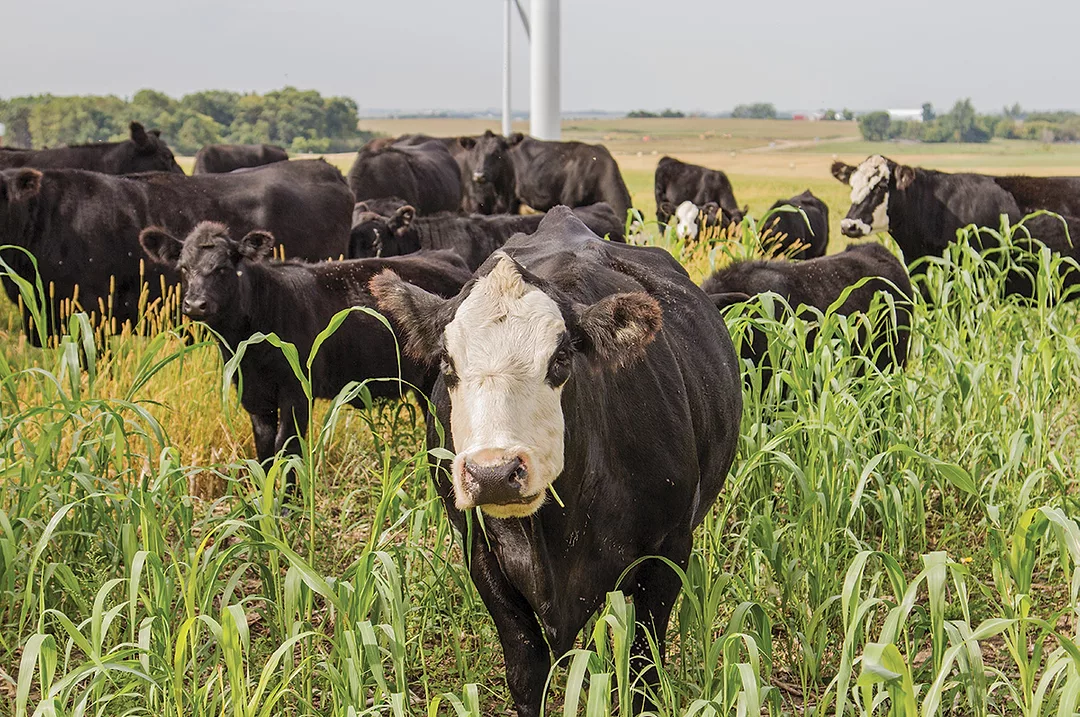
Most cattle producers in the Upper Midwest have been fully focused on cool-season perennial grasses for the majority of the grazing season. While cool-season grasses grow well in our region, producing forage in the spring and again when temperatures cool off in the fall, they suffer from “summer slump” when conditions get too hot or dry, and their growth slows.

That’s where summer annual grasses can benefit the grazing plan. Here are five reasons to incorporate them into your grazing plan:
1. Fill the summer slump
Incorporating warm-season annuals into the grazing mix can provide a longer rest for cool-season pastures during the heat of July and August and provide cattle with a more consistent feed supply during late lactation and early gestation. When we talk about summer or warm-season annuals in the Upper Midwest, we usually refer to the sorghum and millet families, along with some broadleaf annuals.
2. Summer seeding
One of the advantages of warm-season annuals is that they prefer to be planted after the soil reaches 60ºF, so they work well following a late harvest of a cover crop, such as cereal rye harvested for seed or forage, or even following spring-seeded grains, such as oats that are harvested for hay. In Iowa, this would be planting in June or July. Interseeding warm-season annuals to sacrifice winter feeding pastures is a great opportunity to increase forage production in the grazing plan.
3. Requires less moisture
Warm-season annuals are more tolerant of dry conditions than most of our other forages, as long as they get enough moisture to germinate. A general rule of thumb is that sorghum species need a third less water in comparison to corn. A 2023 trial in northeastern Iowa only received 4.3 inches of precipitation from June to September – during the summer annuals growing period – yet summer annuals were still able to produce about 3 to 4 tons of dry matter per acre.
4. Quick grazing intervals/ability to regraze
Many summer annuals are ready to be grazed 30 to 45 days after planting, making them a good option following delayed planting or crop failure – allowing producers to obtain usable forage even when planted as late as mid-July in Iowa. Many of these species are also tolerant of multiple harvests (either grazing or mechanical harvest), so they work well in a rotational system, providing grazing in July, August and into the fall/winter. All these species will be terminated naturally by a killing freeze.
5. Tonnage produced per acre
One other advantage of warm-season annual grasses is the ability to produce 4 to 5 tons of forage dry matter per acre, which equates to a lot of feed from a few acres. Single-cut silage sorghums can equate to greater than 8 tons of higher dry matter per acre. However, when grazing, remember that rotational or strip grazing will only utilize about half of that growth. Small, odd-shaped fields that are a challenge to farm and are close to pastures or building sites for water access are logical locations to incorporate into an annual grazing system.
What species?
Forage sorghum is the highest-yielding warm-season annual; however, it doesn’t work well in grazing systems, since it is a single-harvest forage. Hybrid sorghum-sudangrass is the top-yielding grazing forage, followed by sudangrass and pearl millet. All three work well in a grazing system, provided you leave at least one or two nodes left on the plant, or about 6 to 8 inches of stubble height for the plant to start regrowing for the next harvest. Foxtail and Japanese millet are also options, although these are lower-yielding in comparison to other warm-season annuals. While they don’t contribute as much tonnage as the grasses, incorporating other warm-season annuals such as cowpeas, sunn hemp, buckwheat or sunflowers increases the protein content of the mix and adds diversity to the stand.
How many acres are needed?
A three-year demonstration project in northern Iowa focused on a winter annual/summer annual rotation with two summer harvests and either 50 or 100 pounds of nitrogen applied to the warm-season annuals. These were all single-species stands that were mechanically harvested (Figure 1). The full report can be found online.
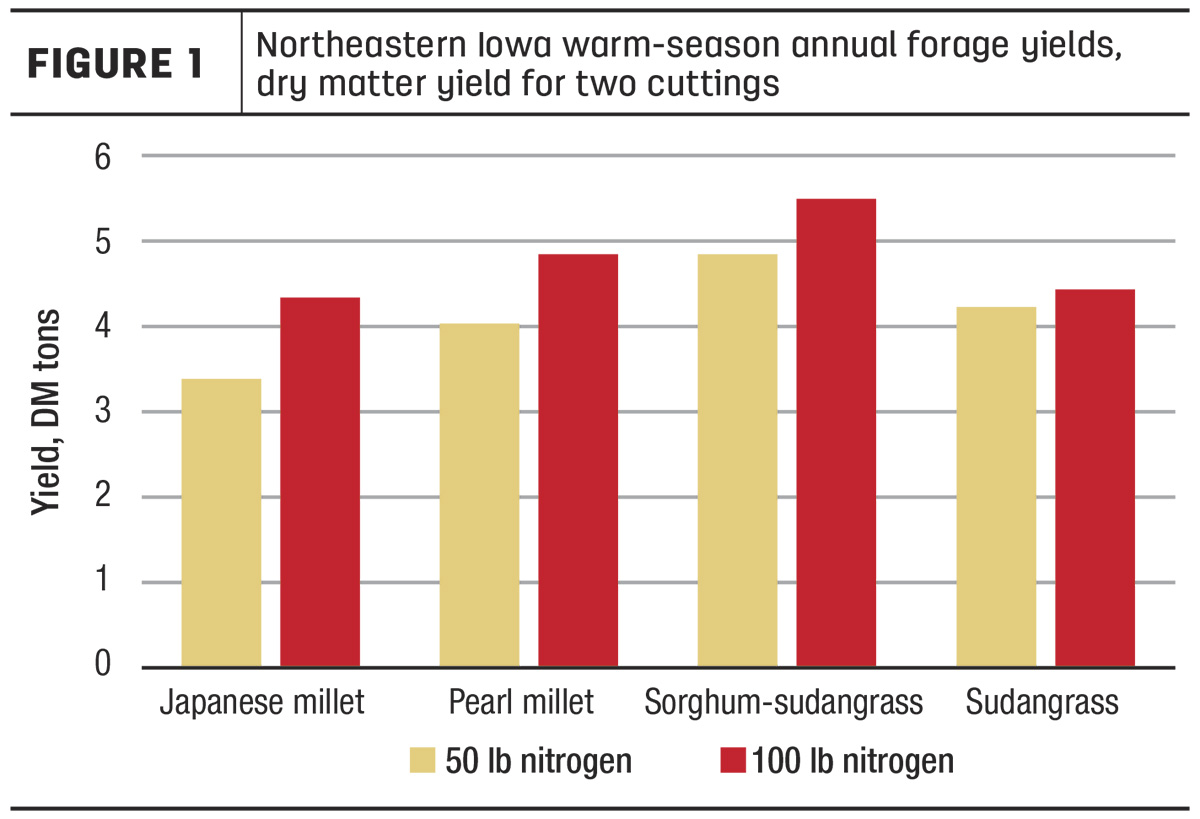
Using these yields as an estimate of production in northern Iowa and a grazing utilization of 50% for rotationally grazing, you can do some cowboy math on how many acres are needed for a herd:
- A 1,500-pound cow consuming 2.5% of her bodyweight per day will consume about 37.5 pounds of dry matter per day.
- Fertilized sorghum-sudangrass producing a total of 5.5 tons (11,000 pounds) of dry matter per year and utilized at 50% grazing utilization provides 5,500 pounds of grazable dry matter annually.
- The 5,500 pounds of dry matter annually provides feed for about 146 cow-days per acre.
- Assuming we graze this field in July and again in August for about one week each time, 146 cow-days for 14 days grazed means we can graze 10 cows on each acre of sorghum-sudangrass in this example.
- If you have a 50-cow herd, then five acres will support this summer annual grazing system.
Cautions when grazing summer annuals
All of these summer annuals have the potential to accumulate nitrates in drought conditions, excessively cloudy conditions and when high levels of nitrogen fertilizer have been applied. Nitrate tends to accumulate in the lower parts of the plant, so increasing stubble height reduces the nitrate risk. Diluting the ration with low-nitrate feeds is also recommended.
All of the sorghum family, except for millets, contains dhurrin, which can cause prussic acid poisoning. Dhurrin is broken down by rumen microbes or by a frost or freezing event into prussic acid (a cyanide), which is highly toxic to ruminants. Dhurrin is highest in concentration in the new shoots and regrowth, so don’t graze sorghums or sudangrass until the plant is at least 18 to 24 inches tall. Avoid grazing frost-damaged sorghums, and delay grazing for at least a week after the first killing freeze to reduce the risk of prussic acid poisoning.
The other caution is to prevent the sorghum family from going to seed, which can lead to a shattercane weed problem in future years. Shattercane is an off-type of sorghum. Foxtail millet also needs to be managed to prevent seedheads, since it is closely related to giant foxtail.
Summer annual grasses are not without their challenges, but they are a great tool to add to the grazing plan for cattle producers in the Upper Midwest.