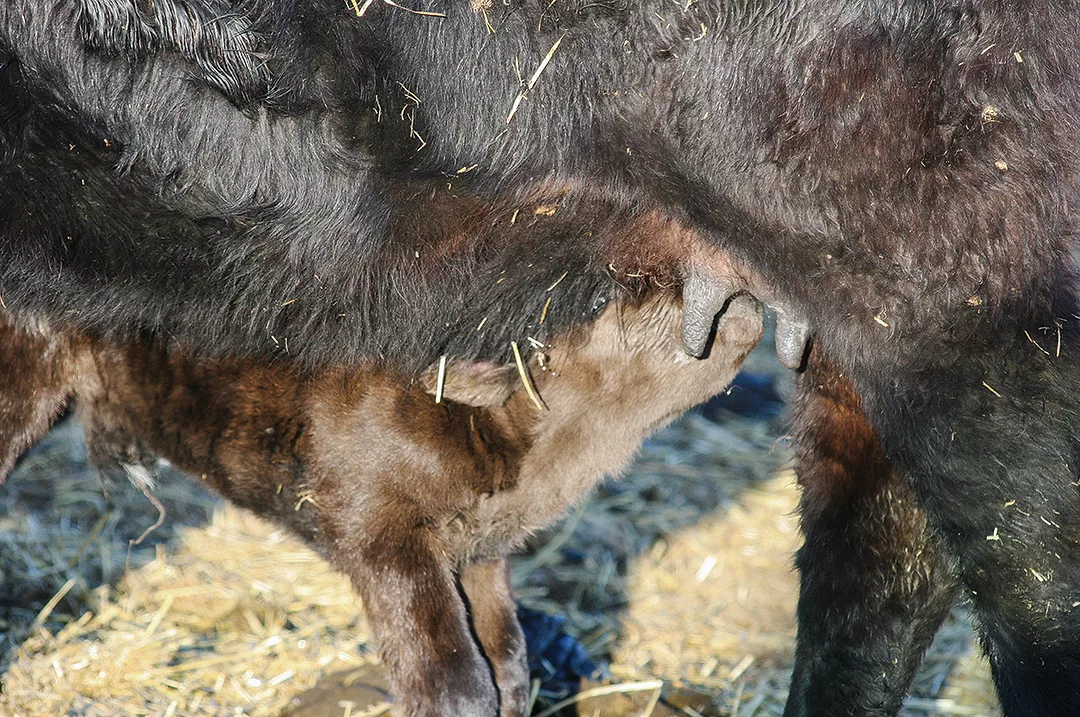
Compared to dairy cattle, beef cattle are more extensively managed unless there is a problem in calving. A tremendous amount of research has been published and continues to be performed related to colostrum management of dairy cattle. Much less research has addressed colostrum management in beef cattle and their calves. Colostrum consumption is considered the most critical event in the life of the calf. Certainly, there are instances where calves survive either without colostrum or with poor-quality colostrum; however, these calves are at much greater risk for disease and death early in their lives.

A primary role for colostrum is to provide maternal antibodies, mostly immunoglobulin G (IgG), which will be absorbed as intact protein in the calf’s small intestine within the first 12-24 hours of life. These antibodies provide immediate immunologic protection against pathogens that the cow has acquired from disease exposure or vaccine administration. The newborn calf has a functional immune response; however, it would require 14-21 days to mount an immunologic response to a pathogen, which may be too late to prevent disease or death.
Passive transfer of maternal IgG can range from failure to varying degrees of adequacy. What determines passive transfer adequacy is the concentration of IgG found in the calf’s blood following colostrum consumption. When it comes to passive transfer, more is better. Originally, a blood IgG concentration of 10 milligrams per milliliter (10 grams per liter) was considered adequate passive transfer for dairy calves. In contrast, 16 milligrams per milliliter (16 grams per liter) was considered the threshold for adequate passive transfer in beef calves. The higher IgG concentration in beef calves is a function of the higher IgG concentration found in beef cattle colostrum compared to dairy cattle colostrum. Selecting livestock for milk production also selects for greater colostrum volume, which reduces colostral IgG concentration. This difference is seen between dairy and meat breeds of cattle, sheep and goats.
A recent consensus report has suggested multiple categories for classifying blood IgG concentration in dairy calves. This report defines four passive transfer categories: excellent (greater than or equal to 25 milligrams per milliliter), good (18-24.9 milligrams per milliliter), fair (10-17.9 milligrams per milliliter) and poor (less than 10 milligrams per milliliter). Recent beef cattle studies have suggested the 16 milligrams per milliliter threshold was insufficient and recommended greater than or equal to 24 milligrams per milliliter, similar to the dairy calf recommendations, based on calf health outcomes. Unfortunately, measuring blood IgG concentration is not practical on the farm.
In place of measuring IgG concentration, serum total protein has been used to estimate IgG concentration. Serum total protein can be easily measured using a refractometer. It is best to collect a blood sample between days two and seven to assess serum total protein. One should also recognize that if the calf is dehydrated, total protein will be artificially elevated. Blood can be collected from the jugular vein into a tube without an anticoagulant and allowed to clot. A drop of clear fluid (i.e., serum) can then be placed on the refractometer to determine total protein concentration. Recommended serum total protein concentrations for the IgG categories are: excellent (greater than or equal to 6.2 grams per deciliter), good (5.8-6.1 grams per deciliter), fair (5.1-5.7 grams per deciliter) and poor (less than 5.1 grams per deciliter). Recommended percentages for each of these categories are greater than 40%, approximately 30%, approximately 20% and less than 10%, respectively, for a group of calves in a herd.
If the assessment of calf passive transfer is less than desirable, then one needs to evaluate the quality of colostrum being produced by the cow herd. The Brix refractometer, commonly used to measure sugars in pasture grasses, wine and fruit juices, has been applied to colostrum assessment in beef calves. Colostrum assessment using the Brix refractometer was first validated in dairy cattle. Only a drop of colostrum is needed to determine colostral IgG with the Brix refractometer. The recommended colostral IgG concentration for dairy cattle is 50 milligrams per milliliter (50 grams per liter) and a Brix value greater than or equal to 22% for good-quality dairy colostrum. Beef cattle produce a lower volume of colostrum compared to dairy cattle; thus, colostral IgG concentration should be higher. A Brix value of greater than 24% was associated with lower-quality beef cattle colostrum, while a Brix value greater than or equal to 30% was associated with higher-quality colostrum with an IgG concentration greater than or equal to 150 milligrams per milliliter (150 grams per liter). In a controlled colostrum feeding study, consumption of greater than or equal to 170 grams per liter of IgG was required to prevent failure of passive transfer; however, due to the lower absorption efficiency observed, greater than or equal to 250 grams per liter of IgG may be necessary to achieve desired levels of passive transfer. Colostrum management using the Brix refractometer is a simple management tool that can be used cow-side to identify those calves that may need special attention.
Although delivery of IgG is most commonly associated with colostrum, one must remember that colostrum also potentially contains higher concentrations of many essential nutrients, especially the fat-soluble vitamins (A, D and E). Proper nutrition of the late pregnant beef cow is essential to facilitating high-quality colostrum and giving the newborn calf its best opportunity to reduce disease risks, survive and grow optimally.
References omitted and available upon request by sending an email to an editor.