The decision to feed an acidogenic ration to late-pregnant dairy cows is a very easy one, as there is no better strategy to initiate the mechanisms of calcium metabolism to meet the sudden high demand for this critical mineral surrounding the time of calving.

Feeding acidogenic rations prepartum has been supported by voluminous research and has been documented to result in higher postpartum dry matter intake (DMI), greater early and total lactation milk yields, reduced incidences of retained placentas and metritis, reduced days open and higher first-service conception rates, all important key indices for dairy farm profitability.
A more thoughtful and sometimes more confusing decision surrounds the extent to which we feed a negative dietary cation-anion difference (DCAD) diet. The consequence of underfeeding anions results in a reduced calcium response and consequently a reduced benefit. When anions are overfed, there is potential for over-acidification and reduced feed intake. Obviously, both scenarios should be avoided.
But what level of negative DCAD is too low? Depends on who you ask. A better way to answer this question starts with a basic understanding of what happens when you feed a negative DCAD diet to induce compensated metabolic acidosis in the prepartum dairy cow.
Compensated metabolic acidosis
Compensated metabolic acidosis is a physiological state where the body successfully maintains a normal level of systemic pH balance. In the case of dairy cows fed a negative DCAD diet, metabolic acidosis is a result of the intentional reduction of dietary cations (sodium and/or potassium) and/or the intentional addition of dietary anions (chloride and/or sulfur). As a result, blood levels of bicarbonate ion are reduced, leading to a reduction in both blood and urine pH.
The balance of anions
When the concentration of anions is purposely increased in the diet and then absorbed by the gastrointestinal tract, the body adjusts by reducing negatively charged particles already in the systemic circulation. The anion that is reduced in the systemic circulation is bicarbonate. As a result of the reduction in bicarbonate, the chemistry of the body becomes more acidic as the proportion of bicarbonate to hydrogen ions is reduced. Remember acid-base chemistry?

Blood bicarbonate
Zhang et al. (2022) demonstrated that prepartum dairy cows fed a fully acidogenic, negative DCAD diet (urine pH 5.75) with either low (0.40% dry matter) or high (2% dry matter) dietary calcium had serum bicarbonate concentrations of 21 and 21.96 millimoles per liter (mmol/L), respectively, compared to cows fed a nonacidogenic ration (24.75 mmol/L). This represents a modest 8.6% reduction in serum bicarbonate. Zimpel et al. (2021) observed a linear decrease in blood bicarbonate concentrations for cows fed a negative DCAD diet. In their study, cows fed a nonacidogenic ration had blood bicarbonate concentrations of 28.4 mmol/L, whereas cows fed a partially (urine pH 6.67) or fully acidogenic (urine pH 5.41) ration had blood bicarbonate concentrations of 26.7 and 24.9 mmol/L, respectively, which represents a 9% decrease. Results from both studies demonstrate that the blood bicarbonate concentrations of cows fed fully acidogenic rations were within the generally accepted normal range of 22 to 30 mmol/L and not considered to be over-acidified from a blood bicarbonate concentration standpoint.
Removal of hydrogen ions (acids)
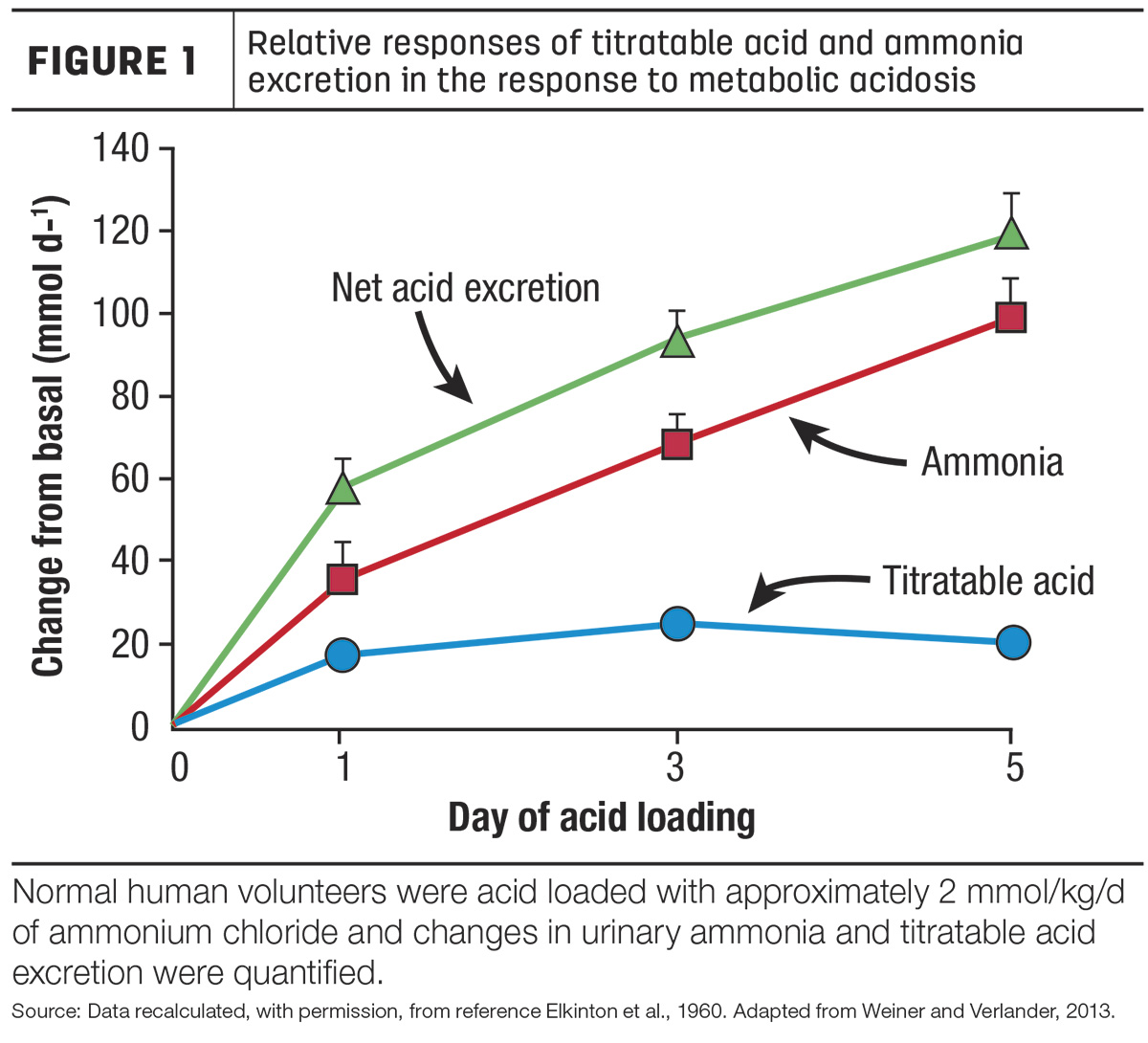
To compensate for this change in systemic pH, the body must remove hydrogen ions to maintain acid-base balance. A term used to describe the removal of acids from the body is net acid excretion (NAE). NAE increases as more anions are fed (as ration DCAD is lowered). To maintain normal acid-base balance, the removal of hydrogen ions is accomplished by urinary excretion of hydrogen ions and hydrogen ions in the form of ammonium (NH4+) (Figure 1). Excretion of ammonium ions maximizes the excretion of hydrogen ions from the systemic circulation.
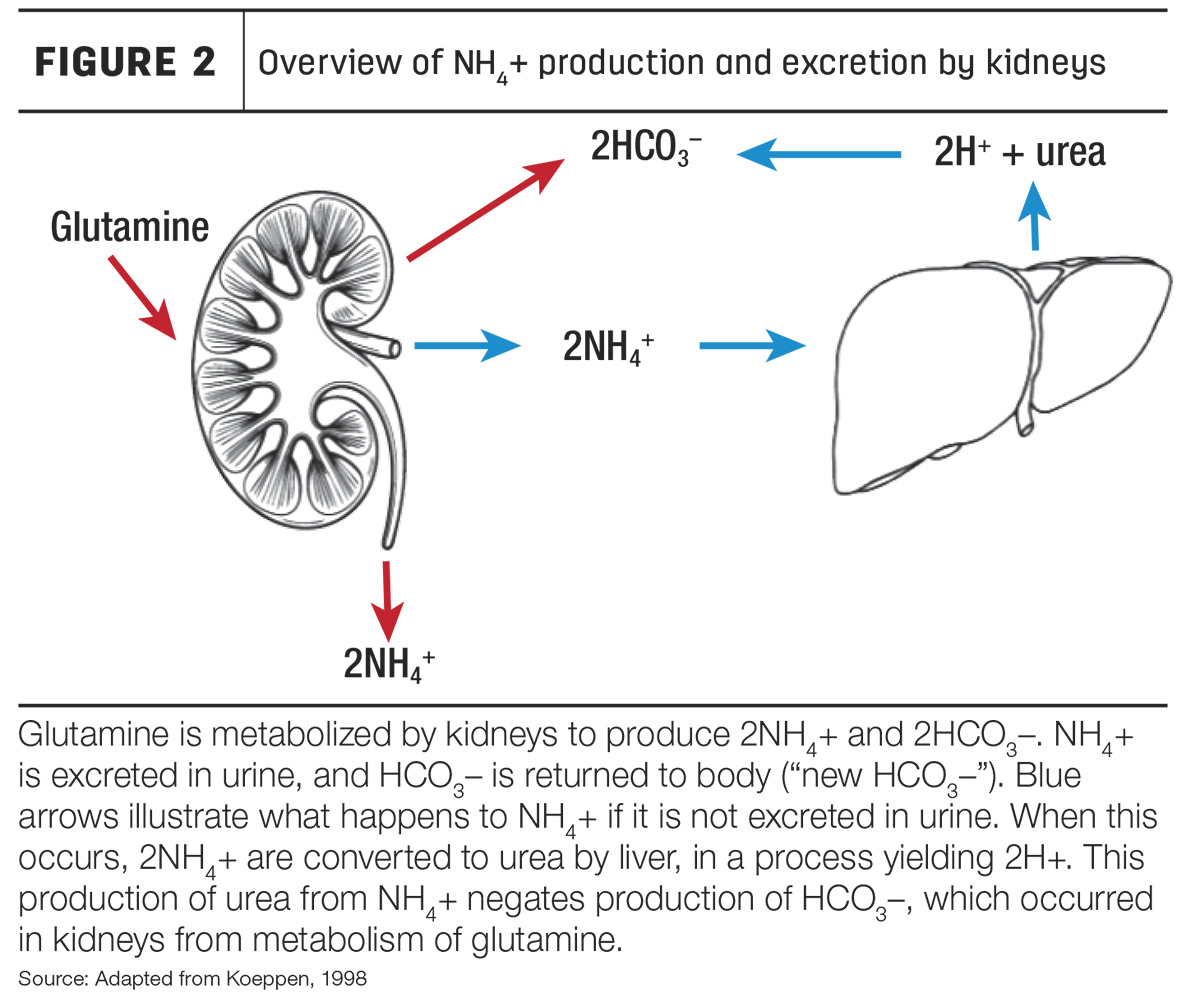
A secondary, but important benefit of having hydrogen ions removed via ammonium is that the generation of these hydrogen compounds from the metabolism of glutamine results in the production of bicarbonate, which can feed back into circulation for removal of hydrogen ions by the liver to form urea (Figure 2), thus helping to balance the extent of systemic acidosis.
Assessing acid-base balance
The amount of hydrogen ions in urine can be measured using pH paper or a pH meter. This is a very fast, easy and accurate method of assessing NAE. However, limitations to the accuracy of the relationship of urine pH to NAE have been described by Constable and co-workers (2009). They suggest that the measurement of urine pH can be an accurate measure of NAE at urine pH values greater than 6.3 (R2=0.69). Below this urine pH value of 6.3, the additional measurement of urine ammonium concentration improves the accuracy of the relationship between urine pH and NAE (R2=0.82) and the range of urine pH which can be tested (pH 5.9 to 8.0). Additionally, the measurement of urine ammonium concentration can give us better insight into the true level of compensated metabolic acidosis.
Recently, a study conducted at Cornell University by Graef et al. (2025), and published in the Journal of Dairy Science, supported the safety of feeding fully acidogenic rations by measuring urinary ammonium concentration. Highlights from that study include:
- Pre- and postpartum DMI were similar for cows fed either a fully acidogenic (mean urine pH value of 5.57) or partially acidogenic (mean urine pH value of 6.75) ration.
- Postpartum DMI and energy-corrected milk were greatest for cows fed a high-calcium prepartum diet.
- Prepartum urinary calcium excretion was greater for cows fed the fully acidogenic ration.
- Urinary ammonium excretion for cows fed the fully acidogenic ration (3.5 mmol/L ) was well below a proposed threshold of over-acidification (20 mmol/L) set by Constable et al. (2019).
Blood pH as a measure of acid-base balance
Results from Amundson et al. (2020) demonstrated the safety of feeding fully acidogenic rations by measuring blood pH. They observed that cows fed fully acidogenic rations with low (0.45% DM), medium (1.13% DM) and high (2.02% DM) dietary calcium concentrations resulting in urine pH values of 5.42, 5.84 and 5.81, respectively, coincided with blood pH values of 7.41, 7.39 and 7.39, respectively. It has been suggested that values of blood pH must be below 7.30 before concerns of over-acidification occur.
Summary
Collectively, studies investigating the effects of fully acidogenic rations fed to prepartum dairy cattle on systemic acid-base balance through measures of blood and urine pH, blood concentrations of bicarbonate and urine concentrations of ammonium demonstrate that fully acidogenic rations (urine pH target of 5.5 to 6.0) are not only safe but are effective in altering calcium metabolism of the peripartum dairy cow, leading to positive changes in animal health and productivity.
References omitted but are available upon request by sending an email to the editor.