Nearly half of the corn acreage in New York state is harvested as corn silage. The correct crop moisture content is critical for nutritional value and proper ensiling. Visual estimation of plant moisture is problematic, based on visual assessment of stover, or on kernel milkline. Moisture content of stover changes very little until after the optimum harvest time for corn silage. Ear moisture is the primary driver of whole plant moisture content. The old rule of one-half milkline has been mostly replaced by two-thirds to three-quarters milkline, but milkline is still not necessarily well related to whole plant moisture.


Our overall goal is to be able to accurately predict whole plant moisture in the field. All current methods of estimating corn moisture involve chopping plants:
- A chopper with a near infrared reflectance (NIR) instrument installed can chop a donut in a field and get an accurate estimate of moisture content. This may not be practical if a farm has many corn fields separated by a distance.
- Plants can be chopped with a chipper/shredder and then dried with a Koster Tester or similar equipment.
- Plants can be chopped and scanned with a handheld NIR instrument to estimate moisture.
- Plants can be chopped and moisture content can be estimated with a moisture meter.
A few plants can represent actual field moisture, but chopping a few plants is only accurate if the chopped sample is very thoroughly mixed.
Stover retains moisture much longer than the grain, such that the relationship between stover moisture and whole plant moisture is not strong. On the other hand, ear moisture is highly correlated with whole plant moisture, based on several years of data. We plan on estimating whole plant moisture based on NIR scans of the ear, using a handheld device. Our current objective is to evaluate the relationship between ear and whole plant moisture over a larger geographical range in N.Y.
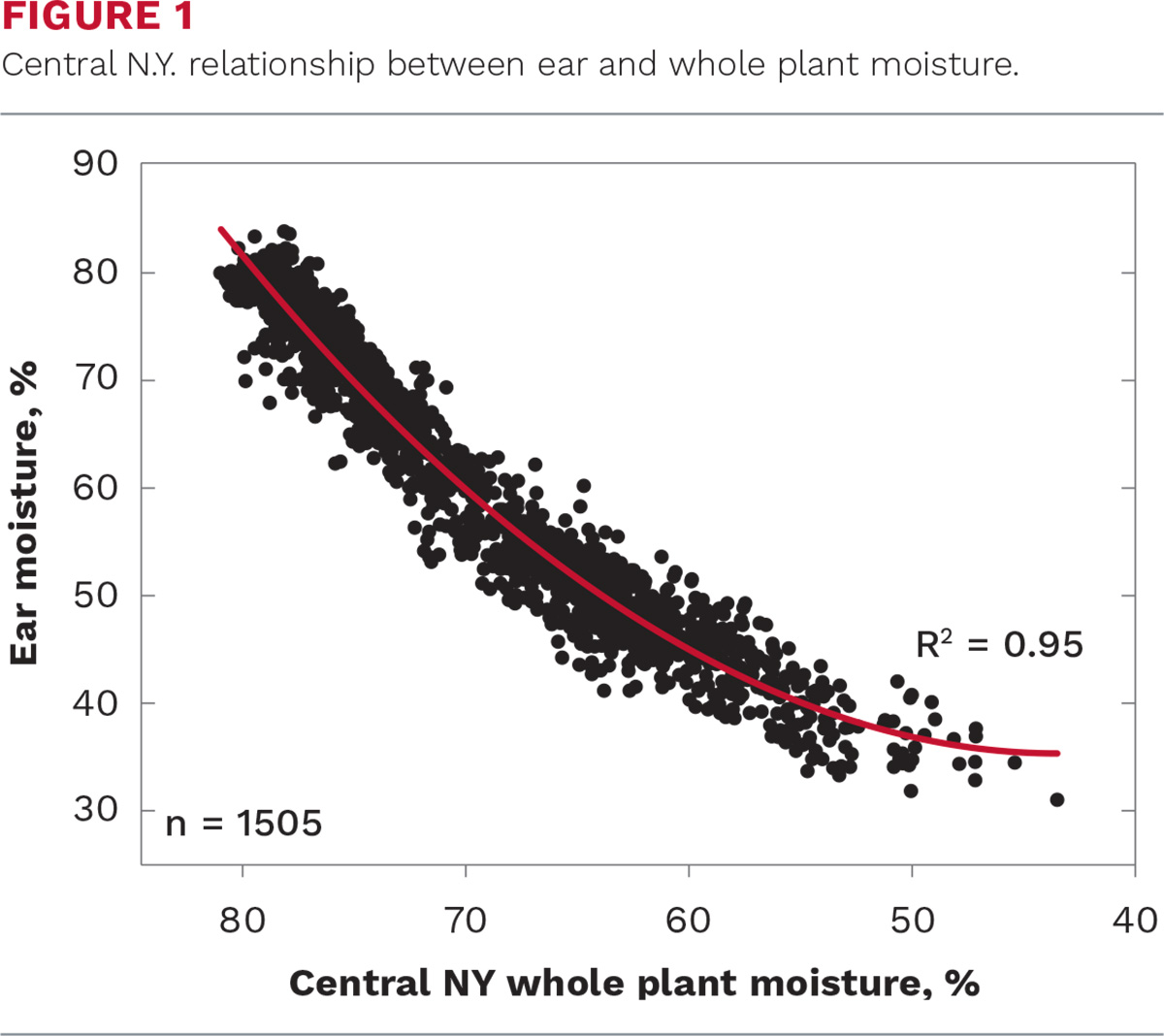
Due to a wet spring, corn was planted over a two-month window in 2025. Whole plant corn samples were collected in the fall of 2025 from mid-August to early October, prior to a hard freeze, in central N.Y. (Tompkins, Cayuga and Cortland counties, 1,505 plants), as well as the western part of the north country (Lewis County, 268 plants), and the eastern part of the north country (Clinton and Essex counties, 108 plants). Over 30 different corn hybrids were sampled. In 2025, a number of corn hybrids produced two fully developed ears. Plants were also collected separately for two-ear plants in central N.Y. (195 plants).
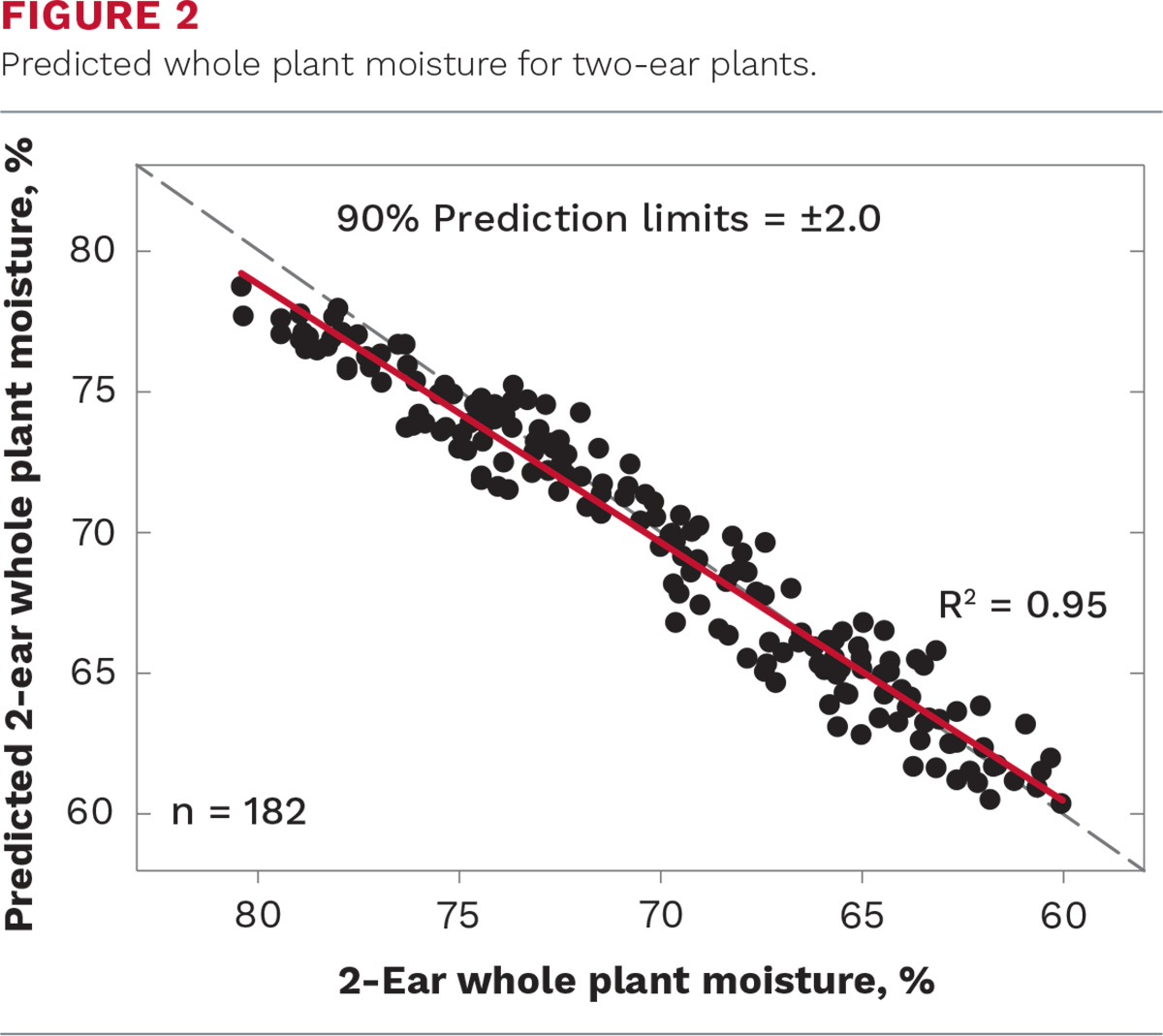
Ear and stover were separated, ears were dried whole, while stover was chopped and dried. Ear, stover and whole plant moisture were then calculated from wet and dry weights. Ear versus whole plant moisture for central N.Y. is in Figure 1. We used this relationship to predict whole plant moisture for the set of two-ear plants, as well as the plants from the two north country areas. Since the ear/whole plant moisture relationship deteriorates below 60 percent whole plant moisture, we only predicted moisture for plants with greater than 60 percent whole plant moisture in the figures. Below 60 percent moisture, corn should be harvested for silage asap.
Prediction of whole plant moisture for two-ear plants in central N.Y. was very good (Figure 2). It appears that two fully developed ears have little or no effect on the ear/whole plant moisture relationship.
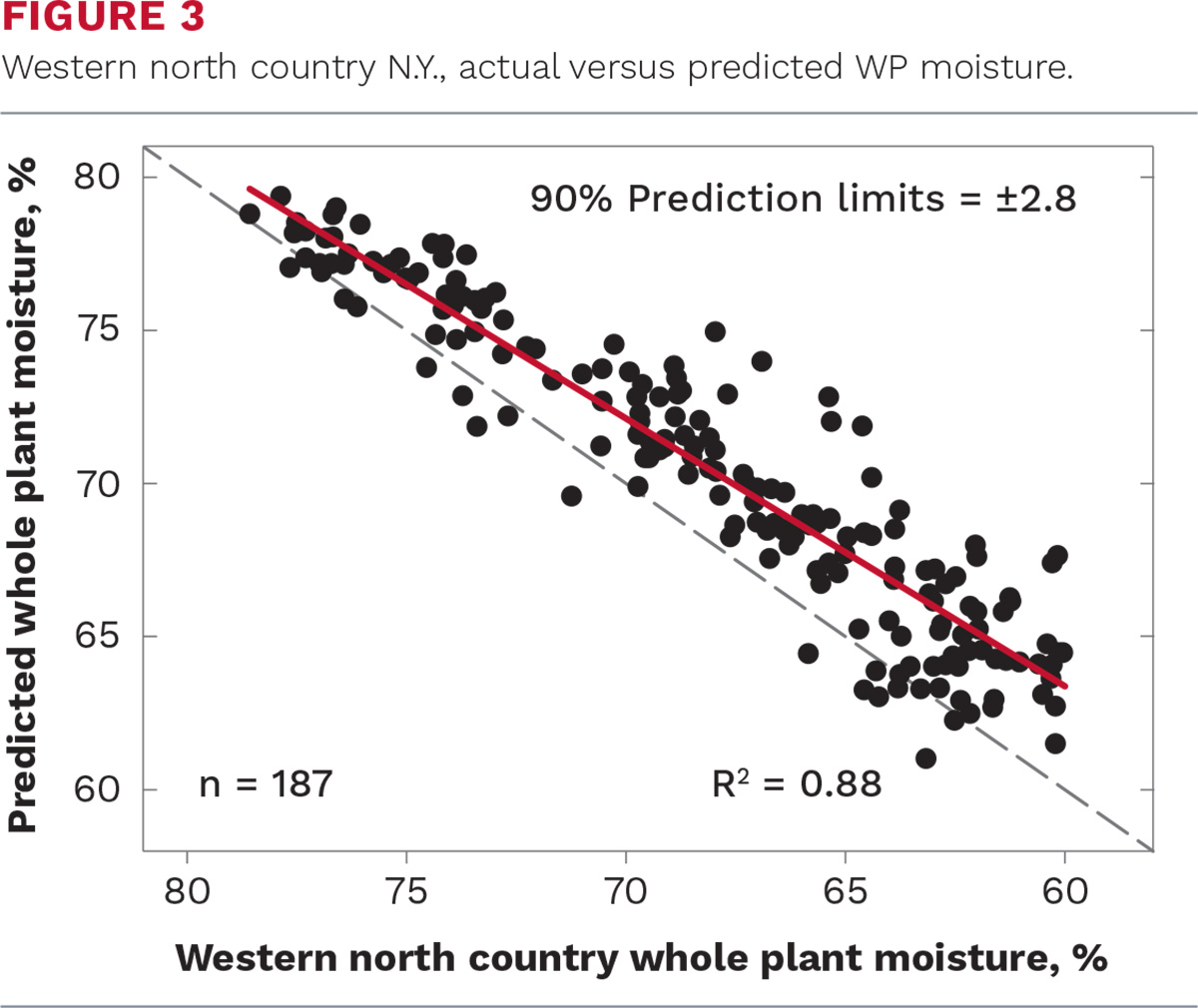
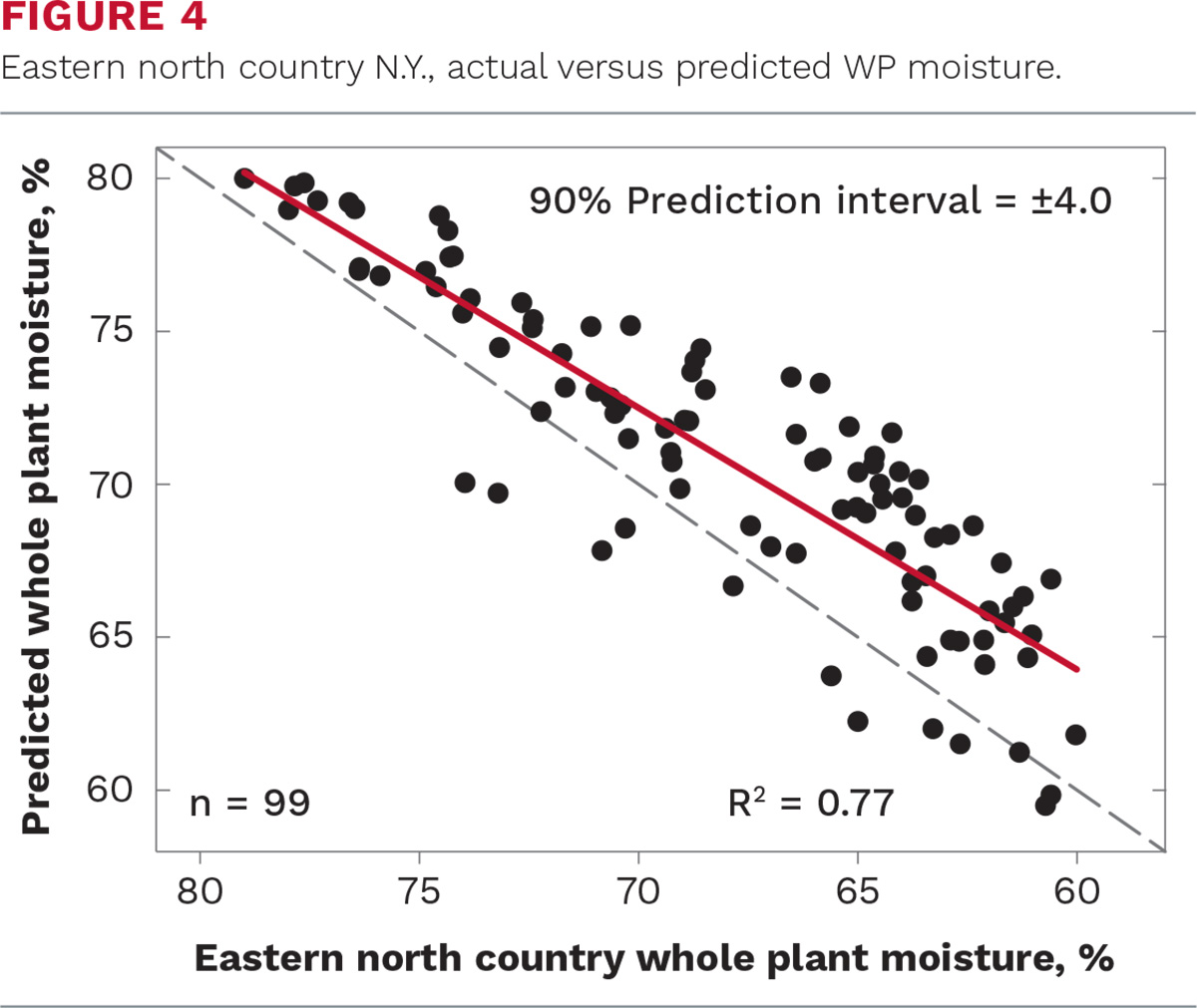
Prediction results were not as good for the two north country sites, which were consistent (Figures 3 and 4). Variability was greater and both sites had a bias, with predicted values higher than actual plant moisture. This bias increased as the plants dried down. This may be due to the different environment in northern N.Y. compared to central N.Y.
Ears of all plants were scanned with a TrinamiX PAL TWO handheld NIR instrument, and that data is still being processed. This gun-shaped instrument allows the scanner to slide along the ear, resulting in a significant area scanned and excellent repeatability. Handheld NIR units with a stationary scan typically cover less than one-quarter inch of surface area. We expect that ear scanning will produce very good estimates of ear moisture. We have yet to determine if ear scans will accurately predict whole plant moisture across a geographical range. Scanning ears from multiple plants in a field will improve the moisture prediction for the field.
 |
This article appeared in PRO-DAIRY's The Manager in March 2026. To learn more about Cornell CALS PRO-DAIRY, visit PRO-DAIRY. |