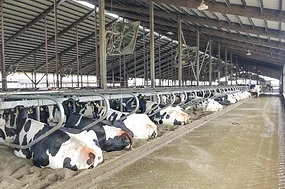
Maintaining an optimal environment in dairy facilities is central to both animal welfare and productivity. Traditional walk-throughs have value, but modern dairy operations depend on remote monitoring technologies to oversee conditions and detect risks.
Remote monitoring makes work more efficient by taking over routine environmental checks and giving staff more time to focus on higher-value tasks. It also helps workers react faster, as real-time alerts reduce response times and the risk of damage or disruption. Over time, remote monitoring systems highlight patterns in equipment wear and seasonal changes. Reviewing this historical data makes preventive maintenance easier, and these automated logs provide dependable records that simplify audits and inspections.
How remote monitoring works
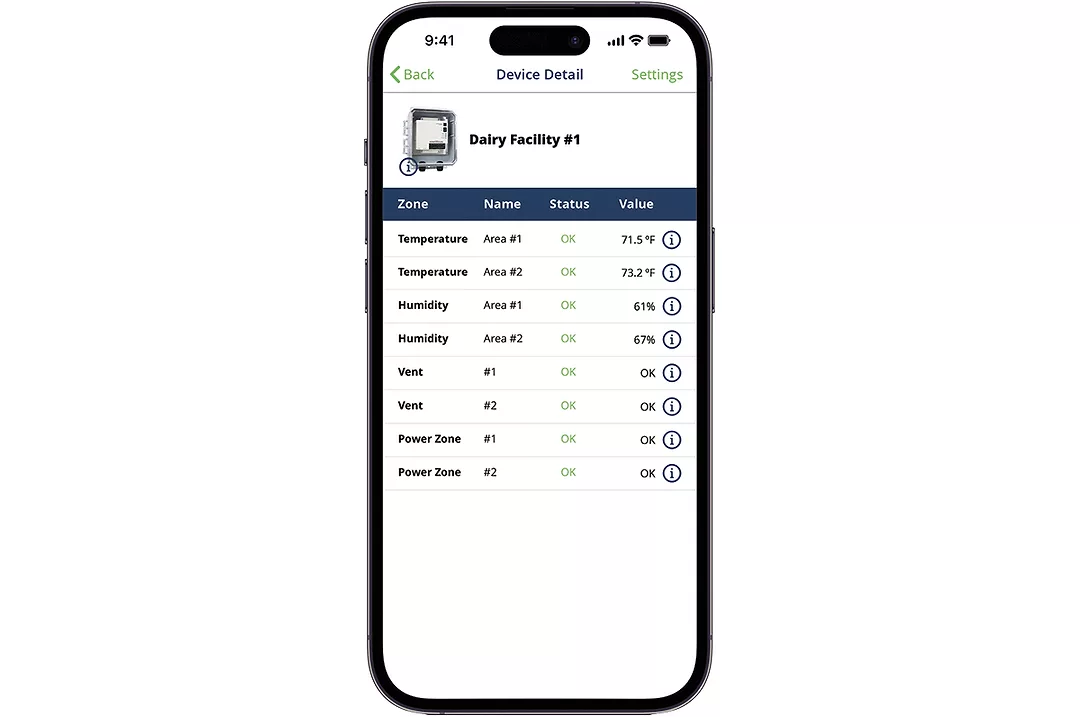
Remote monitors track environmental and equipment conditions in real time. When parameters deviate from safe ranges, the system sends alerts via text, email or voice message to designated workers, even when they are not physically present.
Choosing the right system depends on layout, size and operational needs. Facility operators must first consider the best communication infrastructure – landline, cellular or Wi-Fi. In remote areas, cellular systems are often more effective, especially when paired with signal boosters. Dairy facility managers also need to define the scope of monitoring by deciding how many and which types of environmental or mechanical variables to track.
Practical applications
In practice, remote monitoring enhances dairy management in several ways. Temperature and humidity control become more precise, as zone-specific readings and wide monitoring ranges allow managers to fine-tune conditions throughout the year. Ventilation and equipment oversight also improve, since continuous monitoring of fans, heaters and feeders maintains humidity balance and reduces odors.
Power reliability is another critical application. Monitoring solutions detect blackouts, brownouts or voltage irregularities in real time, and many systems include battery backups that continue to transmit alerts during outages. Security is strengthened as well. Integrated monitoring tracks entry points, flags unusual access and preserves event logs.
Sensors
Each monitored condition typically requires its own sensor input. Smaller operations may find a non-expandable, lower-cost system sufficient, while larger facilities with more monitoring points may need an expandable system for growth.
Sensor configuration is equally important. Hardwired sensors connect directly to the base unit but may require extensive cabling. Many sensors include several feet of wire and can be installed 1,000 to 2,500 feet away from the base unit, depending on the type of sensor. Running wires through walls or ceilings might require the help of an electrician.
Wireless sensors, which use built-in radio transmitters to communicate with the base unit, offer placement flexibility and are ideal when hardwiring is not feasible. Some systems combine both options for customized configurations.
Scalable systems are preferable for operations anticipating growth, as they can accommodate additional sensors and expanded coverage.
Here is a list of important sensors for dairy facility monitoring.
- Combination temperature, humidity and CO2 sensors that use a precision thermistor to monitor temperature; a thermoset polymer-based capacitive sensor to measure humidity levels and a highly accurate infrared sensor to monitor CO2 levels.
- Carbon monoxide sensors that can monitor CO levels from 0 to 300 parts per million (ppm) to provide reliable protection against carbon monoxide hazards. Look for ones that have an LCD screen that displays ppm and menu parameters.
- Smoke detectors that allow connections to multiple devices. Make sure they include a loud alarm horn around 90 dBA.
- Pressure sensors to track and identify decreases in boiler pressure within hot water systems.
- Vibration sensors that can be mounted on machinery like fans to provide ongoing measurement of vibration velocity. Fluctuations in vibration serve as a preliminary warning sign of potential malfunctions.
- Float level switches to monitor for rise or fall of fluids in water tanks and troughs.
- Flow sensors that measure flow rates in internal water pipes.
- Power failure sensors to track outages and voltage irregularities and to monitor for prompt backup system engagement.
- Magnetic reed door and window switches to protect animals, feed and equipment from unauthorized entry.
Data logging feature
A data logger is an electronic device within the monitoring system that records sensor data at set time intervals. Using a data logger to automatically record information helps to identify trends in equipment performance and environmental conditions. This data can provide insight into potential issues that operators can address before they become bigger problems. If it is important to see the data in real time, rather than just a few times a day or on a delay, then make sure to ask about that feature before selecting a remote monitoring system.
Conclusion
Remote monitoring systems help dairy operators keep conditions steady and act on problems before they put cow health or facility performance at risk. These systems protect animal welfare by automating oversight. They also boost productivity by allowing staff to respond quickly when something changes. Beyond that, they safeguard investments by guiding better decisions through reliable data. Together, these benefits create stronger, more resilient dairies where cows stay healthy, and the business continues to perform well.