Forages, like any green plant, require 17 essential nutrients for growth and development. Each of these nutrients has a unique function within the plant. Potassium (K) is most often applied as potash (K2O) and is required in greater amounts than any other nutrient apart from nitrogen (N), but it is often overlooked in pastures. Within the plant, K helps reduce environmental stress, improve structural integrity and enhance winter hardiness. It serves as an activator for more than 60 enzymes associated with growth, water regulation and photosynthesis.

How potash supports forage productivity
In forage crops, including legumes or grass species, K2O plays a critical role in plant growth and development. Potash is important for root development, promoting increased root growth and better winter hardiness. Another key function of K2O is regulating stomatal opening and closing, helping to manage water stress in times of drought. Adequate K also strengthens cell walls, helping plants better withstand disease pathogens. K also plays a role in moving carbohydrates within the plant, which is critical for recovery after hay cutting or grazing. Most producers recognize the importance of N to increase yield and quality of forages. However, without adequate K, N use efficiency is reduced.
Recognizing and preventing potassium deficiency
When K is limited, forage production will be reduced. Studies have shown a correlation between pasture decline and K deficiency. Deficiency symptoms will appear on the older leaves first. This is because K is highly mobile in the plant and will actively move to tissue with the highest demand, such as new growth. K deficiency often causes yield loss even when no visual symptoms are evident. Symptoms of deficiency include yellowing or browning of the leaf tip or margin, stunted growth, thin stands, winterkill and drought stress. High-yielding hay pastures can remove 50 to 60 pounds of K per ton of hay, and if the pasture is grazed, K can be easily lost or distributed unevenly where animals congregate.
Legumes are more sensitive to low K levels than grasses. Proper K fertilization directly increases the vigor of legumes. When K becomes limited in a mixed legume and grass pasture, the legume species often fades out of the mix. When fertilizer is applied, legumes can be reestablished.
Soil samples should be taken every three to four years to monitor K levels and avoid deficiencies. Soil samples provide an estimate of the nutrient levels in the soil, and when taken consistently, producers can often detect a problem and take corrective action before yield loss occurs.
Potassium fertility and management strategies
Although K is mobile within the plant, it is considered immobile in the soil. The main exception to this is in low cation-exchange capacity (CEC) soils or sandy soils, where K can leach out of the rooting zone, making it unavailable for the plant. As a result, K2O can generally be applied at any time of the year with minimal risk of loss. It is often recommended to make fertilizer applications in the fall, allowing the plant to absorb K before winter to improve cold tolerance. In high-yielding, frequently harvested or irrigated systems, split applications can be beneficial to prevent excessive buildup of salts.
There are several options to consider when selecting a K fertilizer source. Commercial K2O sources include potassium chloride or muriate of potash (MOP), which is the most common source. It is highly soluble and contains 60% to 63% K2O. Potassium sulfate or sulfate of potash (SOP) is 50% K2O and is an effective source when sulfur (S) is needed or when excess chloride is a concern. There are also organic sources of K2O such as animal manure, wood ash and plant-based compost.
It is always recommended to follow local recommendations based on a soil test to make fertilizer applications. Generally, there are two primary approaches to fertilizer management decisions: the build-and-maintain approach and the sufficiency-level approach.
In the build-and-maintain strategy, soils are fertilized to bring soil test levels up to a determined threshold, then they are monitored and maintained at this level. This is often referred to as “feeding the soil.”
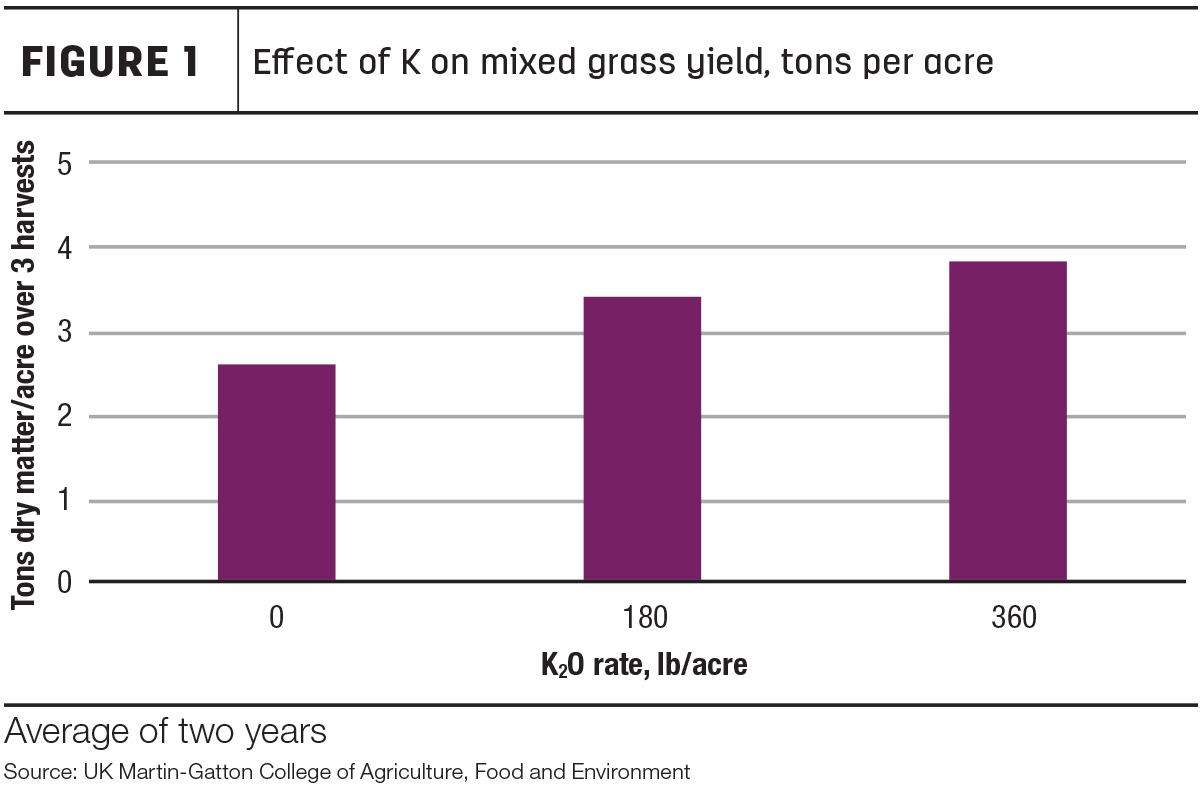
In the sufficiency level method, fertilizer decisions are based on crop removal. The theory behind this approach is that if you know how much of a given nutrient your crop needs to produce a given yield, then you replace that amount with fertilizer. This can be thought of as “feeding the plant.” Forages generally require 40 to 60 pounds of K2O for every ton of hay removed. Figure 1 illustrates the effects of increasing K rates on the yield of a mixed legume and grass forage over a two-year period.
Avoiding K deficiency is important. However, it is just as important not to overapply K. Excessive amounts of K can result in luxury consumption, where the plants take up more K than they need. This can lead to a reduction in magnesium (Mg) and sodium (Na) content, leading to a greater risk of grass tetany.
Putting potassium to work in forage systems
K is an essential nutrient for plant growth. It activates enzymes, increases root growth and helps reduce the effects of stress, resulting in healthier plants that can better resist disease. Optimal K fertility will result in better stands and increased efficiency of other nutrients, such as N. Deficiency can result in stand loss and reduced yield and quality. Always follow soil test recommendations when making fertilizer management decisions. Don’t let this important nutrient limit your forage production.
— Submitted by Nutrien