Cattle markets have rewarded producers over the last several years with historically strong prices. For many cow-calf and stocker operations, that has translated into significant equity built into today’s cattle inventories. But as prices rise, so does the amount of risk tied to every hundredweight.

When cattle are cheap, volatility hurts – but it’s manageable. When cattle are expensive, volatility can erase months or even years of equity in a matter of weeks.
That’s where Livestock Risk Protection (LRP) insurance fits into today’s conversation – not to outguess the market but as a way to protect the value producers have already earned while staying fully open to higher prices if the market continues to move up.
Markets can move faster than most expect
The cattle market has proven time and again that strong fundamentals do not make prices immune to sharp moves. A clear example came after the market close on Oct. 16, 2025, when President Donald Trump publicly emphasized his desire to lower beef prices and later outlined subsequent policy initiatives. These statements introduced uncertainty around government policy and quickly spooked the market.
In the weeks that followed, CME feeder cattle futures declined sharply before rebounding almost as quickly. The May feeder cattle contract dropped from roughly $375 per hundredweight (cwt) on Oct. 16 to a low near $297 per cwt by late November (Figure 1). On an 800-pound steer, that represents more than $600 per head in lost value – on paper – over a relatively short window of time.
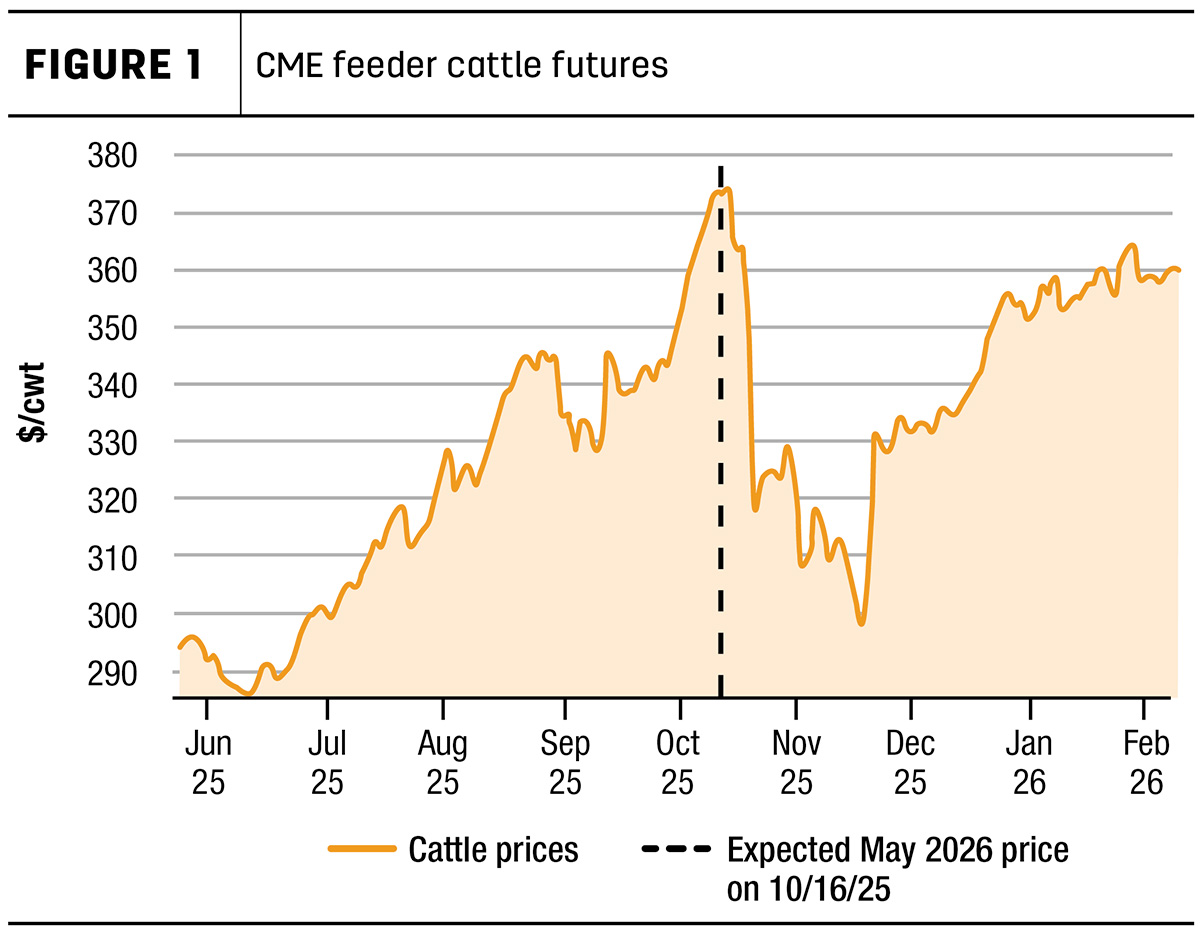
Most producers didn’t change anything operationally during that period. Cattle didn’t perform worse. Demand didn’t disappear overnight. But the market repriced risk rapidly, illustrating how quickly outside forces – particularly government policy – can move prices.
What LRP does – and what it doesn’t
At its core, LRP allows producers to establish a price floor on fed or feeder cattle using national market prices derived from CME futures. Feeder cattle settle to the CME feeder cattle index while fed cattle settle to the 5- Area Weekly Agricultural Marketing Service (AMS) report. If the market declines below the selected coverage price, an indemnity is triggered. If prices move higher, producers fully participate in that upside.
LRP strictly protects against price risk. It does not cover death loss, disease, performance or local basis differences. Think of it as protecting the value of cattle – not the cattle themselves.
Why LRP fits today’s market
In a high-price environment, the question isn’t whether producers are optimistic about future cattle prices – it’s how much downside risk they are comfortable carrying on increasingly valuable inventory. When each cwt is worth more, even modest market moves can have a tremendous impact on the bottom line.
LRP appeals to many producers because it sets a known price floor without capping upside, requires no margin calls or brokerage accounts, keeps cash flow predictable with premiums due after coverage ends and allows coverage on as few as one head or large groups of cattle.
A practical example: Oct. 16 in real time
Consider a hypothetical producer planning to market two groups of feeder cattle at 800 pounds in early 2026 who was watching markets on Oct. 16. Concerned about downside risk following the announcement, the producer purchased two LRP endorsements – one shorter term and one extending into the spring.
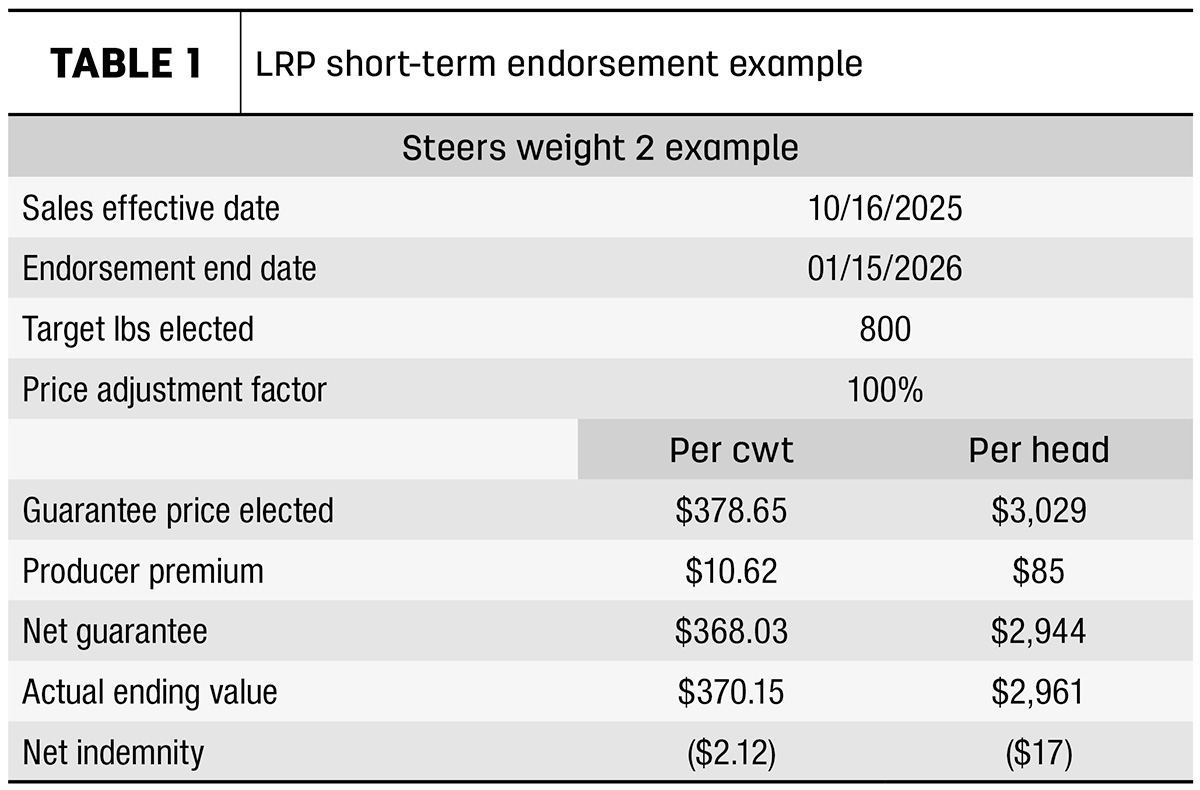
When prices later declined, the shorter-term coverage ended slightly below the guaranteed price, resulting in a modest out-of-pocket premium cost (Table 1). Had prices remained near the $297-per-cwt low into January, the insurance would have paid approximately $568 per head on a net basis. Fortunately, the market largely recovered, allowing the producer to market cattle at a strong price while still having downside protection in place.
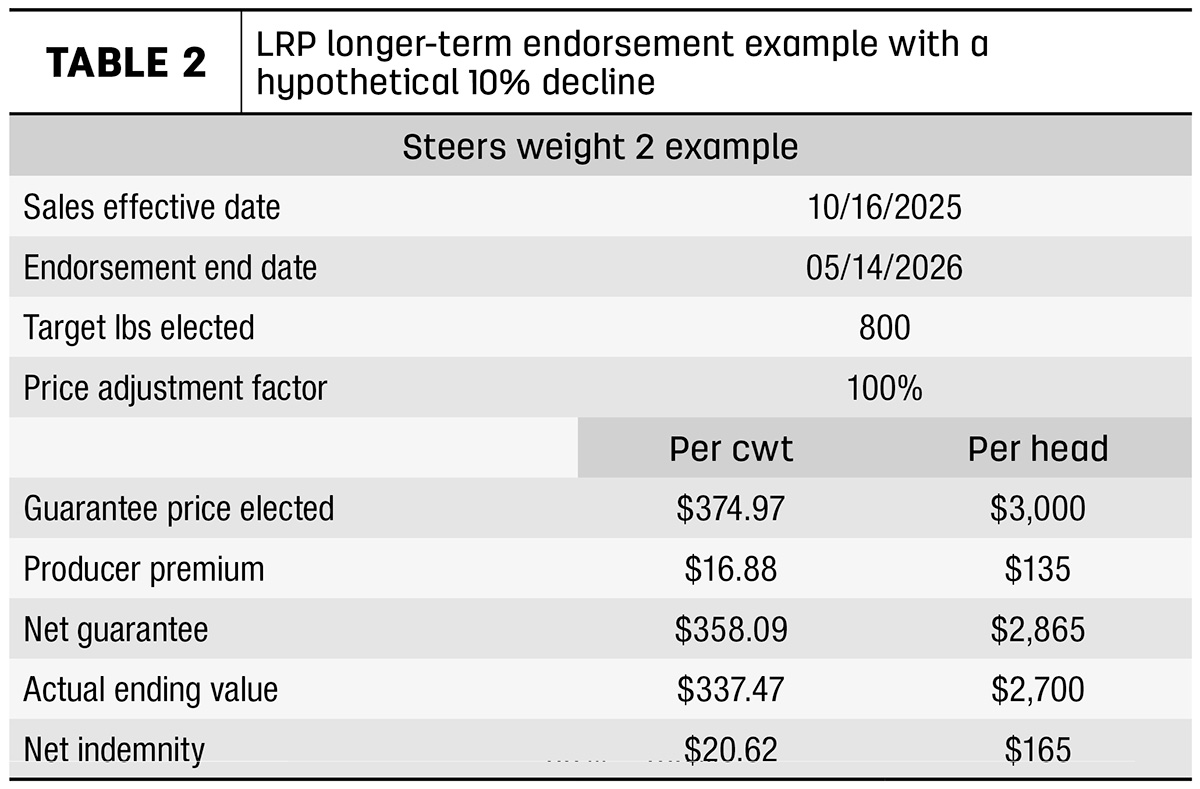
The longer-dated endorsement remains in place. The example provided shows a hypothetical 10% drop in the ending value (Table 2). While the final outcome is still unknown, both endorsements allowed the producer to avoid potentially costly reactive decisions during a period of extreme volatility.
Cost and subsidy: Putting premiums in context
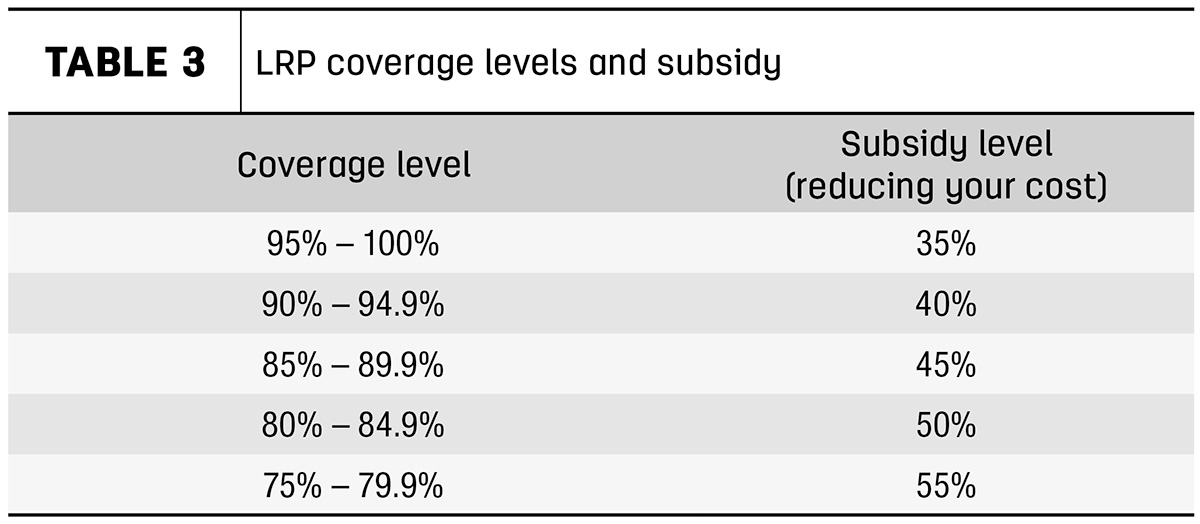
LRP premiums typically range from roughly 2.5% to 5% of the insured value, depending on coverage level and endorsement length. Shorter-term coverage generally costs less than longer-dated protection.
Because LRP is part of the federal crop insurance program, premiums are subsidized, and costs are the same regardless of which insurance agency a producer works with (Table 3).
Producers sometimes focus on premium cost in isolation. A more useful comparison is the cost of insurance versus the cost of a rapid market correction. Losing 15% to 20% of cattle value in a high-price environment can be far more expensive than the premium required to protect against that risk.
Advantages producers value most
Producers using LRP often point to several advantages: knowing the guarantee and cost the day coverage is placed, avoiding margin calls and brokerage fees, flexibility to insure only a portion of production and peace of mind that supports better operational decisions.
Perhaps most importantly, LRP allows producers to sleep well at night knowing downside risk is managed – while still being positioned to benefit if prices continue higher.
Adoption reflects changing risk profiles
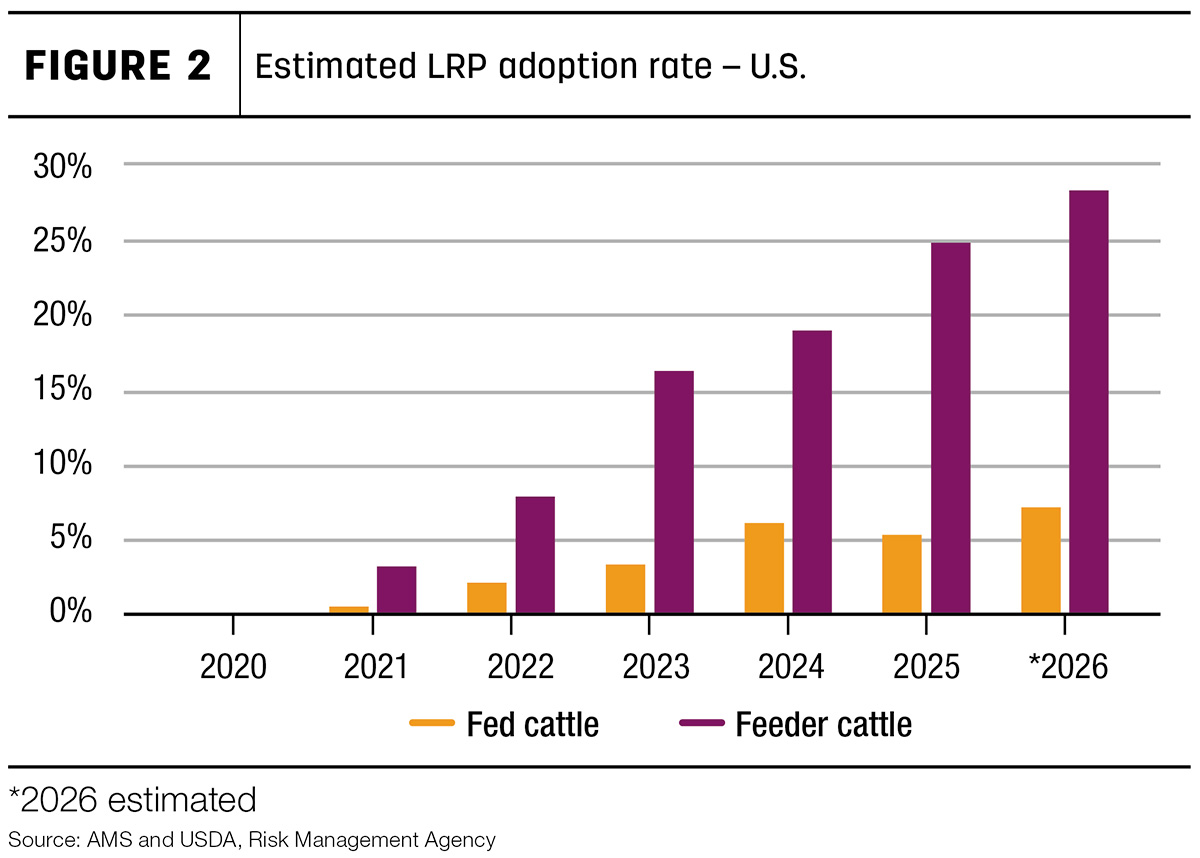
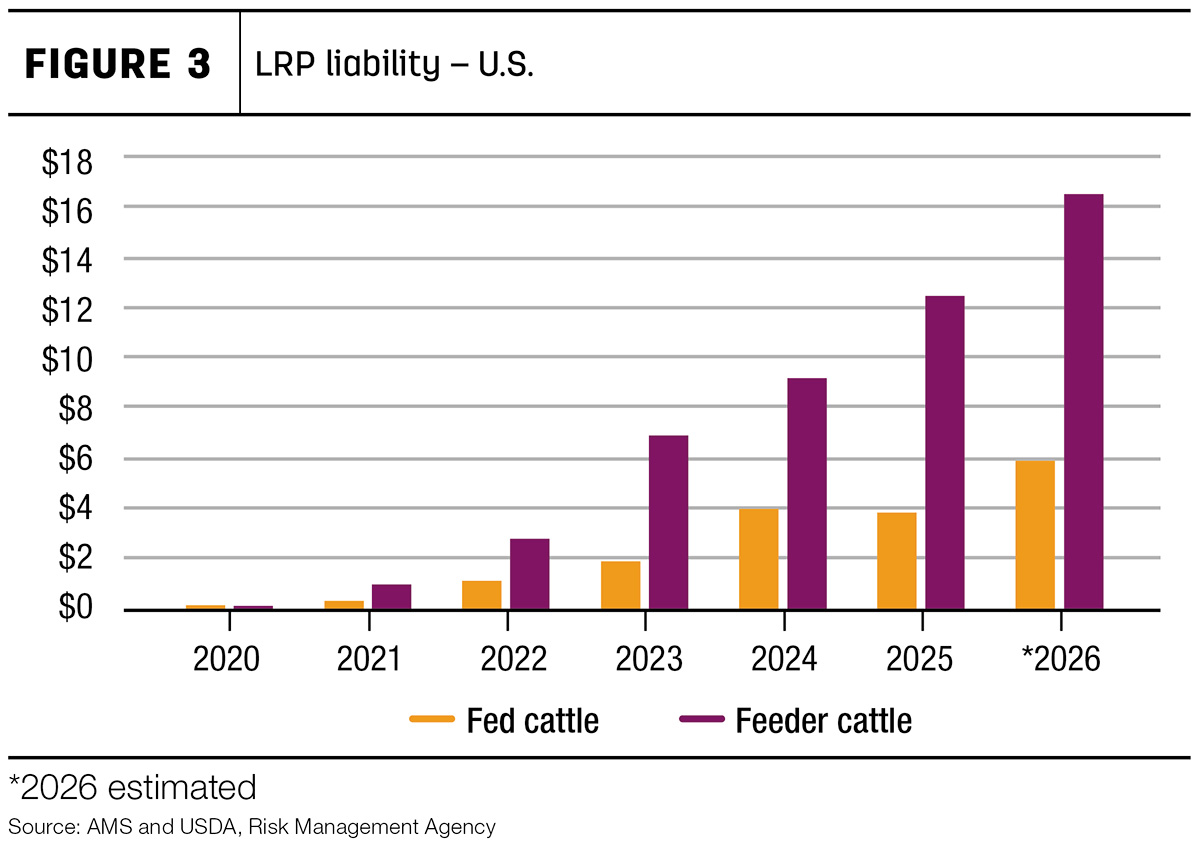
LRP adoption has increased significantly over the past five years. Higher cattle prices, expanded head limits, improved subsidies and added coverage options have all contributed to broader use across cow-calf, stocker and feeding operations (Figures 2 and 3).
As cattle values rise, protecting that value becomes a more common – and more necessary – part of doing business.
Final thoughts
LRP is not about predicting the next market move. It is about recognizing that in today’s cattle market, risk can show up quickly and without warning – often from forces outside a producer’s control.
For producers sitting on high-value cattle, LRP offers a way to protect what has already been earned, manage risk proactively and stay fully engaged in the market’s upside. That balance – protection without limitation – is why LRP continues to be an important tool in modern cattle operations.