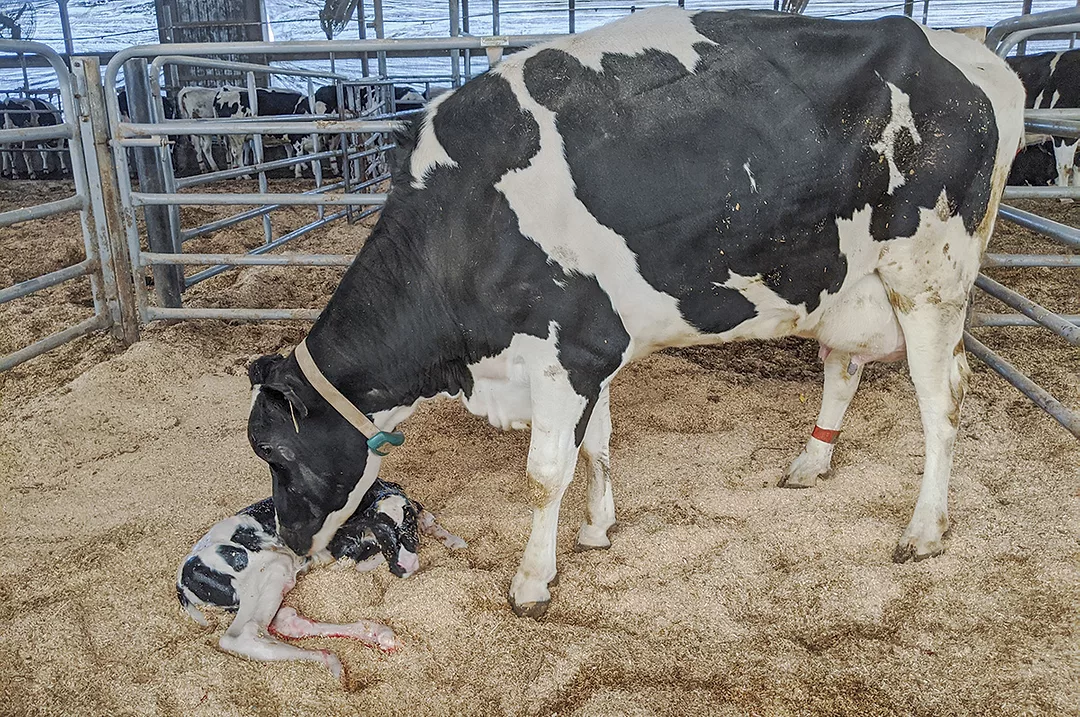
Calving marks the beginning of a new lactation and is accompanied by an increased risk of transition cow diseases, as well as the need to reestablish pregnancy. Traditionally, strong emphasis has been placed on the transition period – the three weeks before and after parturition – because this time is critical for determining the success of the upcoming lactation. However, growing evidence suggests that events occurring during the previous lactation may also influence reproductive success in the subsequent lactation.


Dairy cows commonly lose bodyweight following calving because milk production increases rapidly, whereas dry matter intake (DMI) rises more gradually and cannot immediately meet the cow’s nutritional demands. This imbalance results in a period of negative energy and protein balance. To compensate, cows mobilize body fat and muscle tissue to support milk production. As fat is mobilized, nonesterified fatty acids (NEFA) increase in the bloodstream and serve as an energy source for tissues. When NEFA supply exceeds the liver’s ability to fully oxidize these fatty acids, ketone bodies (e.g., beta-hydroxybutyrate – BHB) are produced and accumulate in the blood. Consequently, circulating concentrations of NEFA and BHB are commonly used as indicators of the severity of negative energy balance in early-lactation cows. Excessive levels of ketone bodies result in ketosis, which is typically classified based on blood BHB concentrations as subclinical (greater than or equal to 1.2 or 1.4 millimoles per liter) or clinical (greater than or equal to 3 millimoles per liter). In severe cases, affected cows may exhibit reduced appetite, firm manure and neurologic signs, such as abnormal licking behavior (e.g., licking of pipes or other objects).
Although elevated blood BHB concentrations are commonly interpreted as indicators of excessive lipid mobilization, recent evidence suggests that high-producing cows may naturally exhibit higher BHB concentrations that are not detrimental to health or performance but rather reflect the high metabolic demands associated with elevated milk production. Timing of ketosis diagnosis seems to play an important role here. Research in 2020 showed that cows first diagnosed with hyperketonemia during week one of lactation are not adapting well to the initiation of lactation, whereas hyperketonemia during the second or subsequent weeks of lactation may indicate high milk production. The issue also seems to rely on cows that have concurrent increased ketone bodies and decreased blood glucose, as demonstrated in a study in 2022.
This concept is further supported by recent research examining reproductive performance in early-lactation cows. In a 2014 study using body condition score (BCS) as a proxy for body tissue mobilization, fresh cows were categorized based on changes in BCS between 21 days before calving and 21 days after calving as losing, maintaining or gaining body condition. As expected, cows that had a decreased BCS had the highest NEFA and BHB concentrations at day seven postpartum. Interestingly, milk production did not differ among groups. However, BCS change had clear effects on reproductive performance. By 50 days in milk, all cows that gained BCS were cycling, whereas only 81% of cows that lost condition had resumed cyclicity. Cows were bred between 62 and 68 days in milk using a synchronization program, and cows that gained BCS had significantly higher conception rates than cows that maintained or lost weight (53%, 27% and 16%, respectively).
The study also emphasized the importance of managing BCS throughout lactation because of its potential effects on the subsequent lactation. For example, cows that lost the most body condition postpartum had the highest BCS three weeks before calving, suggesting that excessive body reserves may predispose cows to greater body condition loss after calving. Evidence also indicated that BCS loss had already begun before calving in these cows. In contrast, cows that gained body condition postpartum had already started gaining BCS during the dry period. Not surprisingly, cows that lost body condition had a higher incidence of metabolic diseases.
The impact of metabolic disorders extends well beyond the initial disease, including subsequent negative effects on fertility. One study showed that more than 60% of cows that lost BCS early in lactation had at least one adverse health event. To evaluate the effect of BCS loss on reproduction, researchers in 2017 superovulated a group of cows and concluded that the proportion of degenerating embryos increased substantially as body condition loss increased, despite no differences in the number of ovulations, the total number of embryos or the percentage of fertilized embryos between BCS gain or loss groups.
The term high-fertility cycle describes the complex interactions between body condition, weight loss, transition cow diseases and how they impact reproduction. The length of lactation directly influences a cow’s BCS. Cows that fail to conceive promptly tend to gain more weight over the course of the lactation, which predisposes them to greater body condition loss in the subsequent lactation. Ultimately, this increases the risk of reproductive failure. Cows that conceive before 130 days in milk are 75% more likely to maintain or gain BCS following calving compared with cows that experience extended lactations. These cows also have a greater likelihood of becoming pregnant and a lower risk of pregnancy loss during the first 60 days following artificial insemination.
From an on-farm application perspective, some animals will inevitably fail to conceive promptly, even when managed under an excellent reproductive program. The months spent in late lactation provide an opportunity to control bodyweight gain. As milk production declines, nutritional demands also decrease. Developing appropriate grouping strategies and adapting diets for these groups can help to minimize excessive weight gain.
How can reproductive programs be optimized on farms where cows experience excessive BCS mobilization postpartum? Although the best management strategy is to prevent excessive BCS gain during mid- to late-lactation, the use of heat-detection technologies may help improve reproductive performance in herds facing these challenges. Researchers have used automated activity monitoring systems to evaluate heat activity early in lactation. These systems have shown that each transition disease a cow experiences increases the likelihood that she will not cycle in the first 60 days in milk. In addition, cows experiencing transition disorders tend to exhibit estrus for a shorter duration. The same study also evaluated reproductive success based on the number of heat events observed during the first 60 days in milk. Pregnancy per artificial insemination was 42.5% for cows with no recorded heat events but exceeded 55% for cows with two or more heat events. This finding is particularly important because cows showing two or more heat events had a median time to pregnancy nearly 30 days shorter than cows with no observed activity (92 versus 121 days).
References omitted but are available upon request by sending an email to the editor.
Practical application
- Tracking BCS at key points. Evaluating BCS at approximately 21 days before calving, at calving and 21 days after calving can help identify cows at risk. Nutritionists and veterinarians can assist with this process or provide training so it can be implemented routinely on the farm.
- Evaluate nutritional strategies in mid- to late-lactation for controlling body condition. Feeding a single total mixed ration (TMR) for the entire herd may not be ideal, particularly for cows with extended lactations that are prone to excessive weight gain.
- Implement effective reproductive programs. Maximizing pregnancies requires not only controlling the time to first insemination but also identifying open cows early and rebreeding them efficiently.
- Establish limits for breeding attempts or days in milk. Defining thresholds for when cows should be moved to a “do not breed” list can help improve herd reproductive management.
- Use activity monitoring systems when available. For farms with automated activity monitors, tracking the percent of cows expressing estrus within the first 40 or 60 days in milk can provide a valuable benchmark for evaluating reproductive performance over time.
- Monitor the percent of cows pregnant before 150 days in milk. Many successful herds achieve 75%-85% by this stage of lactation.