Few subjects on the farm create as much anxiety as farm succession. No matter the involvement of family members or the number of individuals involved, discussions on succeeding an operation to the next generation are avoided or delayed by many. It’s not for a lack of advisers willing to help ease some of the complexities; it’s the issues that make it a complex process steeped in emotions, family loyalties and a need for fairness.

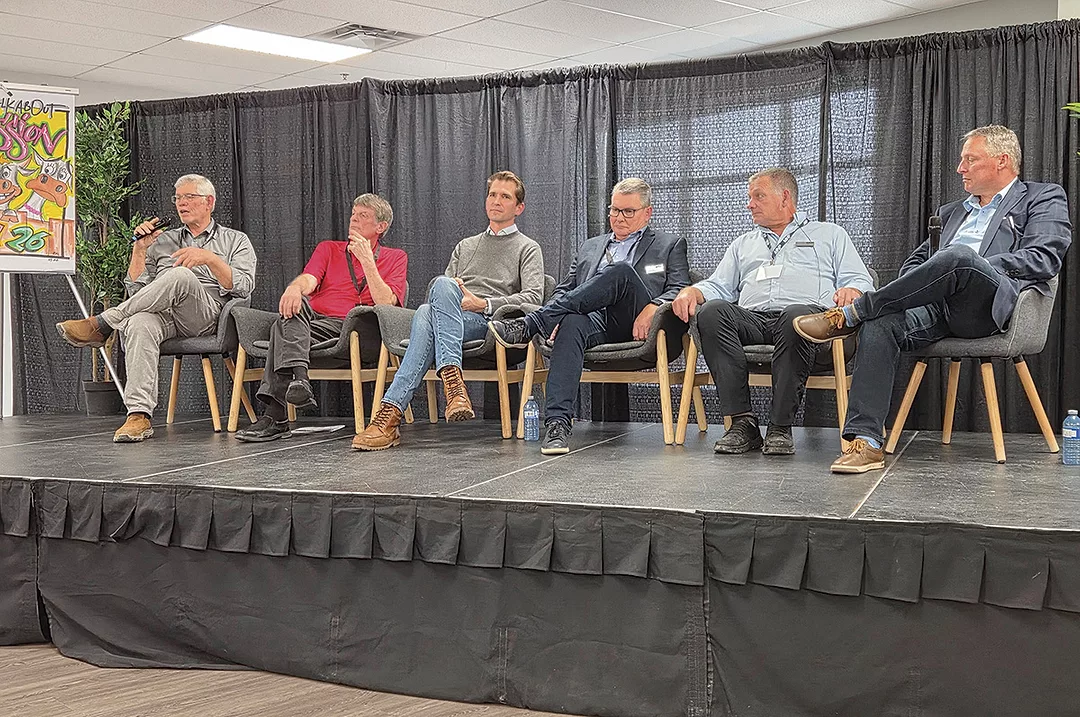
Knowing that producers enjoy learning from other producers, organizers of the 2026 Canadian Dairy Business Summit, held Tuesday, March 31 in Stratford, Ontario, invited two firsthand perspectives on the topic.
The event preceded the annual Canadian Dairy XPO, April 1-2, and included producers who have successfully navigated the farm succession process. Paul MacLeod of Darcroft Farms near Embro, Ontario, and Clarence Markus of Markvale Holsteins near Beachville, Ontario, detailed their respective roads to completing their plans.
Buying shares
MacLeod started the session talking about his years of farming, including four family operations starting near Niagara Falls to the family’s present-day location. From 1951 in Niagara Falls, the farm grew to 60 head from 1983 to 2016 near Woodstock and is now at 120 head with plans to purchase more quota and a new heifer barn and storage space to be built later this summer.
The biggest advantage in developing a farm succession plan for MacLeod is in changing the name to “business development,” simply because that’s how his family has operated through the years. Instead, they deal in shares, which has made all the difference.
“When you’re buying somebody’s farm, when you’re splitting up or you’re buying a car or a tractor, sometimes there’s an attachment to that,” he said. “When you’re buying shares, there’s not much emotional attachment.”
It’s been a hallmark for MacLeod, who together with his wife, Ellen, have raised three children; Jessica, Jared and Kyle. (Kyle now owns part of the farm.) They have managed to balance family and farm relations while creating and refining a model of relative simplicity in succession planning. Like most farm families, they’ve faced various challenges – and have overcome the accompanying anxieties – aided by their core values of honesty, courage and passion.
One drawback to their operation was a decision MacLeod and Ellen, a U.S. citizen, made in 1998 that their three children should also be Americans. Ellen became a Canadian citizen in 2001.
“We thought if the kids wanted to work in the U.S., it’d be easy for them to do so,” he added.
In 2020, they wanted to start transitioning shares to Kyle but couldn’t given Ellen’s U.S. citizenship along with all three children. With the tax implications, especially with the farm value in the U.S., they had to stop that process. After spending considerable money to correct the issue, Kyle and Ellen renounced their citizenship.
“Like I say, ours is a journey,” MacLeod said. “It’s always been business development and it’s the way we’ve looked at it.”
Family eases adversity
The year 1951 was also important to Clarence Markus, with his parents’ emigration from the Netherlands. Upon their arrival, they began working for a farm operation near Chatham, Ontario. In a curious twist, the owners of the farm went to Woodstock that same year to attend the International Plowing Match, leaving his parents to watch over their operation. It was that Plowing Match site that Markus’ parents purchased 16 years later.
In 1954, his parents bought Cambridge Farms, then sold it 13 years later. In 1972, they purchased another dairy operation with 228 acres. Twelve years later, Markus married Wendy and the two took over Markvale Holsteins while raising four children, with each involved in dairy operations of their own. Daryl and Sarah run Markridge Holsteins, Gary and Hilary have Markhill Holsteins, Mark and Willeke have succeeded Markvale Holsteins from Clarence, and Michelle and her husband, Mike, operate Four Daughters Dairy.
His parents imparted several important lessons to Markus and his older brother, John: For starters, cash flow is king. It may require more thought to make something work, but it was imperative they do it.
“From my mom, it was about life skills, the core values of God, trust and the power of forgiveness,” Markus said. “She would pull me aside when I had a spat with Dad – or the other way around – and say, ‘It’s up to you to fix it. You’re going to have to cross the bridge in order to fix the relationship, because we know Dad’s probably not going to do it.’ From that, we learned so much because we all have garbage in our lives, but what do we do after?”
It’s that kind of adversity which helped the family through some tough times, including the death of Markus’ mother in 1999. She held 39 kilograms of quota, which Markus and his brother John split evenly. In 2013, a fire at the home farm cost them all of their buildings and their cattle. Yet instead of despair, Markus laid out the goal of milking cows within roughly 11 months, which became a reality when a farmer from Milton, Ontario, offered to sell Markus his cows.
“On a handshake deal and on a vendor take-back, we were able to milk those cows and 11 months later, they were on the farm and that relationship has continued to this day,” Markus said.
Putting family first
Two terms exemplify the family’s operations – beyond their core values: transparency and unconditional support. Through the many dealings he’s had with his four children, including multiple land and quota purchases and building renovations, Markus and his wife always helped finance their children’s aspirations.
“Between us, there was a trust factor that always existed,” he added, referring to a pattern that his parents instilled. “We figured out at the end of each year who owed what, but we didn’t worry about the last dollar because the trust was there that working together, we were able to go forward in so many ways.”
That arrangement still exists today, including a custom business by another branch of the family, where seven cousins are now involved in the same process. They pay the bills twice a year, and hopefully there’s no concern if they’re out by a dollar.
In 2019, he and Wendy transitioned from a partnership to a corporation. That took two-and-a-half years with Mark and Willeke taking control of Markvale Holsteins in 2023. Sadly, in September 2025, Wendy passed away on the couple’s 41st anniversary.
“This is not my story – this is our story, together,” Markus said. “I’m standing here but overall it’s our story and she took care of the kids and she was the reinforcing side of our vision. If there’s no other message that I got through today, it’s this one line: Succession planning never starts too early.”