The link between farming and professional sports isn’t always thought to be a linear relationship. The exception may be in Canada, where many hockey players grew up on the family farm and used some of that upbringing to define their careers.

In 15 seasons with four teams in the National Hockey League (NHL), Darcy Tucker developed a reputation as a hard-nosed forward who played a little larger than his 5-foot, 10-inch frame. From 1996 to 2010, he played for the Montreal Canadiens, Tampa Bay Lightning, Toronto Maple Leafs and Colorado Avalanche. But in his heart, he is passionate about his time with the Leafs, where he now serves as an ambassador with the team.
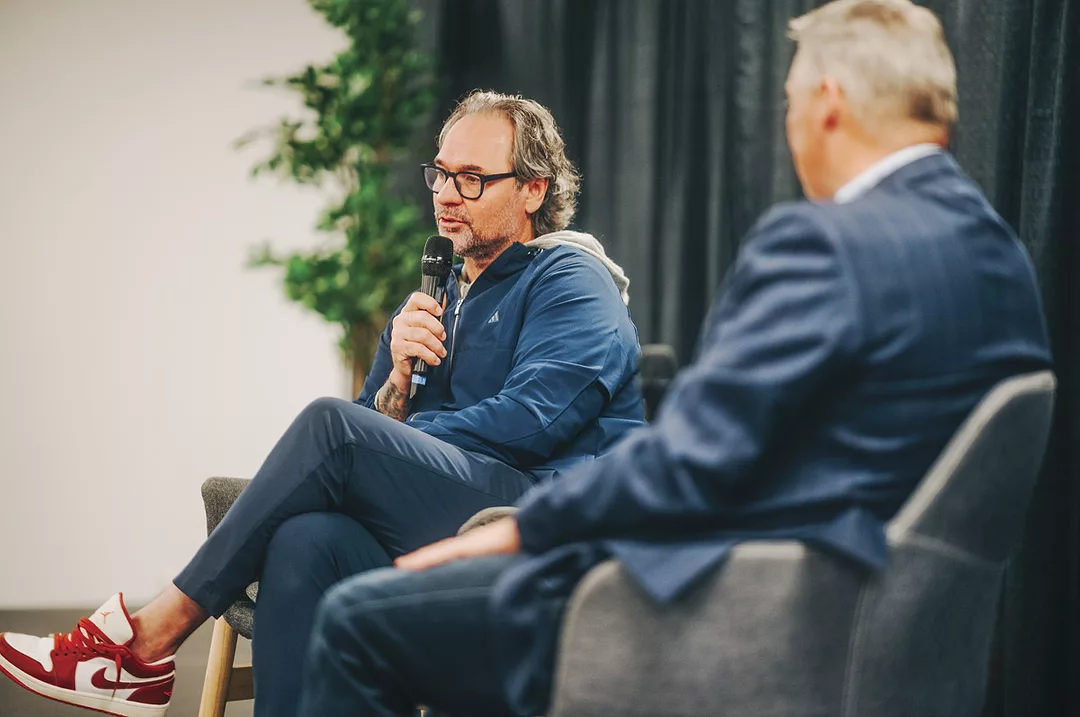
Tucker was part of the Canadian Dairy Business Summit, Tuesday, March 31, in Stratford, Ontario, an event preceding the annual Canadian Dairy XPO, April 1 and 2. He spoke of the many lessons learned while growing up on the family farm near the hamlet of Endiang, Alberta, northeast of Calgary, and how they became part of his career in the NHL.
His mother’s family was involved in dairy farming for 37 years, yet it was on his parents’ cattle-beef ranch where he grew up and developed his tenacity from the teachings of his father. Tucker cited his parents as the two hardest-working people he’d ever known. They took over some of the operation belonging to Tucker’s grandparents and expanded that 135-acre operation into 3,000. From an early age, he and his brother were expected to give their best efforts, including haying every July and August.
“It was the most important thing in our lives, and it’s important even today, for people to understand how hard farmers and people on a ranch work, each and every day, to put food on the table,” Tucker said. “There were a lot of ups and downs – we had times where we thought we might lose the farm. You strive through those and persevere. It’s an important part of my upbringing and what allowed me to become a professional athlete.”
Rough start
That perseverance didn’t come quickly or easily, and Tucker spoke of the time when he was 12 years old and had played a game without the same fire or intensity. He scored two goals and added a pair of assists, yet when his father called him out for being so lackluster in his play, Tucker made the mistake of disagreeing with the critique. His father abruptly pulled over and ordered his son out of the truck for talking back to him, adding that it wasn’t the way the boy had been raised. After walking 4-and-a-half miles home, his father asked him if he’d learned his lesson.
“I absolutely did!” he recalled with a grin. “I’ll never talk back to you and every time I set foot on the ice, it’ll be like I set foot on it for the last time.”
He carried that energy and determination with him to junior hockey and the Kamloops Blazers, of the Western Hockey League (WHL). After his first year, he considered quitting hockey, having scored only three goals. But another lesson from his dad convinced him to give it another chance. (The expectation that he’d return to the farm may have been an incentive.) His performance in his second year convinced the Montreal Canadiens to draft him in the sixth round. In his time with the Blazers, the team won three Memorial Cups as champions of the Canadian Hockey League (1992, 1994 and 1995). Tucker became one of only four players in the history of the league to have won three championships in junior hockey. He was also teammate to future NHL stars Jarome Iginla, Scott Neidermayer and Shane Doan.
In the WHL, lengthy bus trips are a blessing and a curse, given the scale of traveling across four Canadian provinces and into Oregon and Washington state. For Kamloops, the shortest ride during his playing days was six-and-a-half hours to Seattle, while the longest was 22 hours to Brandon, Manitoba. It was on those bus trips that Tucker and his teammates bonded and shared experiences from the farm.
“You learn a lot about them, a lot about their families, how they were raised, and a lot of them were kids from the farm, kids who had a similar upbringing,” he said. “You pick up your teammates when they’re down because some of their parents lost their farms when we were playing junior. The small (family) farm was becoming pinched out at that point, and if you weren’t able to survive, you lost your farm.”
Those conversations were not easy, but Tucker credited them for bringing everyone together as a team and helping create the juggernaut of the Memorial Cup champions. He added that Shane Doan was also raised on a farm in Saskatchewan, and during their time in Kamloops, they’d have teammates out to their respective family operations in September to show them part of their upbringing and share that resilience.
No regrets
Of his NHL days, Tucker said his time in Toronto was the best. The franchise’s culture as well as the camaraderie, the heart and the willingness to jump to the defence of a teammate made the experience more endearing and lasting. He compared that to his time in Montreal, which he disliked intensely, then Tampa Bay, where hockey in the 1990s was a poorly-attended novelty, to his last two years in Colorado. He’s now an ambassador for the Leafs and cherishes the time he spends with other alumni like Wendel Clark and Doug Gilmour, but also in mentoring some of the current younger players.
Leaving hockey was a difficult and necessary decision for Tucker, given the way he threw himself into the game and the resulting impacts on his body. But as much as he learned so many lessons from life on the farm, his succession plan didn’t include going back to the farm.
“As much as I enjoyed my way of life and my upbringing, my thought process on it was my brother was going to take (the farm) over,” Tucker related. “He was there from the moment I left and it should be his. I had no problem with helping out and doing some of the financial obstacles that we would entertain over the course of time, but I think Dad wanted me and my brother there together to run it.”
Even though he’s not actively involved with the farm, he credits his background with showing him how to excel in professional hockey – with tenacity and grit – much like a farmer.