The USDA National Agricultural Statistics Service (NASS) Agricultural Prices report, released April 30, established March’s Dairy Margin Coverage (DMC) program calculations. Both milk prices and feed costs rallied enough in March for the DMC program margin to climb out of the depths of indemnity payments. As milk prices firmed, reflective of continued demand particularly on the export front, and feed costs remained steady, the March DMC margin came to $9.57 per hundredweight (cwt) – just 7 cents above the highest coverage selection in Tier I.

A peek at March DMC
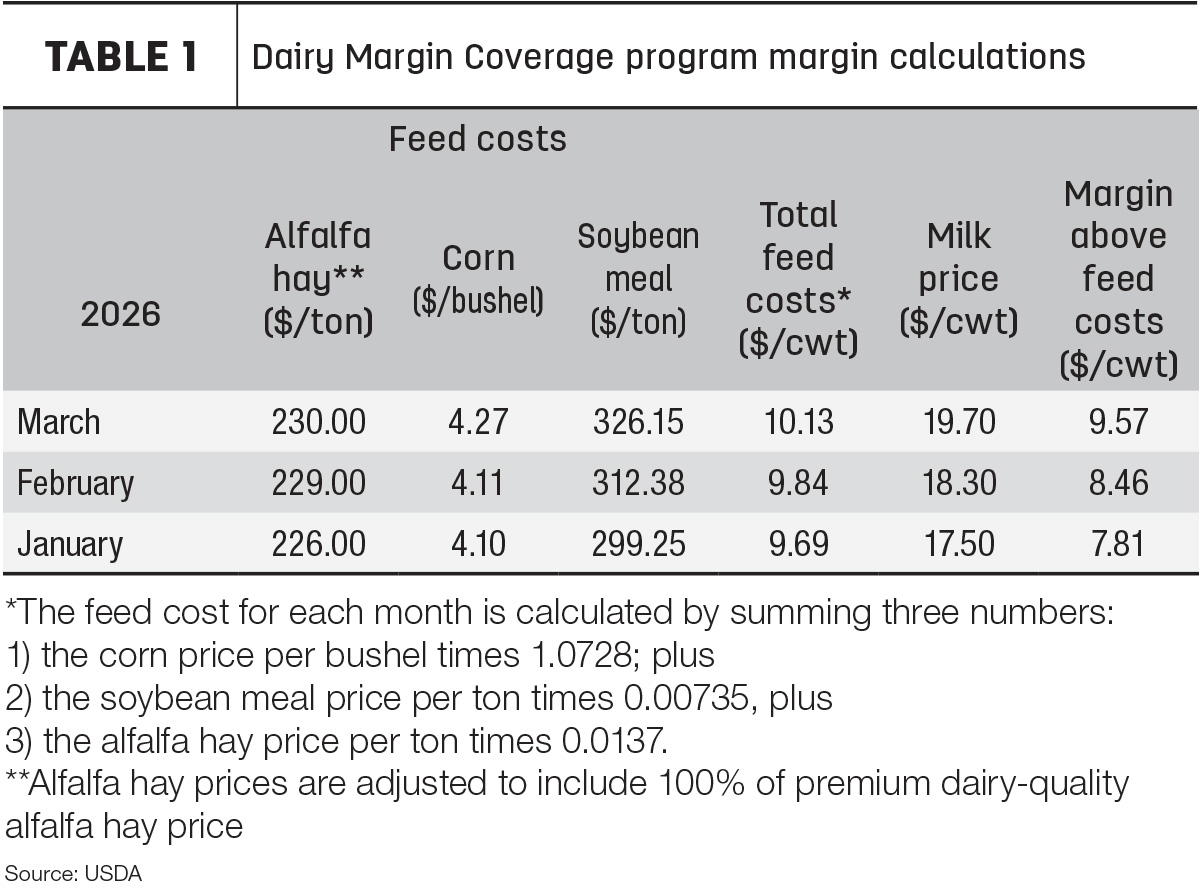
Strong prices for the major dairy feedstuffs were reflected in the March Agricultural Prices report (see Table 1).
DMC program margin factors for March compared to February were as follows:
- Dairy alfalfa hay: $230 per ton, up $1
- Corn: $4.27 per bushel, up 16 cents
- Soybean meal: $326.15 per ton, up $13.77
- Total feed costs: $10.13 per cwt, up 29 cents
- Milk price: $19.70 per cwt, up $1.40
- Margin above feed cost: $9.57 per cwt, up $1.11
Firm milk prices in all major dairy states
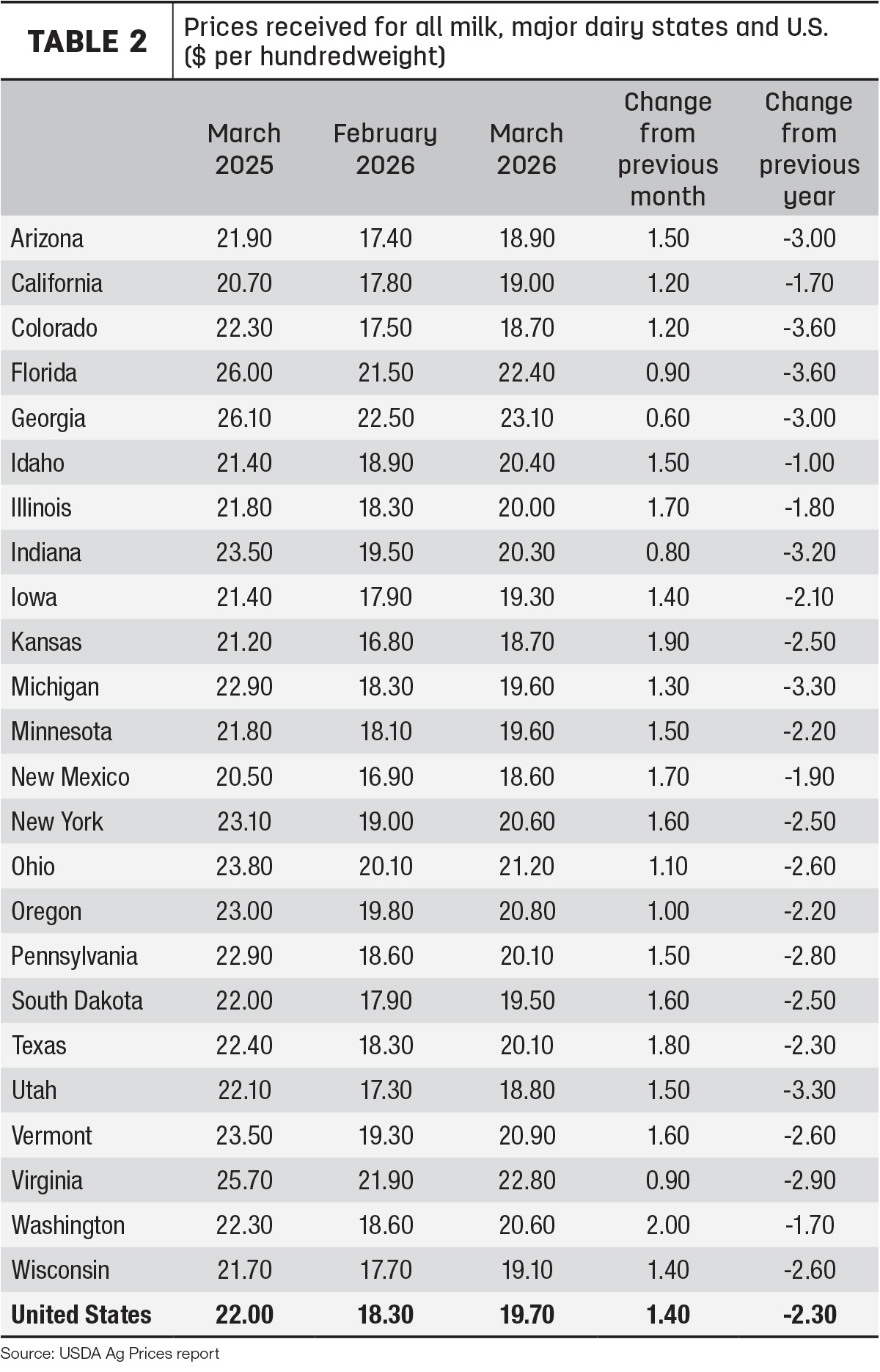
The milk market saw strength in March as the all-milk price in all 24 major dairy states improved month over month. On average, the all-milk price in March was $19.70 per cwt, up $1.40 per cwt from February (Table 2).
From February to March, the 24 major dairy states all improved on an all-milk price basis. The smallest price improvement was recorded in Georgia at 60 cents, up to $23.10 per cwt from February’s $22.50 per cwt. Three other states reported price improvements below $1 per cwt – Indiana at $20.30 per cwt, up 80 cents; Florida at $22.40 per cwt, up 90 cents; and Virginia at $22.80 per cwt, up 90 cents also. The remaining states all saw an all-milk price improvement at $1 per cwt or greater. Washington posted the largest rise, up $2 per cwt to $20.60 per cwt in March from February’s $18.60 per cwt.
While the month-over-month comparison was good news for the industry, prices remained below those reported in 2025. The average all-milk price for all 24 major dairy states in March was $2.30 per cwt below the price reported the same month a year ago, which was $22 per cwt. Several states’ all-milk prices were more than $3 different from March 2025. The smallest price decline was reported in Idaho, where the all-milk price in March was $20.40 per cwt, down $1 per cwt from March a year ago.
Feed costs remain strong
Since October 2025, feed costs have continued to rise as the commodity markets remain relatively strong. As a result, March’s feed cost was 29 cents above those reported in February, leading to a total feed cost of $10.13 per cwt. Corn was the star of the equation, up 16 cents per bushel from February, yet 30 cents below March 2025.
The DMC feed cost for each month is calculated by summing three numbers: 1) the corn price per bushel times 1.0728; plus 2) the soybean meal price per ton times 0.00735; plus 3) the alfalfa hay price per ton times 0.0137.
A strong feed cost coupled with an equally strong milk price resulted in a DMC margin of $9.57 per cwt in March. This value was 7 cents above the Tier I $9.50 per cwt coverage level and will result in no indemnity payments, quite the change from a month ago when the margin was $1.11 per cwt less.
Looking ahead
With the announcement of March’s DMC margin, it becomes the largest margin to date in 2026. However, market forecasts are predicting the margin to continue rising as milk prices are expected to continue climbing and feed costs remain in the $10 range.
As of April 29, the predicted DMC margin for April is $10.36 per cwt, the result of a $20.69 per cwt milk price and $10.33 per cwt feed cost. If realized, April’s margin would not trigger any indemnity payments and set the tone for a healthy remainder of the year with the annual average DMC margin forecast at $10.53 per cwt. Remember though, markets change.
Enrollment up in 2026
As of April 1, participation in the DMC program was at 13,349 qualified farms, up from 12,989 farms in the 2025 program year, according to National Milk Producers Federation. The 13,000-plus farms represent 57% of U.S. dairy farms.