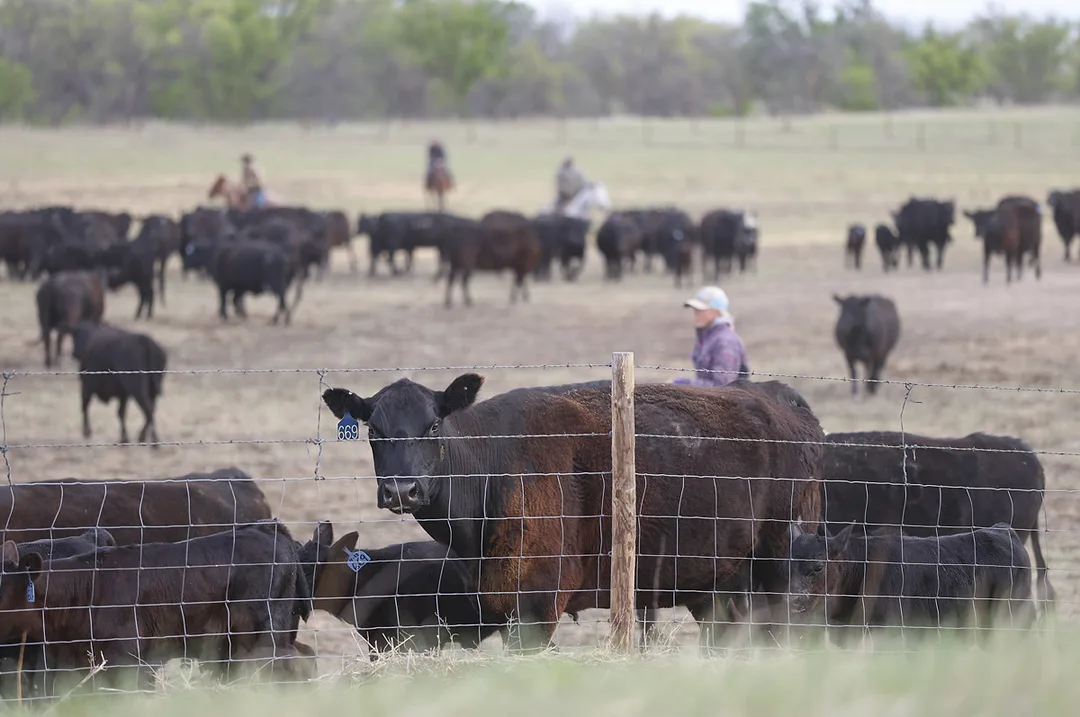
Across the Great Plains, farmers and ranchers are entering another summer under dry conditions balancing feed costs, stocking rates and long-term pasture health while hoping for rain that may or may not come in time. For many, drought planning is no longer an occasional challenge but rather a part of the business model.
For Sioux County, Nebraska, rancher Shon Whetham, those lessons were shaped by the droughts of 2006 and 2012, years he says permanently changed the way he manages cattle.
“The whole reason that we do what we do is strictly because of 2006 and 2012,” Whetham says. “It’s a horrible thing to sell cows because of a drought and then have to buy them back.”
Today, Whetham structures his operation with drought flexibility in mind. His ranch runs as a cow-calf and stocker operation, retaining calves through the year when forage conditions allow. But during dry years, he uses yearlings almost as a built-in pressure valve to protect the core cow herd.
“The yearlings are strictly a drought monitor,” he says. “When you get into a dry year like this, you sell the yearlings and scatter the cows.”
That strategy allows him to reduce grazing pressure early instead of waiting until conditions become critical. Recently, after watching extended forecasts with little chance of rain, Whetham sold a large group of steers he had planned to graze through the summer.
“You have 12 or 14 days where they’re really not calling for any rain at all,” he says. “You’re thinking, OK, it’s going to be the first of June and they’re not showing any rain.”
If dry conditions continue, older cows will likely be the next group to go. Whetham says mature cows are often the most practical place to make reductions because younger females represent the future of the herd.
“My plan is probably to take my 8-, 9-, 10- and 11-year-old cows, sort all the pairs off and put them in the feedlot,” he says. “If it rains, then we can keep them and bring them back. If it doesn’t, those cows are very expendable.”
Like many producers across the region, Whetham is entering the summer already behind on moisture. Last year’s forage production was disappointing, leaving little cushion heading into 2026.
“Last year was not a good year,” he says. “So this year looks pretty tough.”
While some operations rely heavily on hay they produce themselves, Whetham purchases most of his feed. He says forage availability remains a concern, but changing cropping plans may help create additional feed sources this year.
With many irrigated corn acres already struggling, some farmers may switch to alternative forage crops such as millet or other annuals that require less water while still producing usable feed.
“There might actually be some variety of forages to buy that way,” Whetham says.
Jerry Volesky, professor and range and forage specialist with the University of Nebraska – Lincoln, says producers across the Plains are facing similar challenges as drought conditions continue into the growing season.
One of the biggest concerns, he explains, is timing. Even if meaningful rainfall arrives later in the summer, it often comes too late to significantly improve forage production.
“One of the things we’ve seen in past years is that by the time we get to mid or late July, even if it does rain, it’s almost a little bit too late,” Volesky says.
According to Volesky, May and June are the most critical months for cool- and warm-season grass production across the Central and Northern Plains. Without moisture during that window, grasses simply cannot recover enough later in the year to fully rebuild forage supplies.
Because of that, one of the most effective drought management tools producers have is delaying turnout onto summer pasture for as long as possible.
“What you’re trying to do by delaying turnout is let those grasses use what little soil moisture there is and make some growth,” he says. “That has been shown to kind of pay off later in the summer.”
That strategy is not always easy. Feeding hay longer into the spring increases costs, and cattle are eager to begin grazing fresh grass. Still, Volesky says resisting the urge to turn cattle out too early can make a substantial difference later in the season.
That becomes especially important when combined with stocking-rate decisions. Volesky says drought conditions and overgrazing together can weaken grass stands well beyond a single growing season.
“The combination of overgrazing plus drought is really hard on the grasses,” he says. “That can affect what those pastures do next year, even if next year is a normal year.”
For that reason, he encourages producers to continuously evaluate stocking rates throughout the summer, and match cattle numbers to actual forage production rather than normal expectations.
“You’ve got to match that stocking rate with the amount of growth that you have out there,” he says.
Nutritionally, drought years can also create challenges that are not always immediately obvious. Strong forage production in 2025 left many pastures with large amounts of carryover grass, but older forage comes with lower nutritional quality.
“There’s a lot of old grass in them,” Volesky says. “The quality of that old grass isn’t very good, but nonetheless, it is forage.”
As a result, producers may need to monitor cow condition more closely and consider additional supplementation, particularly during breeding season when nutritional demands increase.
“For people that calve in late April and May, breeding occurs in late July and August,” Volesky says. “That’s a very important time where you want those cows to be having adequate nutrition.”
Some operations are also turning to irrigated annual forages to help bridge the gap. Volesky says oats planted early in the spring can provide grazing into early summer before being followed by summer annuals such as sudangrass or pearl millet.
Even with careful planning, however, drought management often comes down to protecting long-term resources rather than maximizing short-term production.
For Whetham, that means making difficult decisions early and staying realistic about what the land can support.
His advice to younger ranchers facing their first serious drought is straightforward.
“Never hold a dry cow,” he says. “She’s dry for a reason, and she’s not helping you.”
Instead, he says producers should focus on preserving the younger cows that will rebuild the herd once conditions improve.
“What you’re doing is building back to the future,” he says.