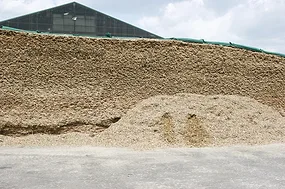
Annually, numerous agricultural crops are harvested, stored and subsequently fed. To maximize preservation of the crops’ nutrients, we rely on fermentation. This is silage-making. But the key to good fermentation is an anaerobic environment (absent of oxygen).

Oxygen is the enemy
Oxygen leads to spoilage, where highly digestible nutrients are converted to several undesirable, poorly digestible products and metabolites. This spoilage is costly for two very important reasons: You have already paid to make this feed (seed, fertilizer, herbicide, harvesting, transportation, storage, etc.), and it reduces the cow’s ability to live up to her genetic potential for making milk (lower digestive efficiency, yeasts, molds, mycotoxins, adverse health events, etc.).
Nutrient losses due to spoilage primarily occur either at the initial aerobic phase of ensiling (when filling the silo), when we are trying to eliminate oxygen from the forage mass or at the feedout phase, when we are trying to minimize the amount of oxygen that infiltrates the stable, fermented forage. Regardless of when they occur, losses can exceed 15% to 30% of digestible dry matter.
When filling the silo, oxygen that remains in the forage mass allows for continued plant cell respiration and for certain microbial spoilage organisms to consume dry matter. During fermentation, oxygen will be consumed and fermentation gases will fill these pores. At feedout, these gas-filled pores will permit oxygen infiltration into the silage mass, quickly promoting the reanimation of aerobic spoilage microorganisms, utilizing available carbohydrates and producing heat.
Improving density of silages is important for several reasons – specifically, it reduces the amount of oxygen in the forage mass, improves fermentation and preservation of nutrients, and allows for storage of more silage in the same footprint without packing forage higher. Higher densities will reduce the annual cost of storage per ton of crop and reduce the crop losses during storage.
Porosity
The primary means by which oxygen is eliminated from the forage mass at ensiling in a horizontal silo (bunker, trench or drive-over pile) is via packing tractors. The metric by which we evaluate the relative success of packing has always been based on dry matter density because dry matter is used to calculate feed inventory and to balance rations. However, bulk density or as-fed density is a better metric, for two reasons: It is easier to measure bulk density when filling the silo, as there is no need to measure moisture content; and as-fed density is more closely related to porosity and silage quality.
Porosity, or gas-filled porosity, is simply the amount of space between the solid and liquid portions of the silage in a specified volume. Since air is approximately 21% oxygen, as gas-filled porosity decreases, the amount of oxygen in the forage mass decreases as well.
Spoilage microorganisms thrive in the presence of oxygen. Yeasts and molds, as well as other aerobic organisms, convert sugars and organic acids to carbon dioxide, water and heat. The result is dry matter loss. Other indicators of aerobic deterioration include increased fiber content, higher ammonia, elevated pH and potential gray or black color. Therefore, reducing the gas-filled porosity in the forage mass will reduce the quantity of oxygen available for spoilage microorganisms to proliferate and consume valuable digestible nutrients.
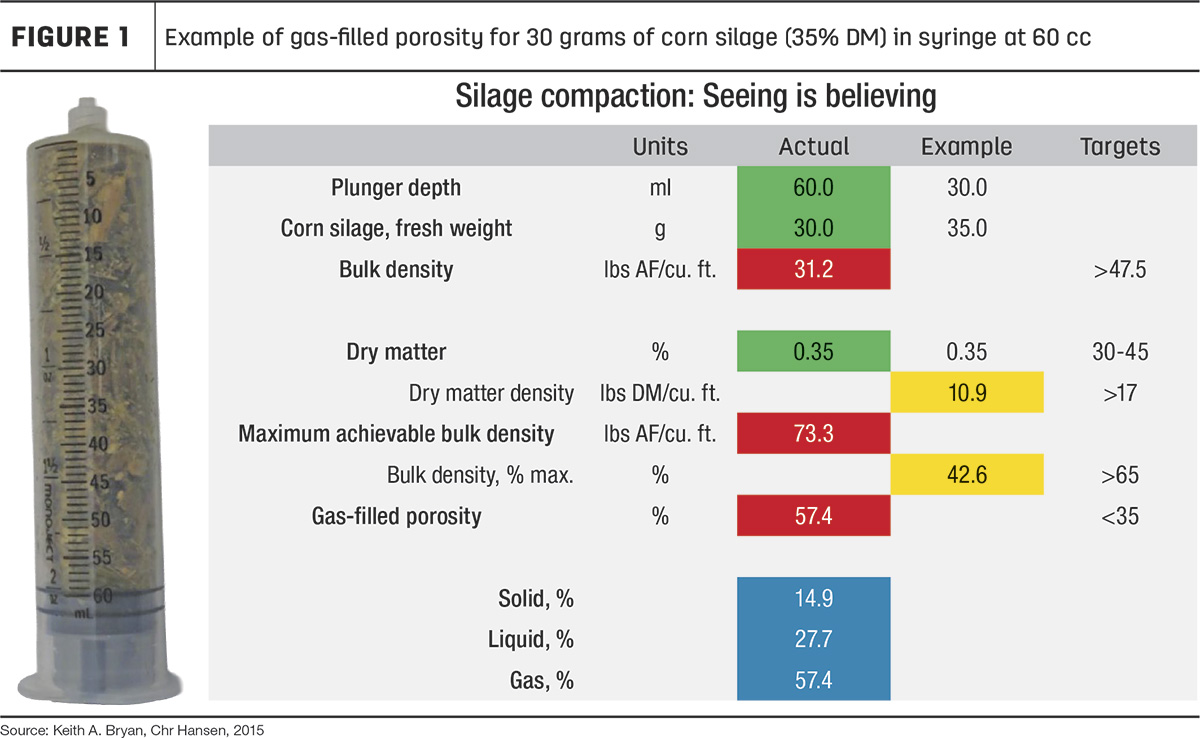
In the example, Figures 1 and 2, the syringe was filled with corn silage [35% dry matter (DM)] and the resulting calculations provide the basis for discussing gas-filled porosity. Thirty grams of corn silage was placed in the syringe, and the plunger was pushed to 60 cubic centimeters. Bulk density (as-fed density) is 31.2 pounds per cubic foot, and dry matter density is 10.9 pounds per cubic foot. Not very desirable when our goal for DM density is approximately 15 pounds per cubic foot. In Figure 1, the 60-cubic-centimeter volume is 14.9% solid (DM) and 27.7% liquid (moisture). The remaining space is gas-filled porosity of 57.4%, of which 21% is oxygen; thus, the syringe holds 12.05% oxygen or 7.23 cubic centimeters of oxygen.
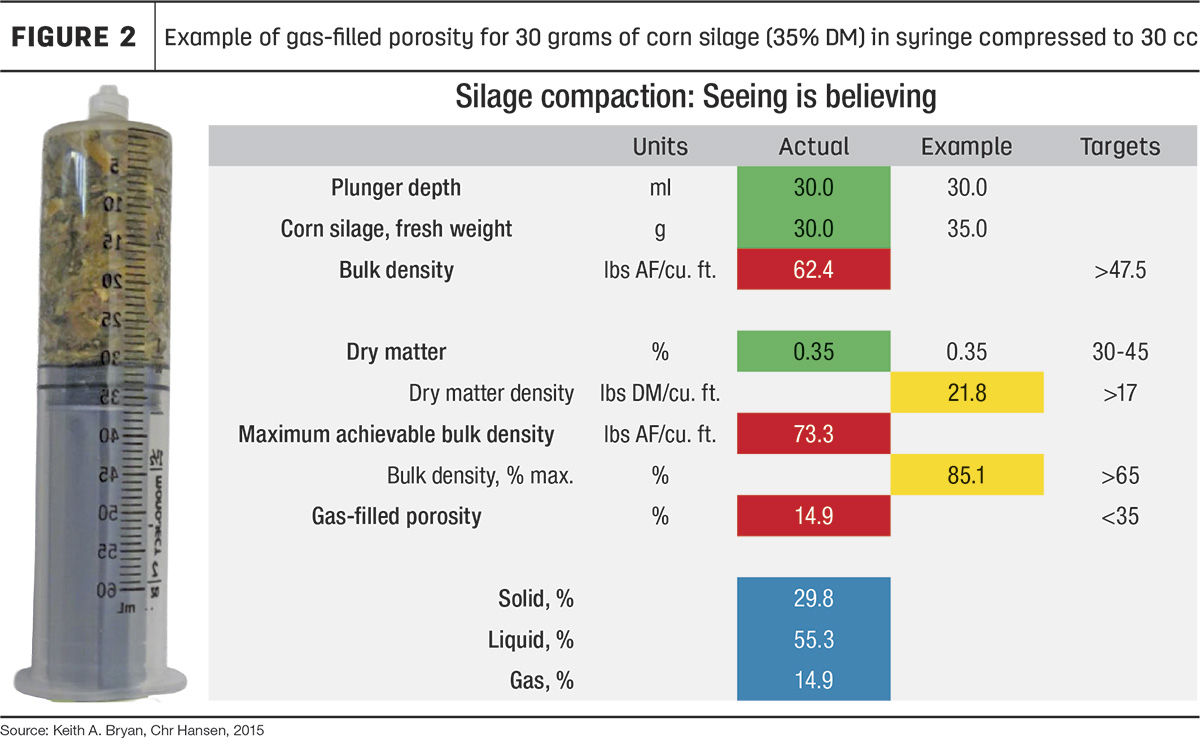
In the example in Figure 2, the plunger was pushed to 30 cubic centimeters. No moisture escaped the syringe and the same quantity of dry matter remained in the syringe; thus, the only difference was the absolute quantity and percent of gas-filled porosity.
Bulk density is 62.4 pounds per cubic foot, and dry matter density is 21.8 pounds per cubic foot. Exactly twice as much as seen in Figure 1, as we have the same quantity of corn silage in half the volume. This would be considered excellent packing density. In the syringe in Figure 2, the 30-cubic-centimeter volume is 29.8% solid (DM) and 55.3% liquid (moisture). The remaining space is gas-filled porosity of 14.9%, of which 21% is oxygen, thus the syringe holds 3.13% oxygen or 0.94 cubic centimeter of oxygen.
By increasing packing density, specifically by minimizing gas-filled porosity, we have significantly reduced the exposure of corn silage to oxygen and allowed for significantly more corn silage to be stored in the same original 60 cubic centimeters of space.
Packing: The critical control points for minimizing porosity
- Match delivery rate to pack tractor weight to exceed ”the rule of 800.”
(Pack tractor weight needed = 800 multiplied by tons of forage delivered per hour or pack tractor weight available / 800 = maximum tons of forage delivered per hour).
- Thin layers (about 4 inches thick) spread and packed in a progressive wedge configuration will facilitate achievement of higher-density bunkers and piles.
- For bunker silos, alternate dumping, push-up and packing from left side to right side and vice versa for uniform layer thickness, optimal packing time and overall efficiency. Alternating dumping, push-up and packing will reduce the likelihood of ”crowned” or ”cupped” filling and the resulting variations in DM density across the face of the bunker.
- The ideal packing tractor speed is 1.5 to 2.5 miles per hour. Do not turn around on the pile. Make sure one set of wheels comes off the pile when changing direction to minimize loss of traction.
- To store more feed in the same volume, increase as-fed packing density. Increasing as-fed packing density from 45 to 51 pounds as-fed per cubic foot increases storage capacity by 13.3%. If you routinely store 6,000 tons of DM, you could now store 6,800 tons of DM in the same area.
- Packing is complete when every square foot of top layer has tire tracks, having been run over twice and is smooth. There is no advantage to more than 30 minutes of packing after the final load has been spread.
- Bottom line: The most skilled tractor operator should be in the push tractor. The people operating the push and pack tractors could be the most valuable (and often most overlooked) team members in the entire process. Oxygen is the enemy.
Take-home message
Fortunately, gas-filled porosity is closely related to as-fed density and allows for practical measurement on-farm. It is the true metric of silage density, and ultimately silage quality, due to reducing or eliminating oxygen in the silo.