What began as a milk bottle search is now a museum of early milkers, butter churns, tools and distinctive Wisconsin agricultural pieces.

Not far from Evansville, Wisconsin, in the rolling farm country of Rock County, sits a remarkable tribute to rural life: Grandpa’s Farm, a museum dedicated to preserving the tools, equipment and everyday items that shaped generations of Wisconsin farm families. Located within the offices of Larson Acres – one of Rock County’s long‑established and successful family dairy operations – the exhibit serves as a community resource and a working archive of Wisconsin’s past.
The museum began around 2013, when collector Ed Larson and his wife, Barb, started stopping at antique stores with friends.
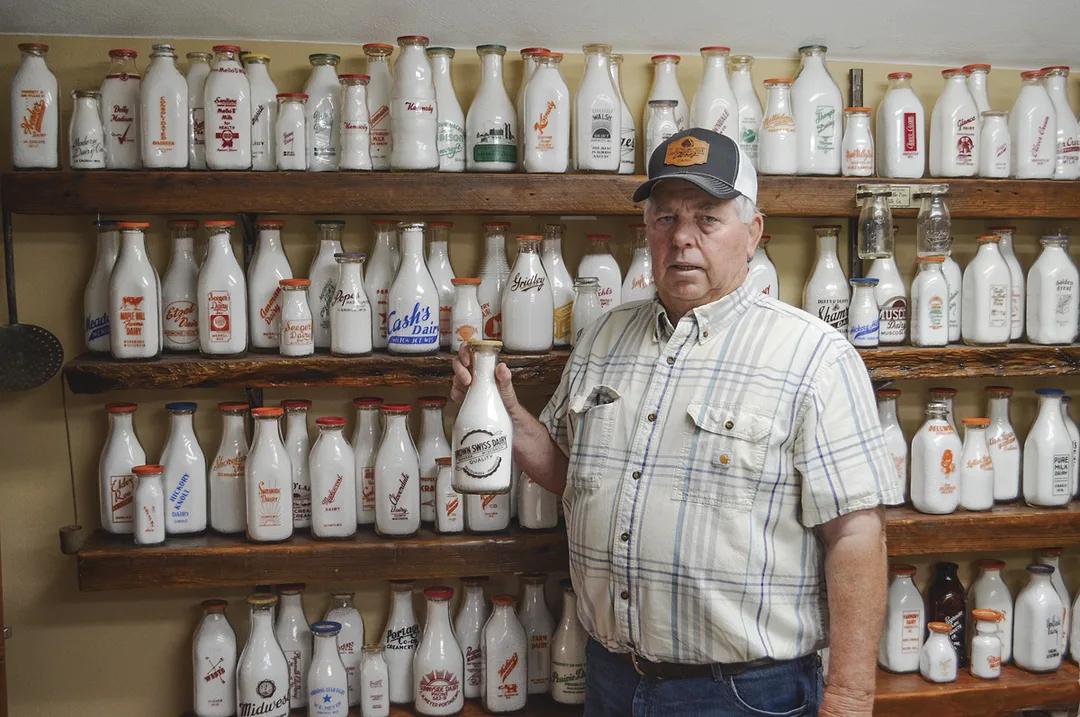
“The first thing I started buying was milk bottles,” Larson says.
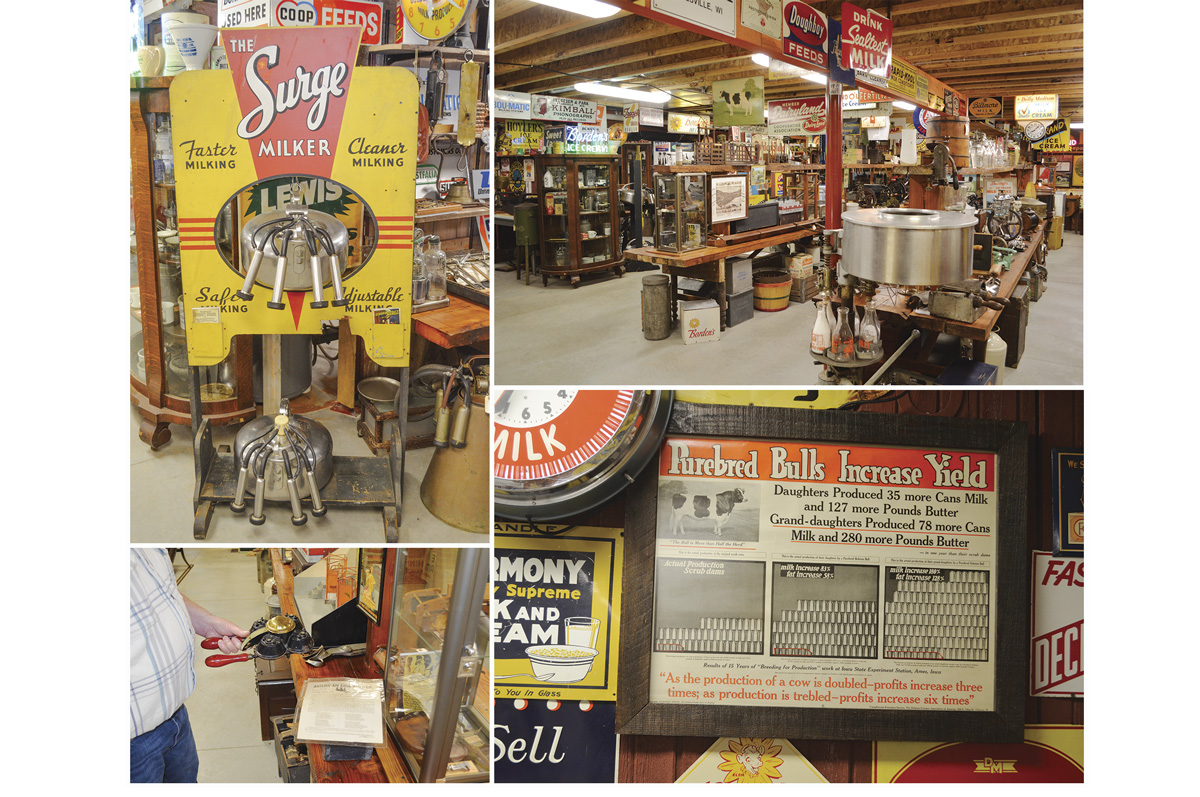
Image by Marian Viney.
When he could no longer find bottles he didn’t already own, the search expanded into early milking equipment, kitchen tools, advertising signs and farm implements. What started as a casual hobby quickly grew into a large, organized collection representing more than a century of Wisconsin agricultural life.
Today, Grandpa’s Farm contains thousands of artifacts, acquired through eBay, local auctions, estate clean‑outs and antique stores. Larson often helps auction companies sort items ahead of sales, giving him early access to unique finds.
Grandpa’s Farm is maintained through a combination of Larson’s ongoing organization and support from others who help keep the collection remarkably tidy and well preserved. Larson sorts the bottles by city, tracks most items through saved invoices and cleans the displays gradually.
“Maybe once a year I wipe off one table, and maybe next year I’ll do a different one,” he adds.
The Evansville Grove Society partners with Larson by hosting an annual open house fundraiser at the museum, helping support local historical preservation efforts.
Beyond its size, Grandpa’s Farm functions as a hands‑on learning museum for anyone interested in agriculture’s past. Visitors often come looking for connections to their own families, especially among the alphabetized milk bottle shelves.
“It’s interesting to watch families search the milk bottles and find their hometown and tell me a little more about its history,” Larson says.
The museum also draws local groups during open houses and historical society events, offering a chance to see equipment that rarely survived on working farms. For the Larson family, the goal is simple: Keep the everyday tools of farm life accessible, organized and preserved for future generations. If you would like to visit, send Larson an email.
Here are four standout pieces that represent the uniqueness of Grandpa’s Farm.
Jameson Alfakorn’s milk bottle
Origin: South of Evansville, early 1900s
Why it’s special: Larson owned the bottle for two years before he could identify its origin. Research on Green Brothers of Evansville eventually connected it to the Jameson family.
Red Borden’s Christmas bottle
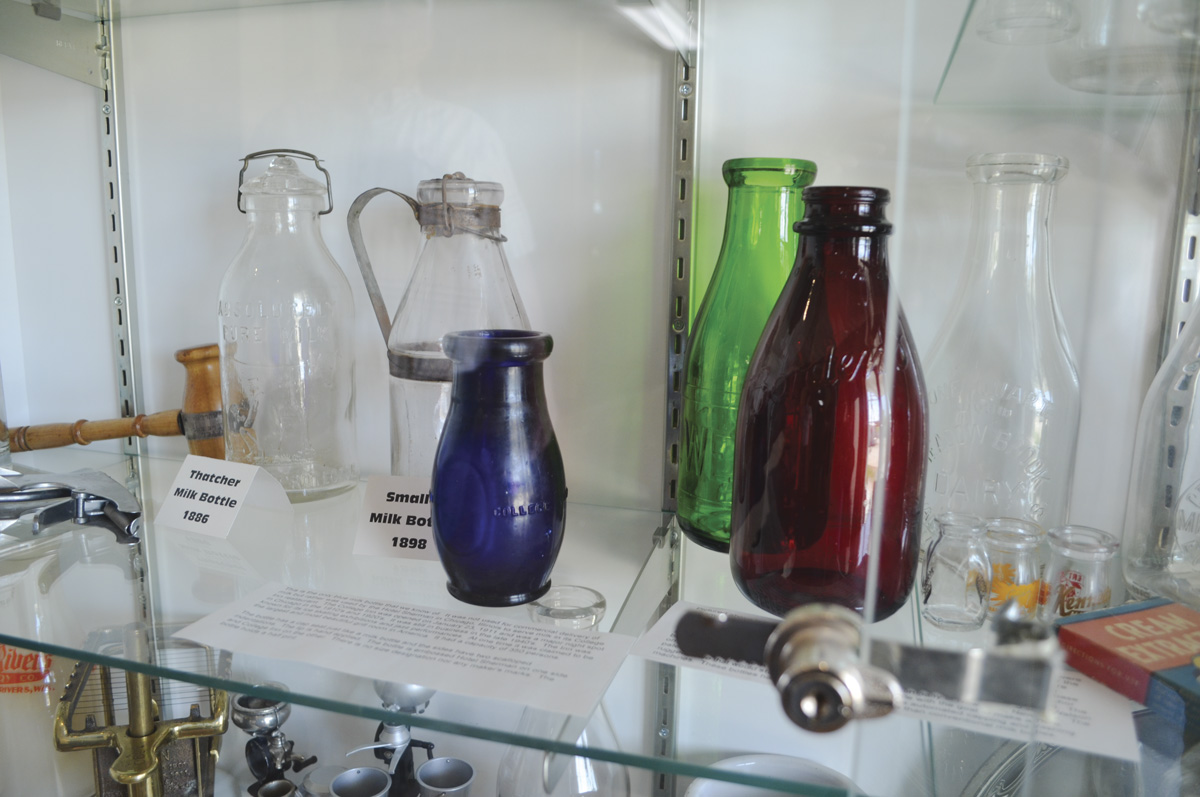
Image by Marian Viney.
Origin: 1950s promotional run
Why it’s special: Borden produced red glass bottles for a holiday promotion, but the milk inside looked discolored. Workers were told to destroy them, but one worker saved a small batch. Very few are around today.
Early hand‑powered milker
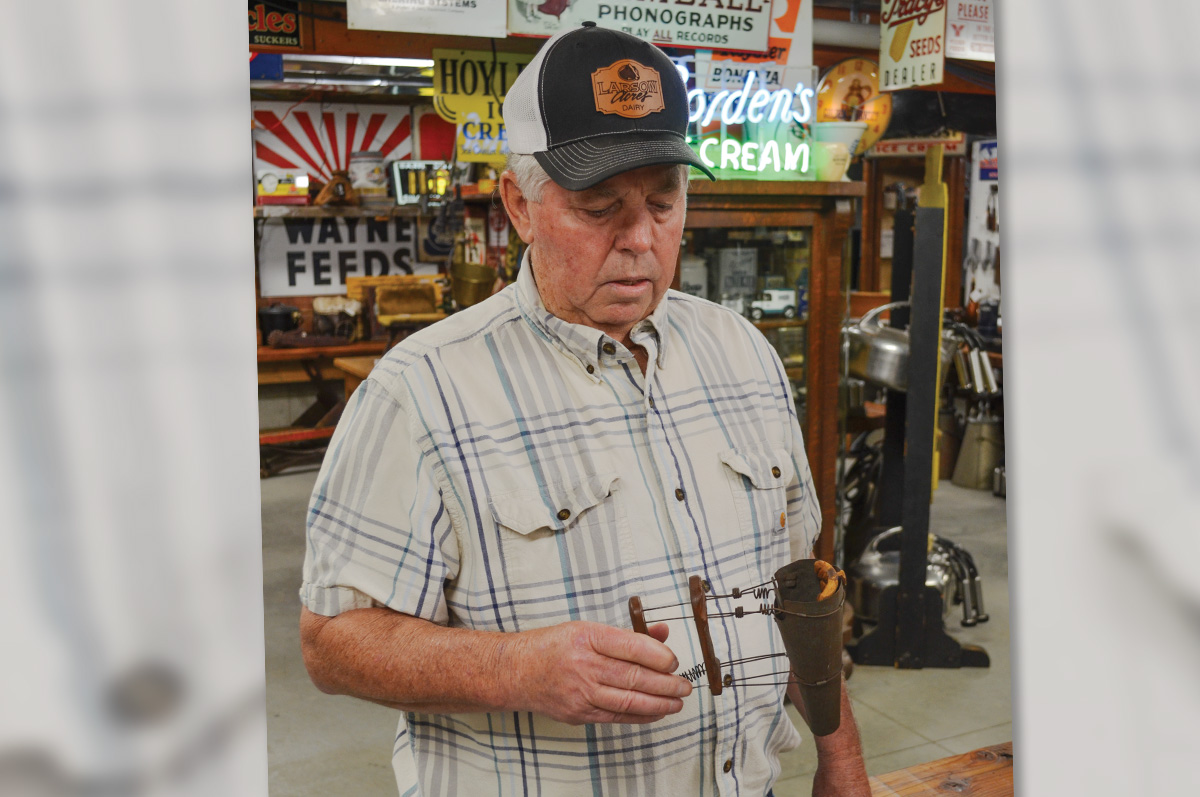
Image by Marian Viney.
Origin: Circa 1900
Why it’s special: A pre‑pulsation device that relied on suction rather than squeezing. Farmers sat on pedals and pumped by hand while holding two cups in place.
Dog‑powered butter churn
Origin: Early 20th century
Why it’s special: Designed so a dog, sheep or goat could walk on a treadmill‑style platform to power the churn. A rare example of early farming ingenuity.
The scope of the collection is significant:
- More than 1,500 Wisconsin milk bottles, including 17 from the Evansville area.
- Bottles ranging from pre‑1930 embossed styles to 1930s pyro glaze painted bottles.
- Milking equipment spanning early hand‑powered milkers, Surge buckets, pipeline milkers and pre‑pulsation suction devices.
- 100-plus butter churns, from crank styles to water‑powered and even dog‑ or sheep-powered models.
- 500-plus advertising signs, thermometers and clocks.
- Tools and equipment manufactured in Albany, Sharon, Fort Atkinson, Evansville and other Wisconsin communities.
- Kitchen tools including cream separators, meat grinders, ice cream makers and French‑cut green bean slicers.