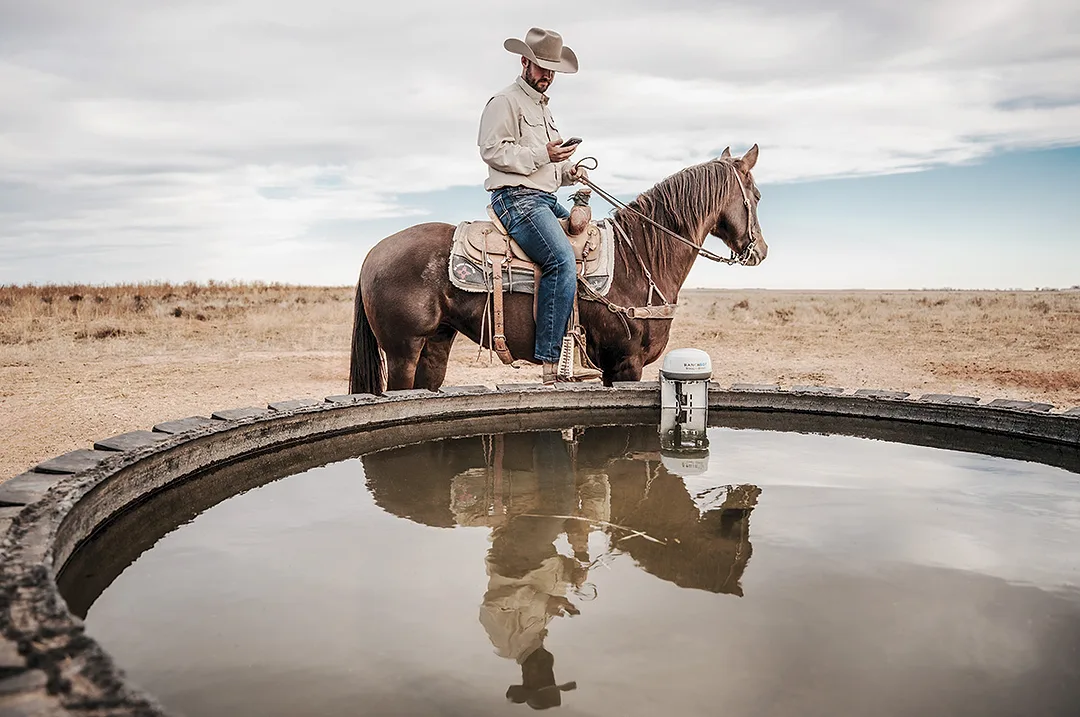
It’s 6 a.m., and before anything else gets done, you’re in the truck checking water. First tank looks fine. Second one too. By the third stop, you’re already wondering if the last two hours were worth it. Ninety-five percent of the time everything’s working exactly as it should, but it’s the other 5% that keeps you driving.

It’s that uncertainty that when something does go wrong … a stuck float, a blown line, a pump that’s gone down … it doesn’t take long before cattle feel it. And by the time you find it, the problem is already bigger than it needed to be.
That “driving to check” routine has been part of ranching for generations despite the fact that one minute after checking, the rancher still doesn’t know what’s happening, but what’s changing now is the cost of getting it wrong is drastically increasing alongside a growing uncertainty around whether the water you depend on will even be there when you need it.
Water isn’t as reliable as it used to be
Across much of the U.S., ranchers are dealing with a shift that’s been building for years: The patterns they’ve relied on are changing.
This isn’t just about dry spells. It’s about increasing weather volatility – longer stretches without meaningful rain, followed by short bursts of extreme rainfall that don’t always translate into usable supply. Timing matters just as much as total inches, and that timing has become less predictable. At the same time, key water sources are under pressure.
Aquifers that have supported ranching for decades are being drawn down in many regions. In parts of the High Plains, the Ogallala Aquifer has seen significant declines as use continues to exceed recharge. In Texas, the Edwards Aquifer is balancing agricultural demand with the needs of growing urban demand due to population growth.
Surface water brings its own challenges. Lower snowpack in some seasons, uneven runoff and inconsistent rainfall all add up to less dependable supply. On the ground, it shows up in ways every rancher recognizes. Wells don’t recover as quickly. Tanks run lower, faster. Water that used to last through a stretch now needs closer watching.
When that happens, decisions get tighter. Stocking rates, grazing rotations and how far you push a pasture all start to hinge on one thing: how confident you are in your water.
More competition = less margin for error
While supply is getting less predictable, demand is accelerating.
While agriculture remains a major consumer of water, it’s now competing more directly with expanding cities and growing industrial demand. In some regions, that competition is starting to show up in real ways – more restrictions, more regulation and less flexibility. There are also newer demands entering the picture. Data centers, for example, require large volumes of water for cooling and energy production, and many are being built in areas that already rely on the same underlying water systems as agriculture.
Layer on top of that the complexity of water rights, and the future for water starts to look increasingly complex. Depending on where you operate, access isn’t just about whether water exists – it’s about priority. Long-standing rules, groundwater districts and drought-stage restrictions all influence who gets what and when. In some cases, water can be there physically but limited legally. The result is a more competitive environment with less certainty.
And at the same time, the cost of managing water is going up. Fuel isn’t cheap. Time isn’t unlimited. Labor is harder to find. Every extra mile driven to check water carries a real cost. That’s where the pressure is really building as not just in having enough water but in the time and expense it takes to stay on top of it.
Why ‘checking water’ is getting more expensive
The traditional approach still works: Go look at it. Drive out, check the tank, check the trough, make sure everything’s running. But in today’s environment, that routine is getting much harder to justify.
You can burn a lot of diesel checking water. Hours in the truck each week, wear on vehicles, time taken away from other more important jobs that need attention. And most of those checks confirm the same thing – everything’s fine. The problem is when it’s not.
A slow leak in a line feeding a remote trough can run for hours (or days) before it’s picked up. By the time it’s found, you’re not just fixing a pipe. You’ve lost valuable water, time and performance in that group of cattle due to shrinkage.
The issue isn’t the act of checking … it’s the delay in knowing. In a tighter water environment, finding problems late is where the real cost sits.
Better visibility changes the equation
When you can see what’s happening with your water systems remotely: tank levels, pumps, flow, pressure, weather, rainfall and more, a rancher moves from reacting to managing their infrastructure and assets.
Instead of wondering if there’s a problem, they know when something changes. Instead of guessing how long a water point will last, they can see how quickly it’s drawing down. Instead of checking everything, they focus their time where it matters.
That shift has some very practical outcomes:
- Less time spent on unnecessary checks
- Lower fuel and vehicle costs
- Faster response when something goes wrong
- Better decisions around grazing and stocking
- More efficient use of available water
This isn’t about adding complexity; it’s about reducing uncertainty – and for most operations, this doesn’t mean changing everything overnight – it starts with understanding where your risk sits.
Which water points matter most?
Where are you spending the most time checking?
Where would a failure have the biggest impact?
From there, it’s about building better visibility into those areas, whether that’s knowing tank levels, tracking usage or simply having a way to know when something changes so you can be responsive and have fewer surprises.
Where is this all heading?
Water pressure across the U.S. isn’t a short-term issue. It’s being driven by long-term trends of population growth, shifting weather patterns and increasing demand from multiple sectors.
For ranchers, that means water management is becoming a core part of running a ranch, not just a daily task. The operations that stay ahead will be the ones that:
- Understand their water systems in detail
- Keep a closer eye on usage and availability
- Reduce waste wherever possible
- Make decisions based on real-time information and data
Bottom line
Water has always mattered. What’s changed is the margin for error.
The operations that stay ahead won’t be the ones working harder – they’ll be the ones who know what’s happening before it becomes a problem.
Because today, water isn’t just something you check. It’s something you should more deeply understand, and the technology to deliver those outcomes is now available, reliable and affordable.
After all, the old adage remains true … you can’t manage what you don’t measure.