Most farmers who used automated milking would agree that 7,000 pounds per robot is an elite production goal. Achieving that goal depends on reliable equipment, healthy and comfortable cows, efficient reproduction, quality forages and overall attention to detail.

When we do the math, that level of production also depends on the right robot cows – consistent cows that fit the system. You can have 65 cows averaging 108 pounds per day or 75 cows averaging 93 pounds per day. The margin for deviation is very small in either of those scenarios. If you can’t get 70 cows through the robot, your cows have to average more than 100 pounds. If you can’t average 100 pounds, you have to get more than 70 cows through the robot. There is no room for cows that don’t earn their spot. Even if your goal is 5,000 pounds, or 6,000 pounds, consistent cows that fit the system are still the key to reaching it.
To maintain a herd of consistent cows that fit the system, we have to use the data to identify inconsistent cows and develop a strategy to manage them.
Identifying inconsistent cows
Many production performance indicators are the same whether cows are milked in robots or parlors. Pounds of milk, fat and protein, and somatic cell count (SCC) are the same either way. For automated milking cows, motivation, milkability and milking speed are also important. I suggest identifying the 10 worst cows for each and evaluating the options for them.
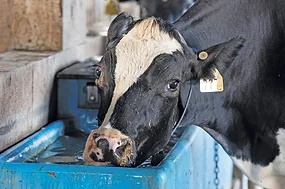
Chronic fetch cows lack motivation. Even in large herds, the best way to identify cows that lack motivation is to talk to the people who are in the barn every day. They know these cows because they fetch them every day. Cows with low refusals or gate passages should also be on the poor motivation list. Nobody likes to spend time fetching cows, but it’s not just wasted labor. Fetching cows interferes with cow flow and takes milking opportunities away from cows that want to come voluntarily.
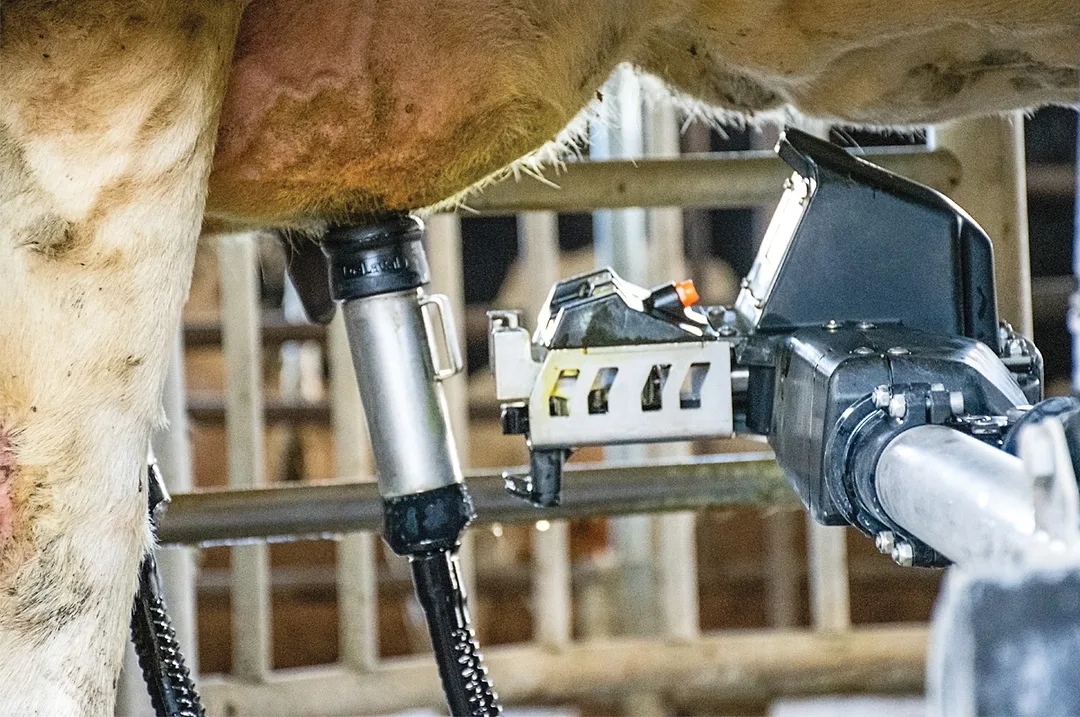
Milkability refers to how efficiently the robot attaches. Conformation and behavior both affect milkability. Light feet can be just as bad as light quarters. Automated milking software reports cows with consistently high incomplete or failed milkings. Incomplete milkout leads to lower production and higher risk of mastitis. It also wastes robot time through slower attachment, more reattachment and additional trips to the robot for remilking. Watch the robot milk these cows to determine why milkability is poor.
Automated milking software reports milking speed for individual cows. Milk flow, in pounds per minute of milking time, is the purest measure of how quickly milk is removed from the udder. Milking duration includes prep time, so it also reflects milkability. Milk per minute of box time also includes prep time. Lower-producing cows usually have lower flow rates than higher-producing cows. A cow that produces 100 pounds per day in three milkings may have a shorter duration per milking than a cow that produces 100 pounds per day in two milkings, but the total daily milking time will probably be less for the cow with two milkings. All of these metrics are useful as long as we understand what is really being measured.
Managing inconsistent cows
Strategies for managing inconsistent cows fall into one of three groups – tolerate them, compensate for them or remove them. Tolerating them is not the same as ignoring them. We might identify a slow-milking cow and tolerate her because of her high production or genetic merit, rather than remove her – at least until a faster cow with similar production or genetic merit can take her place. We can’t afford to ignore a cow that fails at every other milking, but we might make adjustments to improve her odds. The cow that stomps on the arm every milking won’t let us ignore her. She needs to be removed.
Many automated milking settings can be adjusted on a per-cow basis to compensate for inconsistent cows. We can customize take-off and pulsation settings to make sure slow-milking cows have time to milk out. Feed can be dispensed more slowly to make sure it lasts through the entire milking or more quickly to make sure a fast-milking cow has time to eat it all. Some camera and arm settings can be customized for individual cows. Milking permission can be extended for individual cows to get more udder fill and more efficient attachment. We can capitalize on every opportunity to milk a chronic fetch cow by making her permission less restrictive.
If you change settings for individual cows, make sure you have a plan to review those settings on a regular basis. Some settings will revert to defaults at the beginning of a new lactation, but others will not. Cows that are excluded from automated milking permission or automated ration calculation at the end of one lactation will not get a good start in the next lactation unless those parameters are reset. Don’t change an individual cow setting if you don’t have a plan for reviewing it and changing it back.
Another way to manage inconsistent cows is to remove them from the automated milking system. This decision is easier if the farm has a parlor so cows that leave the robots can stay on the farm. But every farm has the opportunity to decide which cows will stay in their automated milking barn and which cows will not. The owner of one of the highest-producing robots in the world insists that it is better to choose cows that fit the system than to make the system fit the cow. He does not have a parlor. Another veteran of automated milking says he cannot afford to keep cows that damage expensive equipment; he doesn’t have a parlor either. Removing cows is not a failure; it’s a management strategy.
There are many tools to identify and manage inconsistent cows in automated milking systems. However, if more than half of the cows are outliers, step back and look at the big picture. Do not try to use individual cow adjustments to solve a whole-herd problem. If you have motivational problems with all of your fresh heifers, you might need to evaluate the training program. If all of your late-lactation cows need extended milking permission because their udders are too flat for efficient attachment, reproductive efficiency might be the real problem. Manage the herd first, then identify and adjust for the outliers as needed.