We use cookies to provide you with a better experience. By continuing to browse the site you are agreeing to our use of cookies in accordance with our Cookie Policy.
  • Sign In
  • Create Account
  • Sign Out
  • My Account
subscribe / renew
  • Topics
    • All recent articles
    • Breeding
      • Dairy Genetics
      • Dairy Reproduction
    • Cow Care
      • Cow Health
      • Dairy Welfare
      • Hoof Care
    • Dry & Transition Period
    • Equipment
      • Farm Equipment
      • Milking Equipment
      • Technology & Software
    • Facilities
      • Comfort & Cooling
      • Dairy Barns
      • Manure Management
      • Pest Control
    • Feed & Nutrition
      • Dairy Feed & Diets
      • Forages
    • Milk Quality & Production
      • Milking Hygiene
      • Production & Components
    • Youngstock
      • Calf Health
      • Calf Nutrition
      • Heifer Raising
      • Youngstock Housing
    • Business Management
      • Employees & Consultants
      • Farming with Family
      • Finances & Profitability
      • Succession Plans
    • Canada Farm Features
  • Blogs
    • From the Editor
    • Guest Blogs
  • News
    • Canada Dairy Issues
    • Dairy Consumption
    • Dairy Trade Agreements
  • Buyers Guide
  • Magazine
    • Current edition
    • Past Issues
  • Advertise
  • Ask AgProud
USFR

Progressive Dairy

Progressive Dairy Canada

PD Canada en Francais

Progressive Cattle

Progressive Cattle Canada

Progressive Forage

Agproud Idaho

Home

Home » Topics » Progressive Dairy — Canada

Progressive Dairy — Canada
Progressive Dairy — Canada RSS Feed RSS

Whole milk is an ideal nutrient source for newborn calves

June 6, 2012
Pawel Gorka and Matthew Walpole

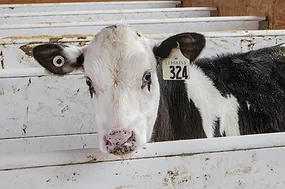
Calf management has become increasingly important for many dairy producers, as scientific evidence suggests that the early stages of a heifer’s development can have long-lasting effects on her future production. As such, more attention has been given to adequate colostrum feeding soon after birth.

On many farms, it is not uncommon to supply calves with large quantities of milk or milk replacer, in some cases consuming 10 to 12 litres per day, which has shown to have positive effects on a heifer’s future milk production.

Read More

Attaining hoof health one step at a time

June 6, 2012
Anita Heeg

Lameness is a common on-farm reason for culling cows. About 20 to 30 percent of cows in a herd are expected to become lame in any given lactation.

A cow that is lame may not immediately show symptoms but eventually lies down longer, eats less and consequently produces less milk.

Read More

How does feeding calves relate to a bank account?

June 1, 2012
Aurora Villarroel

 Many producers report problems rearing calves without disease. First off, it is important to understand that they are living beings and, as such, some will get sick. Second, these are babies, so they are more susceptible to disease than adults. 


Read More

Time to open the barn doors

May 1, 2012
Karen Lee

The sun is shining, the birds are chirping and the world is green again. Springtime is the perfect time to throw those barn doors open – but not just to make milking more pleasant. While attending a presentation analyzing society’s changing perception of agriculture, I heard a producer ask, “What are ways to engage the public?”


Read More

Producer tour showcases Alberta farms

May 1, 2012
Karen Lee

One of the pre-conference events in relation to the Western Canadian Dairy Seminars is a producer tour of local dairy farms.

This year, three farms south of Red Deer, Alberta, opened their doors and stories to two busloads of visitors – Van Den Broek Dairy, Ten Brummelhuis Dairy Ltd. and Yff Dairy Ltd.

Read More

Spring has sprung: Watch for changing starch digestibility

May 1, 2012
Robert Larmer
The era of higher corn prices has many nutritionists looking at feeding elevated levels of corn silage as a way to reduce starch input costs. In Eastern Canada, it is not uncommon to be working with rations in the 70 to 80 percent corn silage range as a percentage of the total forages fed – significantly more than even 10 years ago.
Read More

Protecting your business from fraud

May 1, 2012
Craig Bremner

The increasing use of technology brings speed and efficiency to many processes, and business owners are right to leverage it. However, technology also provides opportunities for fraud.

And when times are challenging, fraud increases. In fact, a recent study by the Certified General Accountants Association showed that more than half the businesses operating in Canada today have experienced some form of fraud in the past five years.

Read More

Consider benefits of balancing dairy rations for amino acids

April 30, 2012
Elliot Block

If you aren’t yet familiar with balancing dairy rations for amino acids, you will soon be learning quite a bit about this newer nutrition strategy.

That’s because amino acid balancing has the potential to improve milk component and milk production, improve protein utilization and lessen dairy’s environmental impact.

Read More

Watch for silage mycotoxins’ effects on herd performance

April 30, 2012
Paul Groenewegen

While enjoying the mild Canadian winter, the last thing on a producer’s mind is the threat of mycotoxins on their farms.

But an early and unseasonal increase in temperature gives mould growth and its subsequent mycotoxin formations an ideal environment in storage facilities.

Read More

Big changes brought to Holmdale Farms

April 30, 2012
Alice Guthrie

There have been big changes at Holmdale Farms in the last several years, as fifth-generation farmer Todd Holm has gradually assumed day-to-day management, then ownership of the Bruce County, Ontario, dairy operation.

At first, Todd worked with his dad, George, then in 2000 he took over management, and purchased the operation in 2007.

Read More
Previous 1 2 … 218 219 220 221 222 223 224 225 226 227 228 229 Next
  • RECENT ARTICLES
  • Navigating a bovine tuberculosis investigation: One vet’s experience

    June 11, 2026
  • 63512-benschop-dixon.jpg

    Preweaned calf rumen development: How it shapes heifer growth and future milk production

    June 9, 2026
    • How rising temperatures are affecting dairy cow fertility in Canada

      June 4, 2026

FREE NEWSLETTERS

Award-winning coverage of in-depth news and analysis to make your business more profitable.

SIGNUP TODAY
Advertisement
THE GUIDE

How do I get my company listed in your Buyers Guide? 
Submit a request to be listed for FREE in the Buyers Guide here.

Why can I only see so many articles before I have to register for the site?
Find out why here.

SUBSCRIBE to Leading Industry Magazines

Award-winning coverage of in-depth news and analysis to make your business more profitable.

Subscribe/Renew
Advertisement

I'm looking for ________

Find the right products and services for your farm, ranch or operation.

CHECK OUT OUR BUYERS GUIDE
Advertisement
  • FEATURED PODCASTS
  • [Podcast] Changing the Rules of Pre-Fresh Dairy Cows

    Progressive Dairy
    Podcasts
    SPONSORED BY Applied Biotechnologies Inc.
  • [Podcast] Selling Calves in a Record Market: What Ranchers Need to Know Right Now

    Progressive Cattle
    Podcasts
    SPONSORED BY Superior Livestock Auction
PERSONALIZED CONTENT
Create an account and see website content tailored to your operation.  It only takes a few seconds!
SEE RECOMMENDATIONS NOW!
Copyright © 2026 Progressive Publishing

MORE INFORMATION
  • About Us
  • Terms & Conditions
  • Privacy Policy
  • FAQs
  • Advertise
  • Shop
  • Stats Posters

OUR MAGAZINES
  • Progressive Dairy
    • Facebook
    • Twitter
    • Linkedin
  • Progressive Dairy — Canada
    • Facebook
    • Twitter
    • Linkedin
  • Progressive Dairy — en français
    • Facebook
  • Progressive Cattle
    • Facebook
    • Twitter
    • Linkedin
  • Progressive Cattle — Canada
    • Facebook
    • Linkedin
  • Progressive Forage
    • Facebook
    • Twitter
  • AgProud — Idaho
    • Facebook
    • Linkedin

CONTACT INFORMATION

Progressive Publishing
238 West Nez Perce (physical)
PO Box 585 (mailing)
Jerome, ID 83338


info@progressivepublish.com
(800) 320-1424
(208) 324-7513 (Main)
(208) 324-1133 (Fax)