Our country is highly divided right now.

There’s an us-versus-them mentality that seems to be strong on both sides. And whatever side you’re on, it’s the right side and the other side is wrong.
Granted, it’s difficult to look at news headlines and understand where some people are getting their rhetoric. It’s challenging to be in rooms with people who bash others, regardless of what stance they’re taking.
I’m not about to debate politics or hot-topic headlines. My point is that “we the people of the United States” aren’t very united. We’re slinging mud as if the other people won’t feel the slap.
Yet there’s a silent cry for peace.
Yes, peace from wars and riots and uncertainty. But I also mean a personal place of peace, an internal peace.
I’m guilty of grabbing hold of stress and running with it, so I’m by no means saying I’ve got it figured out. What I’d like to propose is this: Our land can be a pocket of peace. Ranching and agriculture could potentially be a launchpad for peace.
That’s not to say there aren’t controversy and opinions about packing houses, meat labeling and the price of land. Controversy is a free byproduct of anywhere humans are.
What I mean to say is, when I’m around people who have differing opinions and the proverbial “talking stick” comes around to me, the first question I’m often asked is, “What do you do?” This seems to be the default conversation-starter question.
Rather than explain that two days ago I made enough food to feed a large crew, yesterday I worked cattle, today I’m at class and tomorrow I’ll be talking about the benefits of humor in children’s picture books, I usually say, “I live on a ranch, and I like to write about it.”
Often this brings follow-up questions and statements, the most common of which is, “Wow, that is the dream life.” Followed by, “What’s it like to live on a ranch? Are cows mean? What is your role there?” Obviously, the first two questions are from people who don’t share this agricultural life with us. To them, it’s all a dreamy, romantic notion of living out West.
But it doesn’t really matter what the questions are; what matters is that the conversation brings us together.
People who don’t live the ranching life are curious and inquisitive about what happens on one. People who do live it talk about similarities and differences, often offering suggestions and encouragement. Unless there’s a fight over a person, a survey line or water rights, ranching conversations can be unifying. Our words can bring people together.
Furthermore, we have the opportunity to decide what our homes and our ranches are going to feel like, how the atmosphere will be for those visiting us.
- We decide how we handle our cattle.
- We pick the words we say and how we say them to the people around us – in and out of the corral.
- We choose how we’ll see our neighbors – whether or not we agree with their land practices.
- We control how we treat our horses, our trucks and our equipment.
- Will we be perfect? Nope. We’ll make mistakes. So then, we decide when and how to say we’re sorry.
In full disclosure, my life has been a bit chaotic. We’ve had a lot of moving parts, confusing situations and uncertain decisions. Recently, I read something that said, “You will manifest outside of you whatever is inside of you.”
I’m not one to say I believe in manifesting destinies; I think God oversees that. However, the words we say have an impact, and it made me pause and think, “How can I have peace inside when the world around me is chaotic?”
Prayer and scripture are mainstays for me, but I’m also realizing that where I live, our home, needs to be a place of peace. I long for the land around us to be peaceful. The animals need to have the best opportunities to be at peace.
Sure, storms come. Life happens. I mess up. But that doesn’t mean peace is gone forever. Peace can be brought back with a cleanup after a storm, kind words and an intent to understand without judgment.
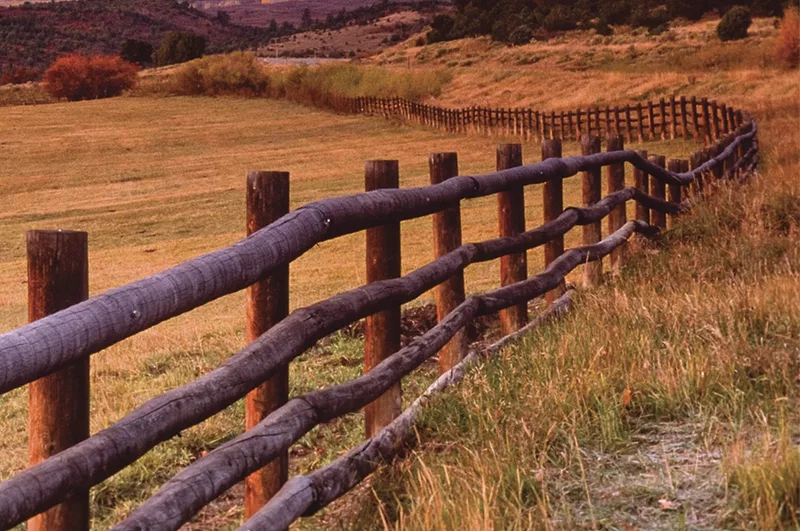
What’s between our fences is under our management or ownership, whatever the case may be. And those fencelines and what’s happening there is often a great way to share about our lives and invite others to do the same. It might be a great way to build some bridges. After all, land is something that literally and figuratively brings us together.
As Red Green says, “We’re all in this together.”