A warm summer day is often a most desirable time on the ranch, especially when a “leisure” trip to check the pastures and cow-calf pairs is on the day’s agenda. But this relaxing trip quickly turns stressful when the first calf we encounter is teary-eyed, followed by another and another. Perhaps one or two cows also display cloudy, whitish-gray eyes.

A pinkeye outbreak has shattered the peacefulness of summer.
What exactly is pinkeye?
Matt Hille, pathologist and extension veterinarian at the University of Nebraska – Lincoln Veterinary Diagnostic Center, has been involved in a handful of projects since 2018 focused on pinkeye and the diversity within the strains or species of bacteria that cause it.
“We’ve found quite a diversity of several subtypes or genotypes in what was traditionally thought to be one bacterial species, and our diagnostic tests have attempted to identify which of these subtypes are present in specific cases,” Hille explains. “Since it’s a multifactorial disease, it’s not a simple case of ‘this pathogen equals this disease.’”
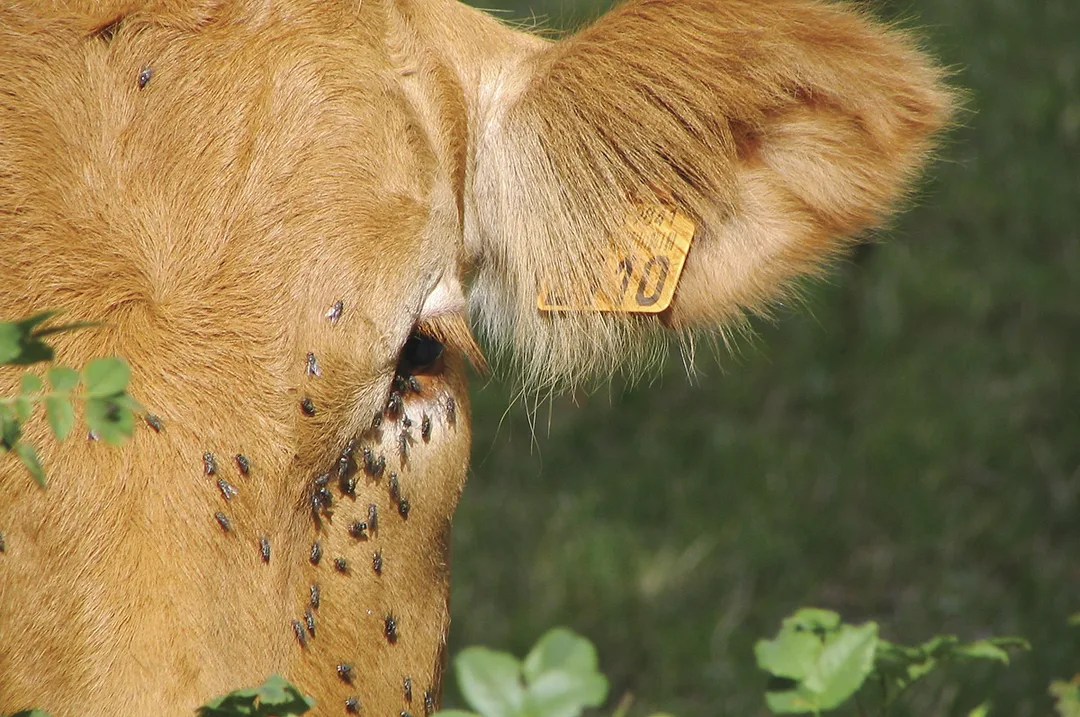
Hille adds that other dynamics correlate with and are strong indicators of the disease, particularly the fly load experienced and subsequent corneal damage.
“Factors such as flies, dust, weather conditions and UV light all play a role in letting the cornea’s guard down,” Hille says. “Under experimental conditions, the only way we’ve reproduced this disease is if the cornea is scarred or damaged in some way before administering the bacteria.”
Additionally, bovine herpesvirus, often referred to as infectious bovine rhinotracheitis (IBR) virus, is sometimes speculated to be involved. Hille says it may play a role, but from his experience, it doesn’t seem to be a primary player.
Prevention
Laura Meier, technical service veterinarian at Valley Vet Supply, agrees that many influences contribute to pinkeye development on summer pastures, including flies, excessive dust or foreign debris like grass awns that scratch the eye’s thin cornea and make it susceptible to bacterial adherence, propagation and infection.
“The bacteria causing the disease normally live on the eye without an issue,” Meier explains. “But even slight damage to the cornea allows it in. Rains are wonderful, but grass growing taller also increases the chance of grass seeds and awns entering the eye.”
For Meier, controlling fly populations has the greatest effect on reducing the risk.
“I can’t stress fly control enough when I speak with cow-calf producers in my region,” she says. “Anything we do to limit flies will help control pinkeye.”
Meier is a big proponent of insect growth regulators (IGRs) to break the flies’ life cycle.
“Cattle eat the IGR via loose mineral, protein tubs, liquid feed or a bolus,” she explains. “It passes through the animal and is deposited into their manure where the flies lay their eggs. From there, the IGR breaks the breeding cycle, resulting in a die-off of the biting fly population.”
She also recommends using back rubbers or fly strips on mineral tubs but suggests they’re mounted where cattle will walk through them every day, typically on paths to regularly used water sources. Fly tags have also improved over the years. Spraying cow-calf pairs with a pump sprayer or paintball guns is also useful but can be overly time-consuming and logistically challenging.
A cyclical uncertainty
Hille says pinkeye outbreaks hit both well-managed and poorly managed herds, underscoring how complex the disease is.
“It goes back to its multifactorial presentation,” he says. “Since there are so many moving parts involved, it’s hard to pin down a working management tactic.”
Additionally, he says pinkeye also tends to follow a cyclical pattern, with severe outbreaks often followed by milder years, sometimes on a three-year cycle.
“It’s hard to make accurate assessments on management changes because chances are the next year, no matter what we did, we’re left wondering what worked and what didn’t and why,” Hille says. “It’s contagious, in the sense that a lot of calves will get it in an outbreak, but whether it’s being spread from one animal to another is questionable. It’s possible they all just experienced the same environment at the same stage of vulnerability.”
Vaccine possibilities
Hille’s department has completed a five-year field-based study collecting data on vaccine efficacy – the largest vaccine trial done in years.
A range of commercial vaccines is available, but pinkeye’s multifactorial nature makes it difficult to develop consistent protection.
“I think it’s safe to say, none of them work reliably, at least to a good efficacy, under all conditions,” Hille says. “Anecdotal reports have indicated they work in certain groups, but as a whole, we don’t yet understand why a vaccine might work in one herd and not another.”
If producers choose to vaccinate, Hille recommends following the label directions, paying close attention to accurate dosages, handling and proper administering.
“My hope is for more research to improve the vaccines,” Hille says. “It’s the big-picture goal of what we’re doing. As we identify more diversity within a specific bacterial species, hopefully it will lead to more fine-tuned, efficacious vaccine approaches in the future.”
Treatment with a side of patience
Treatment should start with checking the eye for grass awns, dust or other debris, then flushing it with an appropriate product to help remove irritants. Since pinkeye is usually bacterial, early antibiotic delivery is often warranted, and Meier stresses using them according to label directions.
“Recovery often takes longer than expected, particularly with large ulcers, as the cornea only heals about 1 millimeter per day in every direction,” she says.
Some producers will inject antibiotics into the underside of the eyelid or spray them directly over the cornea. Others apply powders or various sprays.
“People tend to become a little frantic and try to be proactive in a desire to be helpful,” Meier says. “But in my opinion, all these tactics, including spraying into the eye, are just an expensive wash that may do more harm than good. A large ulcer won’t heal quickly since the cornea doesn’t have much blood flow, so long-acting antibiotics, close observation, repeated treatment when needed, patience and veterinary guidance are all important.”