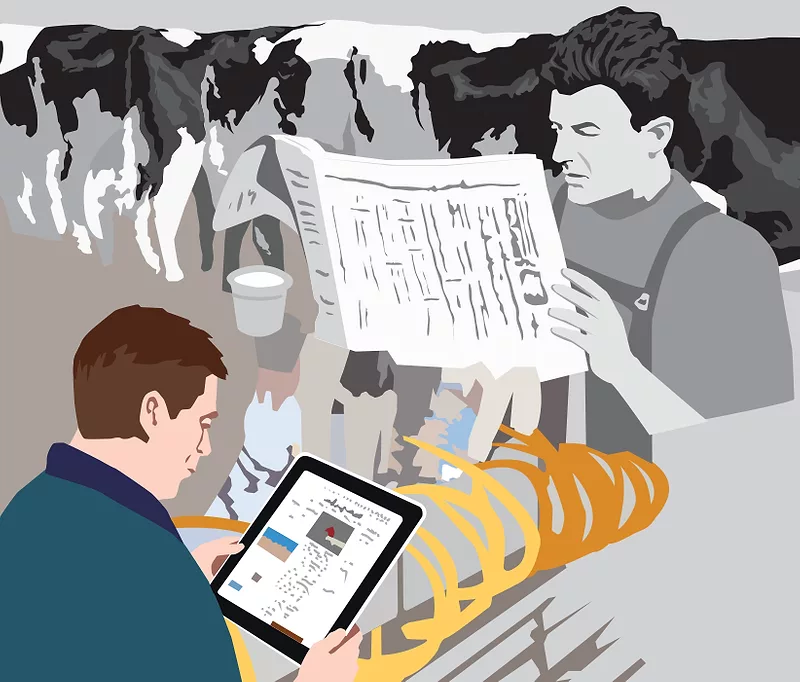
Most of the farming journals on our kitchen table had milk stains. They were piled everywhere and my cereal bowl never set evenly on them. Some had manure stains, too, where they were brought to the milking parlor and made their way back. Being surrounded by their headlines every morning gave one the sense of being fully grounded in what was happening in the industry. Inevitably, all of us would grab a magazine we hadn’t read yet and flip through its pages while we ate off-brand Captain Crunch or discounted Grape Nuts. I think those journals made us feel that we were part of something bigger, and the articles inside helped us understand what that part was.
Since high school, I knew I wanted to write. More specifically, I wanted to write about farming. Those who farm give of themselves in a way that is different than how other people approach their jobs and, because of that, there is a lot to explore in its dynamics. It is an occupation that requires an immense amount of labor and personal sacrifice and brings back poor financial compensation, and yet people are still driven to do it. I suspected that answering all the reasons why would fill a lifetime of notebooks.
The farm journal in North America is a tradition that goes back to near the founding of the U.S. At first, farmers were suspicious when, in 1819, The American Farmer was put into publication by John Stuart Skinner. Never having a periodical dedicated to farming before, some suspected it was only put forth by politicians in an effort to garner votes. However, The American Farmer was firmly non-partisan and produced with the aim of sharing agricultural knowledge and experiences to the benefit of all. The experiment proved successful, enjoying two-and-a-half decades of circulation.
Published out of Baltimore, the first article in the founding issue of The American Farmer was titled “The Ruta Baga or Swedish Turnip,” discussing the benefits of growing the root vegetable as a cattle feed. Other content in the opening volume included a detailed drawing of the cuts of meat on a Delaware ox and news snippets from around the world, from the anniversary of King Louis XVI’s death in Paris to police reports of who had drawn their pistol on whom in Cincinnati. There was also a section called “Amusements” which, in this instance, was titled “Sketch of English Manners,” mocking the wealthy British and all the dirt their servants probably had on them. Often The American Farmer also included a poetry section, as well as a department written by women for a female audience, which was uncommon at the time.
I was in my mid-20s when Progressive Dairy (then called Progressive Dairyman) gave me my start in writing about agriculture. I’m not sure why Walt Cooley and the editorial team took a chance on a farmer’s son without any publication history, but I’m thankful they did. My family got a kick out of seeing my face in one of the farming journals on the kitchen table. (One grandfather, a super-fan of Baxter Black, thought that I had eclipsed all Pulitzer Prize winners by being in the same magazine as the vet-turned-media personality.)
Because of the column, every three weeks I had to come up with something to say about what it means to be a farmer. That task has helped embed that effort as my life’s work and has formed the bedrock for me to do something similar in fiction and creative essays. In particular, the column laid the foundation for my memoir, Barn Gothic: Three Generations and the Death of the Family Dairy Farm, which explores how dairy farming in the U.S. has changed since the turn of the century and what it was like for our family to try to survive those conditions. Some of the moments in the book have already been written about in this column.
Eventually, The American Farmer became a victim of its own success. When it printed its last issue in 1834, there were at least 15 other agricultural journals in the U.S. following its lead, and it found that it couldn’t retain a large enough share of farmer subscriptions to keep going. However, its pioneering efforts proved that the sharing of information, experiences, humor and creative writing about farming is an essential part of sustaining the larger farming community in a country. It allowed farmers to receive important news and knowhow that formed the decisions they made, while also connecting them across geography, making the act of farming less lonely.
The ultimate gift of the farm journal is to remind us that we’re all in this thing called farming together. Thanks to the work of Progressive Dairy and the magazines that have come before it, thousands of farmers have a better understanding of what they do, one writer got his start, and some families out there never had a bare kitchen table.