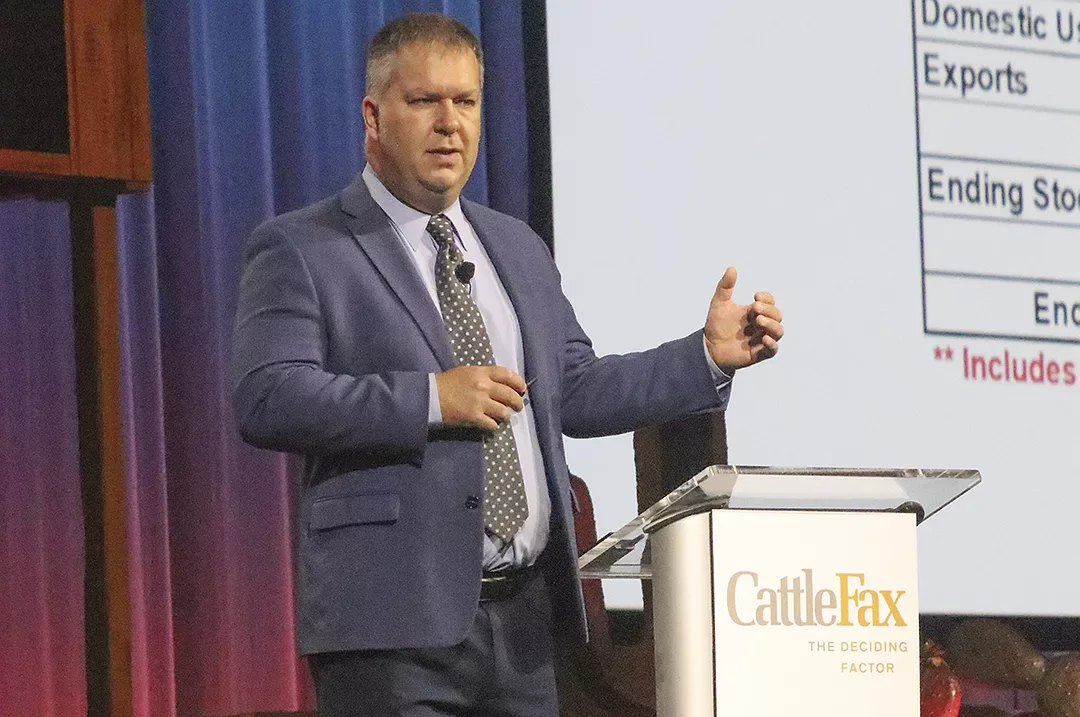
The CattleFax Symposium at the National Cattlemen's Beef Association's (NCBA) 2025 CattleCon revealed a fairly healthy supply of feed and grain in the early winter, all thanks to a record high yield in 2024.

Which is good, because 2025 could be a rougher year for yield on the grain and forage front.
U.S. corn yield hit 1.76 billion bushels in the last calendar year, and that’s with a smaller acreage of 4 million acres last spring and a drier fall as well, according to CattleFax analyst Troy Bockelmann.
“We had adequate production. It wasn't the record production, but it was, second, third-highest, and then you had record-high demand. Not only record-high demand domestically, but global demand outpaced global production as well by about 100 million bushels.”
As the supply of cattle continued to decline in 2024, cattle on feed numbers also didn’t rise, but production was still high as cattle stayed on feed longer, drawing down some grain supply through winter.
“We have a stocks-to-use number in the current marketing year sitting here at 10.2 percent; that's right on the border between a comfortable and a tight stocks-to-use number as we head into the 2025 growing season.”
With the La Nina weather pattern portending dry conditions in corn-growing states, supplies could be in for a decline in 2025. Five of the past six years have had below-trendline yields.
But the real factor emerging for the coming year is exports, and the uncertainty of how trade negotiations could swing through the year.
“Exports is going to be the driver. If we think about price, are we going to see export demand slow down, or is export beginning to stay relatively stable?”
China, which bought 800 million bushels in 2020 and 90 million bushels a year ago, hasn’t received 1 million bushels yet in the current marketing year. But Bockelmann said South Korea, the European Union, Japan and Colombia have stepped up as buyers.
Given strong export demand, “the market’s responsibility, if we’re going to have a tight supply, is to ration some of that demand through higher prices, and that’s what we’ve seen as you’ve had this rally in the corn market.”
Corn spot futures went from $3.64 in the second half of 2024 to a current price around $5, a 30% rally. Bockelmann forecast corn futures at $4.40 and $3.75 as a floor. “That’s a little bit conservative,” he added. “It could be 4.50 or even 4.60. What’s going to matter is what happens here over the course of the next three to five months.”
Bockelmann said soybean yields were below the trendline in 2024, coming in at 51.5 bushels per acre. Hay prices followed similar trendlines to corn and had a nationwide average around $175 per metric ton. Given that correlation between the two, as corn increases this year, producers can expect some similarity in the hay market.
“Even though we have rebuilt hay stocks a little bit from those record-low levels two years ago, [with a] little bit more drier weather, hay prices are going to follow corn a little bit higher here. We don't have them going significantly higher on the U.S. average basis per metric ton.
Hitting briefly on energy prices, Bockelmann said, “You're not seeing a big change of supply and demand. It's going to be driven a lot more by geopolitics than it is about supply and demand. So we would expect prices for energy as we go into 2025 compared to 2024 to be relatively flat.”