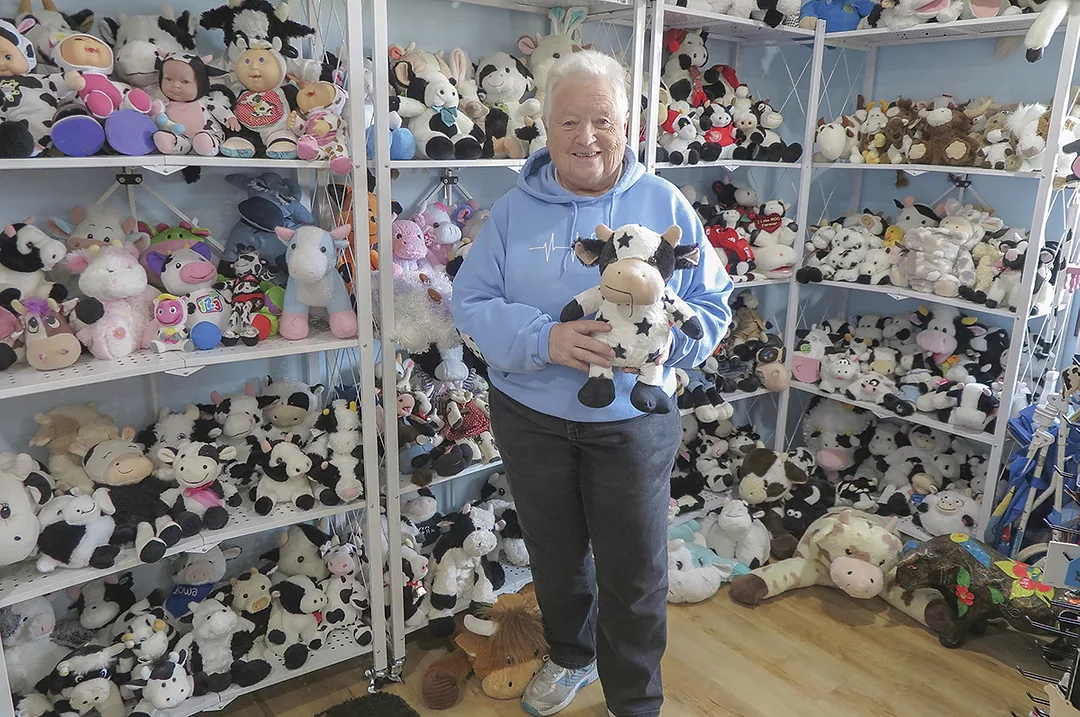
In a quiet corner of Minnesota, in a home bursting at the seams, lives the Guinness World Record holder for the largest collection of cow-related items. What began as a simple admiration for dairy cows has transformed into a one-of-a-kind collection that spans over 21,805 unique items and fills every room of Ruth Klossner’s house.

What makes this collection truly extraordinary is how unlike most collections confined to a shelf or a single room, this one has taken over the entire home.
“I don’t think there’s another one like it anywhere,” Ruth Klossner says. “I know a lot of people have cow collections, but what makes it unique is that it covers the whole house. It fills every room from the first floor to the basement, and some are out in the garage because there’s a lack of wall space in the house now, even with the addition I built on.”
Klossner’s love for cow items happened by chance, she says. It wasn’t something she set out to do, even though as a kid she was always drawn to farm toys, especially the cows.
“The collection started totally by accident one day in the mid-1970s when I went to a household auction with friends. In the auction, there was a white plaster statue of a cow and a calf,” Klossner says. “I bought it because I liked it. At the time, I was also showing horses and had a similar statue of a horse and colt. So I decided I may as well have a statue of a cow and calf sitting with it.”
When Klossner bought her house out in the country in the little burg of Bernadotte (four houses, seven people and four dogs) in 1979, it wasn’t long before she dug out her old 4-H cow figures and models to decorate with her existing pieces.
“I remember placing all of my cow items on the ledge in the stairwell, which is 4 inches wide and about 8 feet long,” Klossner says. “That’s when they started multiplying. First, they filled the basement, and then they filled the upstairs.”
Eventually, Klossner’s collection outgrew the space she had, so just over a year ago, she added a new 16-by-32-foot addition to the house consisting of part office but mostly display space. However, even that space has since already filled up.
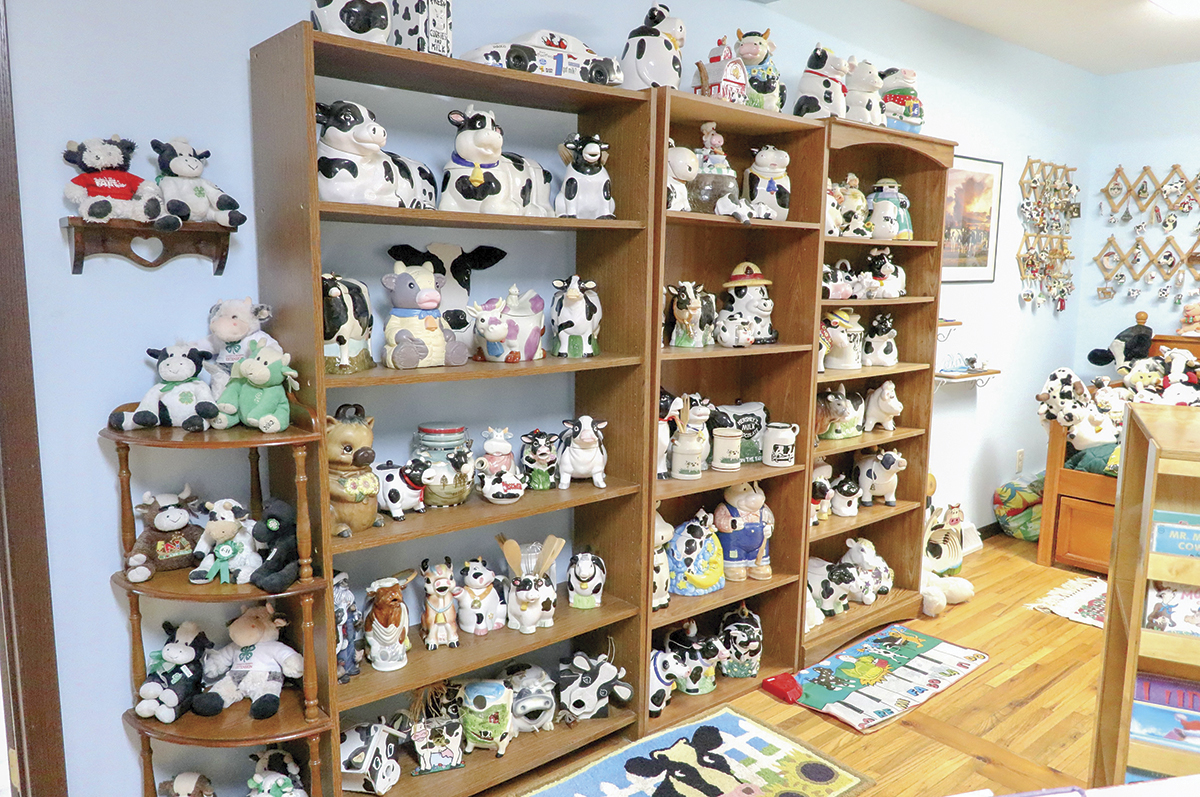
Klossner’s one-of-a-kind collection began by chance and continues to grow, delighting visitors nationwide. Image provided by Ruth Klossner.
Recently, Klossner was gifted 23 totes full of cow items from a family in Wisconsin that wished to have someone who would appreciate the items and take the things their mother had collected.
“It’s time-consuming going through new items. The first thing I determine is if it is a duplicate or something unique. Sometimes I can’t quite remember, so I have to go wandering around the house looking to see if I really have the piece or if it is similar to something I’ve got and is unique,” Klossner says. “I list every piece on a spreadsheet on my computer and whatever number I’m up to, I put a sticker number on the piece or write the number wherever I can. After that, I also photograph each new piece for documentation.”
When that is all done, Klossner has to find a place to put the item. The sheer volume of cow collectibles presents its own logistical challenges, from finding display space for new additions to dusting.
“Half of the fun is the hunt of going to find something new at garage sales, flea markets, department stores and craft shows. The other half of the fun is sharing it with people. I’ve had everything from individuals to bus groups,” Klossner says. “Dusting, however, is no part of the fun.”
For years, Klossner’s friends told her she should get in the Guinness Book of World Records. However, while working as a newspaper editor until 2011, she didn’t have a lot of spare time, knew it would be a time-consuming process and would require research on how to do it.
“After I retired from the newspaper, I had a little more time and started the process. Guinness requires you to submit a computer list, photos, video and letters of authenticity,” Klossner says. “So I had the local county sheriff and a district court judge, both of whom I knew through Lions Club and the community, come out at separate times to verify the collection in writing.”
Klossner sent all her information to Guinness in early 2015 and received a letter back saying it was not accepted.
“The next time I saw the district court judge, he asked, ‘Well, what did you hear from Guinness?’ I said, ‘It’s not going to happen. We either have to photograph or count them all,’” Klossner says. “He looked at me and said, ‘We’re going to count them. I’m retiring this summer and will have time, so we are going to count them.’ I told him he was crazy.”
When June arrived, the judge got in touch with Klossner, blocked off three full days, brought his wife and had a clear system in mind ready to tackle the collection room by room, wall by wall and shelf by shelf.
“They finished in two days and tallied everything up, and it came out to 15,144 pieces. My computer list at the time showed about 15,700, but they knew they had missed some. So many were small and close together, and in one area the only way to get an accurate count would have been to take them all off and put them all back. I told them to just do the best they could,” Klossner says. “Afterwards, he wrote another letter to Guinness with the tallies and sent it in. In June of 2015, I got the letter and certificate saying it was accepted.”
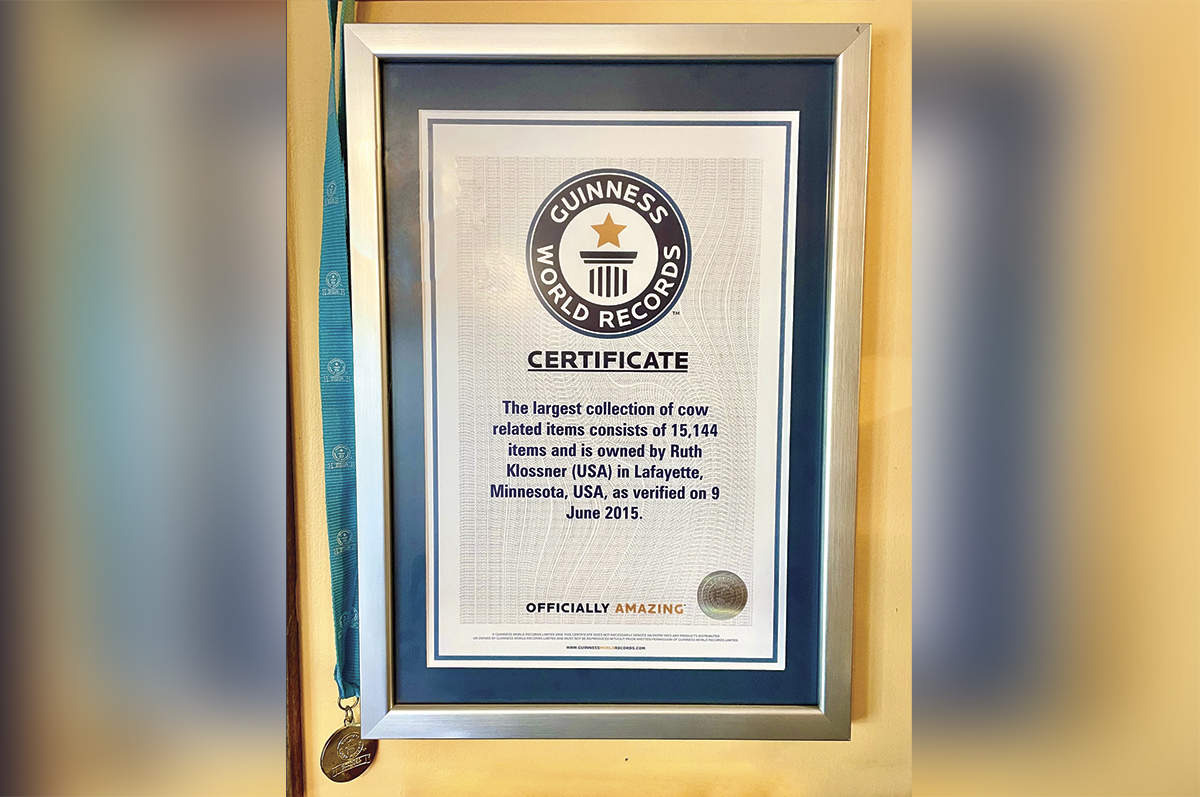
In June of 2015, Klossner received her Guinness World Records certificate for the largest collection of cow-related items. Image provided by Ruth Klossner.
Earning the Guinness World Record came with a deep sense of relief more than anything else, simply because of the process, says Klossner.
“It's really special to have a Guinness World Record, and it’s special to other people to see it, but I'm probably not as hung up on it as a lot of people are,” Klossner says.
Among the cow treasures, Klossner’s favorites are her model figure and paintings of her favorite 4-H cow named Klossner Princess Delight.
“I have a cow model made by Carol Herdon of Amboy, Minnesota, who does various livestock models and is at World Dairy Expo every year. The model is painted like Princess and has all of her markings on it,” Klossner says. “I’ve also got two paintings of Princess done from photographs by local artists.”
Princess was champion of the registered Holstein show at the Minnesota State Fair in 1966. She classified 89 points, had a production record of 26,688 pounds of milk and 1,042 pounds of butterfat as a 7-year-old, Klossner says.
“Princess was my claim to fame. She was the one good cow I was able to raise before our dairying halted when my mom died and my dad quit farming,” Klossner says. “Growing up on the farm is where my dairy background comes from, starting with Midnight, a grade calf, to my first purebred cow named Delight and the daughter of that first purebred cow named Princess.”
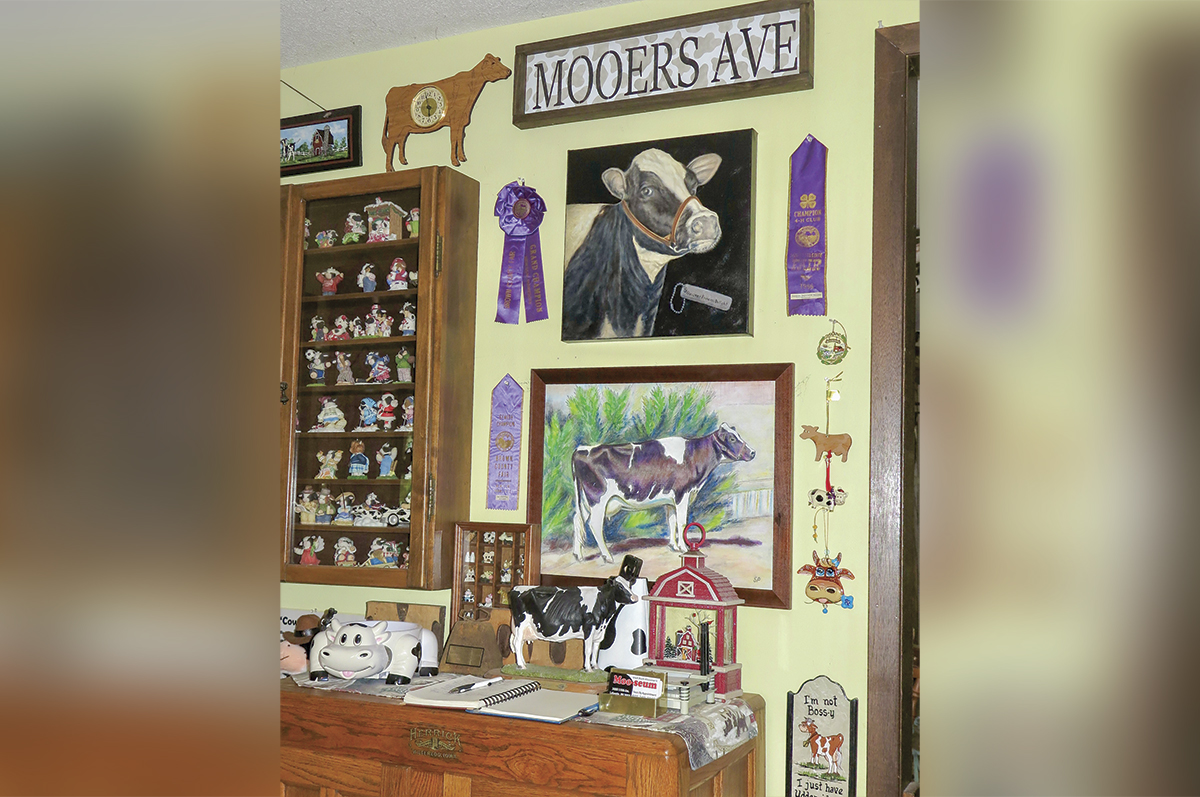
Among the cow treasures, Klossner’s favorites are her model figure and paintings of her favorite 4-H cow growing up, named Klossner Princess Delight. Image provided by Ruth Klossner.
The piece Klossner is most proud of is a sterling silver cream pitcher affectionately known as “Tippifina,” gifted by none other than actress Tippi Hedren, star of Alfred Hitchcock’s The Birds.
“Tippi lived at Lafayette and lived here until she was 5 or 6 years old. She came back to be Grand Marshal of our town’s parade in the year 2000, and she ended up staying at my house here because she wanted to stay with her sister, who was going to stay at my house,” Klossner says. “So Tippi stayed here at my house and we had a ball. She was as personable as anybody and we had fun laughing and carrying on.”
Then, in 2014, Hedren came back to speak in a program in New Ulm, Minnesota.
“When she saw me, her first words to me were, ‘I brought you some little cows for your collection, but I've got one more you're gonna have to wait for. I'm gonna leave it to you in my will.’ She didn't tell me any more about it, just that she had this cow she was gonna leave me in her will,” Klossner says. “After Tippi went back to California, she called me and said, ‘The cow and I talked it over. She wants to come live with you now.’ So I didn't have to wait for it in her will and she shipped me the sterling silver cream pitcher.”
Tippifina has a place of honor on one of Klossner’s shelves and is the most valuable piece in her collection, both financially and because of where it came from.
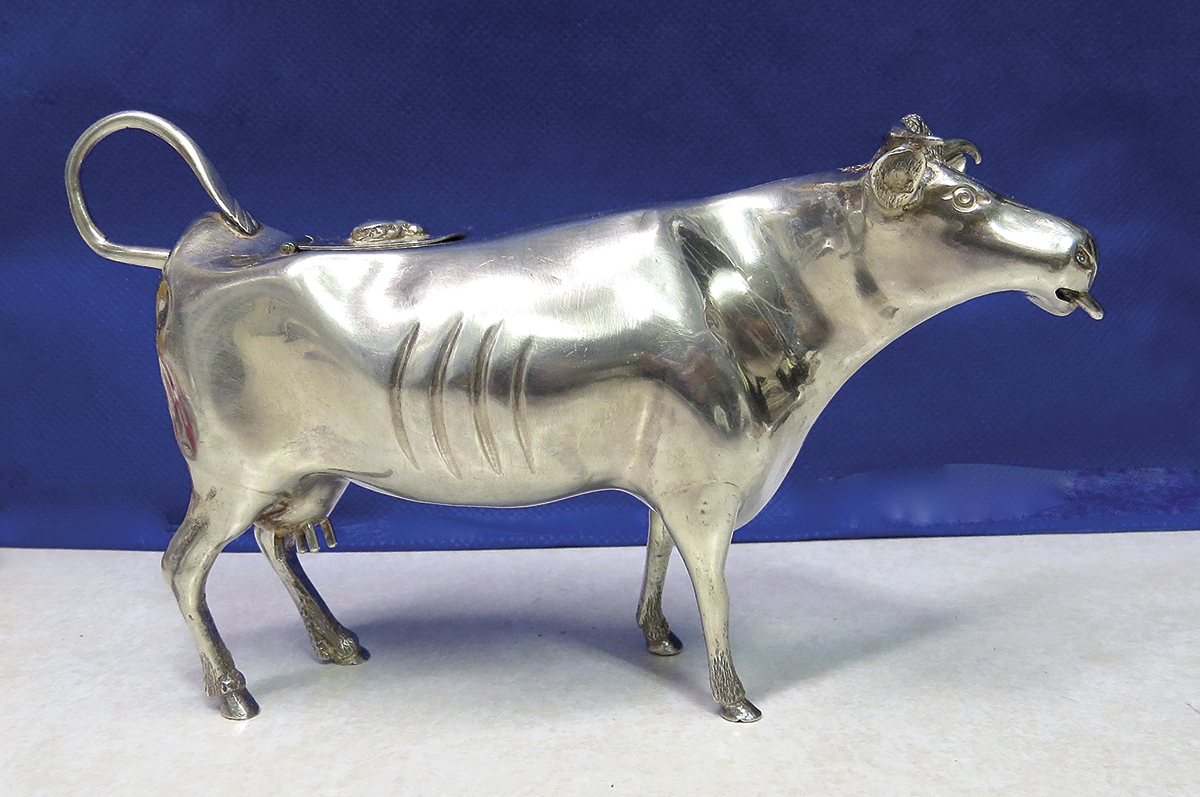
The piece Klossner is most proud of is a sterling silver cream pitcher affectionately known as “Tippifina.” Image provided by Ruth Klossner.
Looking ahead, the future of the collection weighs on Klossner’s mind. With no family wanting to carry it on, she finds herself hoping a large dairy company or organization might see the value in preserving it.
“The family who was here yesterday said it should stay right here in this house because packing it all up would be impossible. And I agree,” Klossner says. “There's been some talk it could stay here as a museum, but I don’t know who's gonna run it. So nothing is decided. I'm 77 years old, but my dad lived to be 101. So I figure I have a little time.”
Over the years, Klossner’s motto has become “If it’s bovine, it’s fine.” While many assume the collection is all Holsteins, a closer look reveals a mixture of all dairy breeds and beef cattle.
“At some point, I am planning to write a book about my life with cows and the title will be, If it's bovine, it's fine with the subhead, ‘Cows I have known, shown and collected,’ So I've been saving little snippets of stories that'll go in the book,” Klossner says. “I've been writing history books for the area towns, and I haven't had time to write my own book. So I say that's it for others. The next book is going to be mine.”
If people wish to come view Klossner’s cow collection, they can reach her by phone (507) 240-0048 or email.