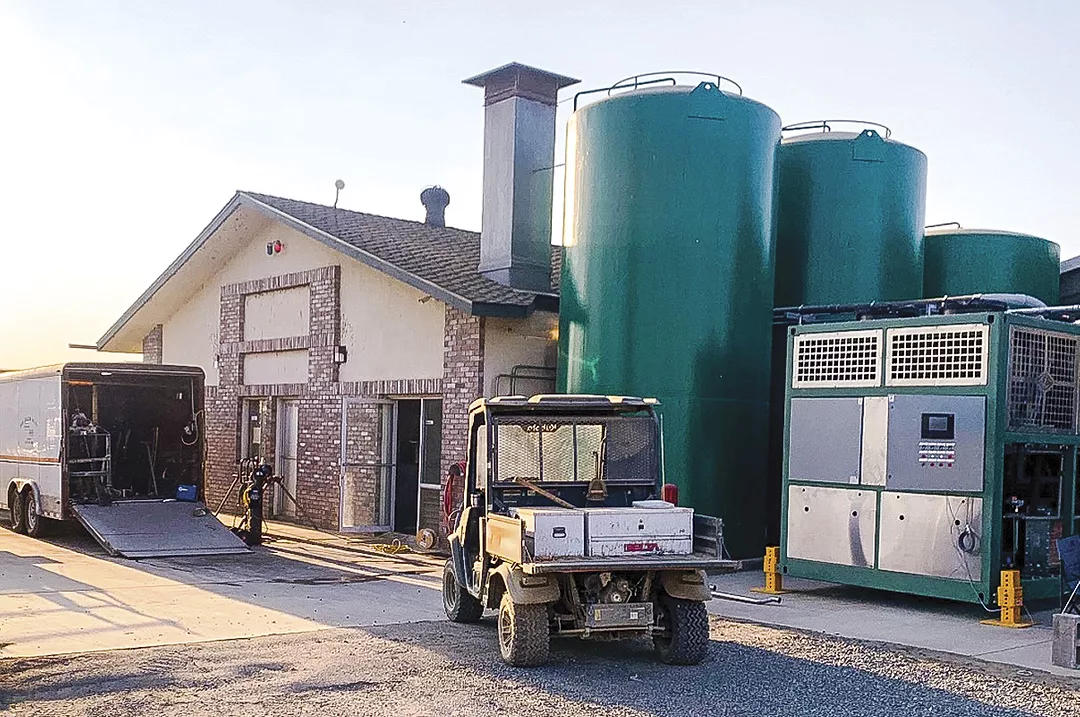
Dairies have long been navigating complex challenges that make it difficult to lean into forward-looking innovations. But certain cutting-edge solutions have the ability to address numerous priority areas all at once and simultaneously yield a substantial return on investment.

Chief among these are milk chilling systems that replace synthetic chemical-based refrigerants with naturally occurring, readily available carbon dioxide (CO2) or R744, its refrigerant-grade version. No longer new, these chillers are gaining momentum in the dairy industry, following the path of supermarkets, where CO2-based systems have become the standard over the past 20 years. They are already highly utilized overseas, though they have yet to become the norm for dairies in the U.S.
But that is changing rapidly. Those who embrace these systems now will gain some big competitive advantages and improve their prospects for growth far into the future.
A proven, sustainable solution
In 2021, the first CO2 chiller system for milk cooling was commissioned on a California dairy farm. Fast-forward to 2025, the results are clear: Dairies adopting this technology are seeing tangible benefits in efficiency, cost savings and sustainability.
Bill Jongsma of Tipton, California, became the first U.S. dairyman to transition to CO2 refrigeration, and his success has inspired other farms to follow suit. About a year later, his nephew, Christopher Jongsma, also installed a CO2-charged chiller system.
Bill Jongsma, of William & John Jongsma Dairy, milks in an 80-stall rotary parlor. By pushing more cows through the parlor, he is able to generate more hot water through the chiller system, and in 2024 the farm reduced propane use by two-thirds.
“We’ve decommissioned two of the three propane hot water heaters on the farm, and we’ve been able to operate for extended periods when the heater was shut off for repairs,” Bill Jongsma says.
There are variables to generate the hot water.
“The more cows you can push through the parlor, the more hot water I can generate. We can also generate more hot water in the summer and still support the dairy during the cooler winter months,” Bill Jongsma says. “Timing on a dairy is the biggest factor.”
At Christopher Jongsma’s South Creek Dairy, cows are also milked in an 80-stall rotary parlor. The dairy’s system provides 100% of the farm’s hot water supply.
“We’ve opted to leave our natural gas-fed hot water heater off after it was shut off due to a fault,” Christopher Jongsma says. “When that happened, we waited for two months to make sure there wasn’t a billing mistake. Our natural gas bill went to almost zero dollars.”
Why make the switch?
One of the biggest advantages of CO2 refrigeration is its ultra-low global warming potential (GWP). With a GWP of just 1, CO2 is the benchmark that all synthetic refrigerant manufacturers are striving to reach. In contrast, common refrigerants like R404A have a GWP of 3,900, making CO2 a far more climate-friendly choice. Unlike synthetic refrigerants, which are subject to phase-out regulations, CO2 has no regulatory risk, making it a stable, long-term solution for dairy farms looking to future-proof their operations.
Efficiency is another key advantage. CO2 chiller systems use less power than their synthetic-based counterparts while delivering equal or better cooling performance. In addition, the high density of CO2 allows manufacturers to utilize smaller-diameter components, and a higher operating pressure allows systems to move refrigerants at higher volumes. These benefits are holding true even in extreme climates and continue to be validated in independent studies underway in California that compare CO2 systems with traditional refrigerant-based equipment. The findings continue to confirm what early adopters already know – CO2 is simply a smarter choice.
A major benefit of CO2 systems is their ability to repurpose waste heat. Unlike traditional refrigeration systems that discard excess heat into the air, CO2 chillers convert waste heat into 180ºF potable hot water. This means dairy operations can use their refrigeration system as a primary water heating source, significantly cutting down on fossil fuel use. Many dairies report saving thousands of dollars each month by reducing their reliance on traditional water heaters.
For dairy operators, regulatory compliance can be a major burden. The EPA strictly regulates synthetic refrigerants, requiring farms to register systems, track refrigerant usage, log losses and document recharges. CO2 refrigeration eliminates this administrative headache. Because CO2 is not a synthetic refrigerant, it is exempt from these regulations, freeing farmers from the time and costs associated with compliance.
Also, as a naturally occurring part of the air we breathe, CO2 is a highly abundant resource that can be simply borrowed from the atmosphere. As such, it is dramatically more affordable than common, chemical-based refrigerants. To illustrate, refrigerant-grade CO2 currently costs approximately $4 per pound, compared with the more-than-$40-per-pound price tag for synthetic-based refrigerants.
Switching to CO2 refrigeration also opens the door to potential financial incentives. While carbon credit programs in the U.S. are still evolving, farms that transition to CO2 will likely be in a strong position to apply for funding opportunities, incentives and low-interest financing. The environmental impact of this switch is significant – 1 pound of R404A refrigerant has the same carbon impact as 3,900 pounds of CO2, or nearly 2 tons. To put it into perspective, a 400-pound CO2 charge has the carbon impact of a one-way flight from Seattle to Los Angeles, whereas a 400-pound R404A charge has the same impact as 400 round-trip flights between those two cities.
A smart move for dairy’s future
The transition to CO2-based refrigeration isn’t just about sustainability – it’s about making a financially sound, future-proof investment. With CO2 chiller systems already delivering real-world results, early adopters are gaining a competitive edge while reducing costs, compliance headaches and environmental impact.
The future of dairy refrigeration is here. Are you ready to make the switch?