When the heat arrives, it is often too late to prepare facilities for the battle that is already in full force. Heat stress can also come at times before the calendar indicates that it should be a problem. With a plan for maintenance of the heat abatement system scheduled during cool temperatures, the system can be fully functional when needed. Assuming the system worked when it was shut down in the fall can lead to disappointment in the spring. How well the system was running at the end of the season will also play a role in startup. Parts may need to be ordered; pieces of the system may need to be replaced. Cleaning should always be a part of the setup for the cooling season.

What is heat stress?
Heat stress is defined as the point where the sum of physical heat production and environmental heat is greater than the ability to dissipate the heat. Physical heat production is influenced by body maintenance, production level, feed intake and physical activity. Environmental factors affecting heat production include air temperature, relative humidity, solar radiation and air movement.
For those who need proof that cows are under stress, this can be demonstrated in a couple of ways. Cows exhibit heat stress symptoms when rectal temperatures of 80% of the cows in a group exhibit a temperature above 102oF. Respiration rates greater than 80 breaths per minute are also a good physical indication of heat stress.
Other signs of heat stress include a drop in dry matter intake of greater than 10%, which is generally followed by a milk production drop of 10%. Cows will bunch in the areas where air is freshest and areas that have the highest airflow. This bunching can also be influenced by the presence of flies, where cows will bunch to combat the pests. When cows exhibit this behavior, the heat is literally on, and measures should have been implemented to avoid this, or urgent measures need to be enacted to relieve the cows.
Temperature Humidity Index
When does heat stress occur and what should be the indicator of when to turn the system on? Temperature Humidity Index (THI) is one measure that has been researched as a means to determine how stressed animals are. This index combines the effects of temperature and humidity in a formula to compute a value. The researchers then evaluated animals exposed to various THI measures to determine at which THI animal activity and performance is affected. The THI studies have determined that animals in an environment of THI less than 68 do not have heat stress. Animals in an environment with a THI of 68 or greater would exhibit some degree of heat stress. As the THI increases, the necessity of heat abatement will be increased. Many dairies will start with some fans for ventilation and air movement. As the THI increases, more fans will be activated and, finally, water applications for evaporative cooling will begin.
There is the question of what to do when the THI gets extremely high. At the high extremes, it is not possible to keep cows cool, but that does not mean to stop trying. Any movement of air across the cows is a benefit.
The question of when to stop cooling cows for the day is another area of discussion. When the temperature is comfortable for humans, that does not mean the THI is comfortable for the cows in a building. Keep the heat abatement system running into the evening. The return on your investment of electricity will be returned in cow recovery.
Steps to prepare for the heat
- Verify that curtains are operational, especially in naturally ventilated barns. Curtains have been buttoned up in cold climates and these must be able to be adjusted. This is especially true in the spring when temperature fluctuations can be dramatic. Seldom during this season can curtains be set and ignored.
- Clean and check the electrical fixtures that control fans and curtains. Barns can be a dirty environment, and routine cleaning will help keep these crucial components operating optimally. When one of these components fails, it often affects other parts of the system.
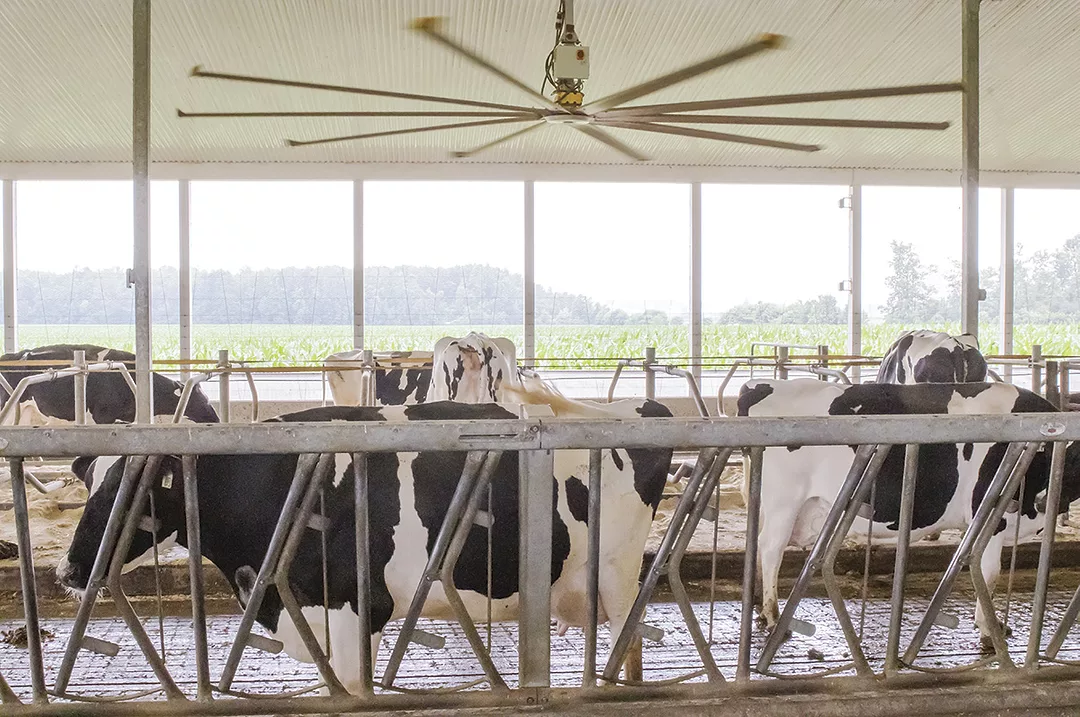
- Fans should be cleaned, and the performance of the fans should be checked. Fan blades should be physically cleaned to remove dirt and dust. Dirt accumulation on fans can reduce the effectiveness of their ability to move air by 24%. Belts should be checked and tightened as needed. Direct drive fans should be checked to be certain they are operating appropriately. Airflow from the fans should be verified and compared to manufacturer specifications. If fans are underperforming, these fans should be replaced. This may seem like an arduous task, but efficient operation of these fans will benefit the cows with proper ventilation and will be the most cost-effective way to operate the heat abatement system.
- Verify the positioning for fans and adjust to recommendations for maximizing the effects of the fans. Fans should be spaced appropriately. A minimum recommendation would indicate that 36-inch fans should be spaced no greater than 30 feet apart and 48-inch fans should be spaced within 40 feet. This is influenced by the type of fan and placement of the fans. Following the manufacturer specifications will be key for these components. Fans should be installed above the stalls (7.5 to 8 feet) to keep out of reach of the cows and angled such that the air from one fan reaches the location of the next fan to create a continuum of airflow.
- The water systems should be cleaned and checked to ensure that it is delivering water when expected at the volume and rate required. Solenoid switches should be cleaned and filters cleaned or replaced so that water can be dispensed when needed. These systems are only effective when working properly.
- Thermostats should be cleaned and tuned. If the fans are set to turn on at 68oF, do they turn on? What is the sequence of fan startup to prevent circuits from being overloaded and system failure? Does this work properly? Cycling through the startup is crucial to know it will work when it is needed.
- Shades in drylots for milking cows, dry cows and heifers should be checked and repaired as necessary. Shades over resting spaces should run north to south to allow the cows to follow the sun and maintain shade protection. The feeding area shades should run east to west to allow for maximum coverage over the bunk space.
- Barn doors must operate to allow airflow to be directed by the ventilation system. In tunnel and cross-ventilated facilities, this is critical. It is also important in naturally ventilated barns. The deceiving part of barn doors is that when the doors are open, the air flowing down the feed alley feels very good to the person standing in the center alley. The problem is that the cows are not in the center alley, and the air flowing down the center alley is not flowing over the cows. The cows are the creatures that these systems are designed to cool, and if the doors are open, this is not happening. The doors must be closed if this is how the barn is designed.
- If the system has cool cells for evaporative cooling, these should be routinely cleaned and replaced when they are no longer effective in cooling the environment.
- If the system includes bunk line sprinklers for cows, nozzles should be cleaned and checked for functionality. It may be necessary to descale malfunctioning nozzles in a vinegar solution or replace. The area of water application should be checked and adjusted to ensure water is being applied appropriately behind the feedline and that target wetting rates are achieved for each on cycle.
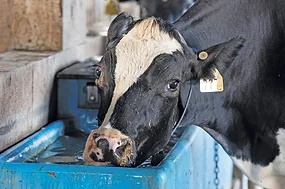
- Water access, availability and cleanliness are always critical factors on a dairy. This is especially true during heat stress. Cow activity levels decrease during heat stress and their motivation to fight for water will also decrease. Water must be readily available in a clean trough to encourage water intake.
Being prepared for the heat will result in the least amount of stress on the cows and the people dealing with these animals. The environment where the cows reside is the critical area of the barn to evaluate. Keep the ventilation system, including doors and fans, set to where the system was designed. These actions will allow cooler heads (and cows) to prevail.