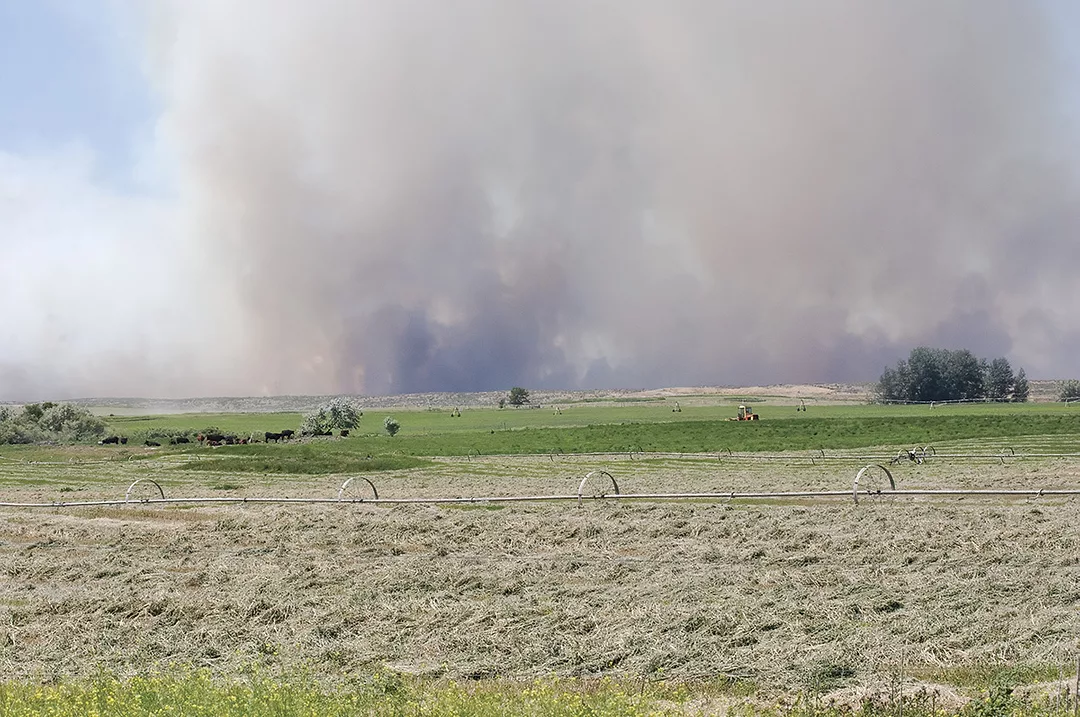
Wildfires have become more frequent and severe across the U.S. and globally. Since the 1980s, the area burned by wildfires has increased, peaking in spring and summer. The primary driver is climate change, which extends fire seasons, raises temperatures and intensifies droughts. These conditions, along with wind, humidity and temperature shifts, contribute to unpredictable and fast-spreading fires.

Wildfire smoke contains a complex mix of gases and fine particles, with PM2.5 (particulate matter smaller than or equal to 2.5 microns) being particularly harmful. These tiny particles penetrate deep into the lungs and bloodstream, contributing to respiratory, cardiovascular and neurological issues in humans. The air quality index (AQI) can be used to assess how clean or polluted the air is. It includes six color-coded categories, with darker colors indicating worse air quality.
How wildfire smoke affects cattle
Our group at Oregon State University recently demonstrated the effects of natural wildfire smoke exposure on 18 beef-on-dairy calves (Jersey-Simmental). Calves were enrolled in the study at birth, and blood samples were collected before, during and after wildfire smoke exposure. Air quality data, specifically PM2.5 near the study location, was obtained from the AirNow database.
Air quality before wildfire smoke exposure was considered adequate, and PM2.5 was, on average, 4.9 micrograms per cubic meter from June to August. In September, a wildfire occurring approximately 10 miles from the study location reduced the air quality, increasing PM2.5 to an average of 44.6 micrograms per cubic meter for four consecutive days. After the fire was contained, air quality improved, and PM2.5 dropped to 8.6 micrograms per cubic meter.
Blood cortisol concentrations were evaluated for the duration of the study, as this hormone is known as the stress hormone. Blood samples collected before smoke exposure did not differ. However, cortisol concentrations increased and peaked during wildfire smoke exposure at 10.3 and 7 nanograms per milliliter. Immediately after smoke exposure, cortisol concentrations averaged 6.3 nanograms per milliliter, intermediate between those before and during wildfire smoke exposure.
Plasma ceruloplasmin, which is an inflammatory marker, was also affected by wildfire smoke. Ceruloplasmin concentration of samples collected before smoke exposure did not differ during the three initial collections (21 milligrams per milliliter), but increased and peaked after smoke exposure at 35.1 milligrams per milliliter. During smoke exposure, ceruloplasmin concentrations were intermediate (27.6 milligrams per milliliter) between those before and after smoke exposure.
Simulated wildfire smoke exposure study
One of the limitations of studying the effects of wildfire smoke exposure and the effects on livestock health and performance is the unpredictability of wildfires, therefore hindering the ability of researchers to plan and execute such studies. In order to overcome this challenge, our group has developed a methodology to produce wildfire smoke indoors, mimicking natural wildfire smoke conditions livestock are exposed to during wildfire season.
In this study, we are currently investigating the effects of simulated wildfire smoke on physiological and behavioral responses of heifers over time.
In the first year of the study, eight heifers (Angus-Hereford crosses averaging 531 pounds at 8 months old) were individually housed in pens within a completely closed barn for 36 days. The study was divided into three phases: acclimation, smoke exposure and post-smoke exposure. The acclimation phase lasted from day -7 to -1 as shown in Figure 1, during which heifers were adapted to their new environment. The smoke exposure phase occurred from days 0 to 7, where the heifers were exposed to controlled smoke for seven consecutive days. The post-smoke exposure phase was from day 8 to 28, where heifers were monitored for three weeks following smoke exposure. Throughout the study, blood samples were collected once a week for the evaluation of multiple blood parameters. Heifers were individually fed alfalfa hay free-choice, and feed intake was monitored daily.
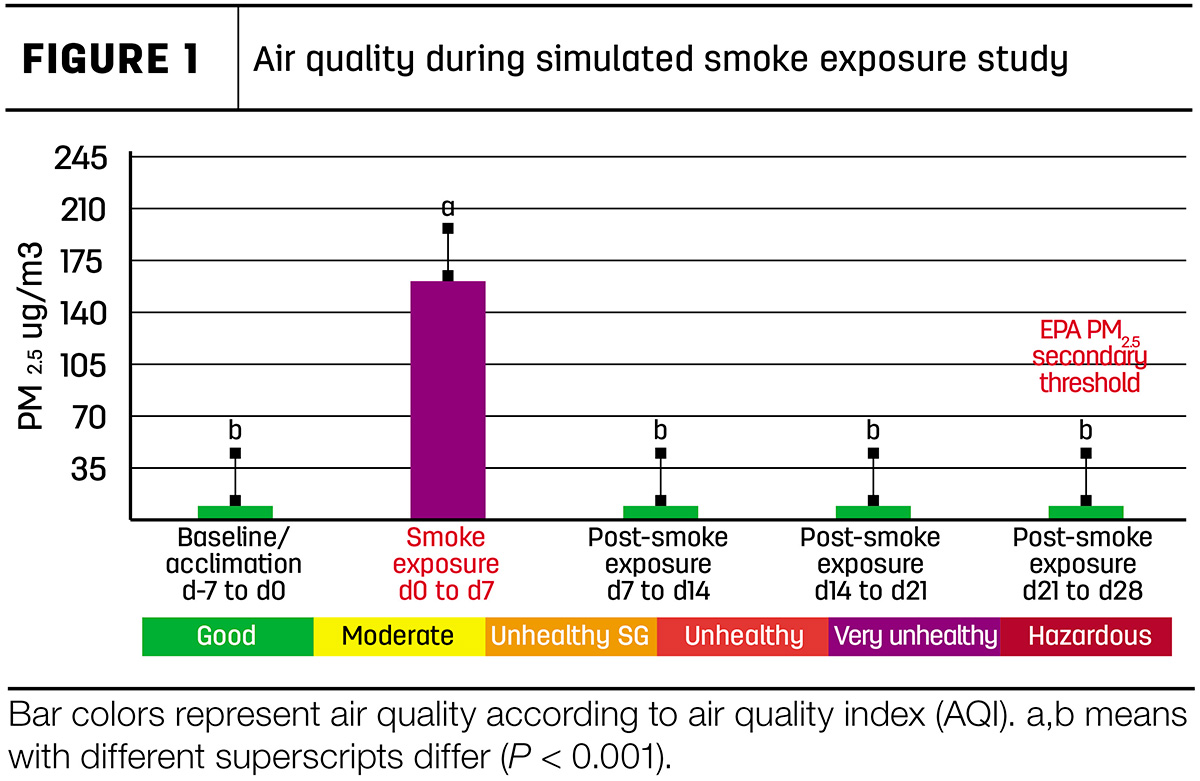
Preliminary results showed that air quality, measured using PM2.5, exhibited changes over time, with a daily average of 159 micrograms per cubic meter during the smoke simulation phase, exceeding the EPA standard of 35 micrograms per cubic meter (Figure 1).
Similar to what was observed during the natural wildfire smoke exposure study, changes in blood markers were also observed in this study. Preliminary analysis showed that heifer plasma ceruloplasmin increased over time, reaching a peak during smoke exposure (29 milligrams per milliliter), which was maintained (27 milligrams per milliliter) for a week post-smoke exposure before returning to nadir (23 milligrams per milliliter). Furthermore, blood hematology revealed an increase in the percentage of lymphocytes over time, which was greatest at post-smoke exposure before returning to similar levels at the beginning of the study.
The feed intake of heifers in this study increased gradually over time, which was expected for these recently weaned growing heifers with ad libitum access to feed. However, during the smoke exposure phase, feed intake was stagnated, and no changes were observed in daily intake during this phase. In fact, feed intake only peaked again seven days post-smoke exposure (day 14 of the study; Figure 2), suggesting that smoke exposure negatively influences feed intake.
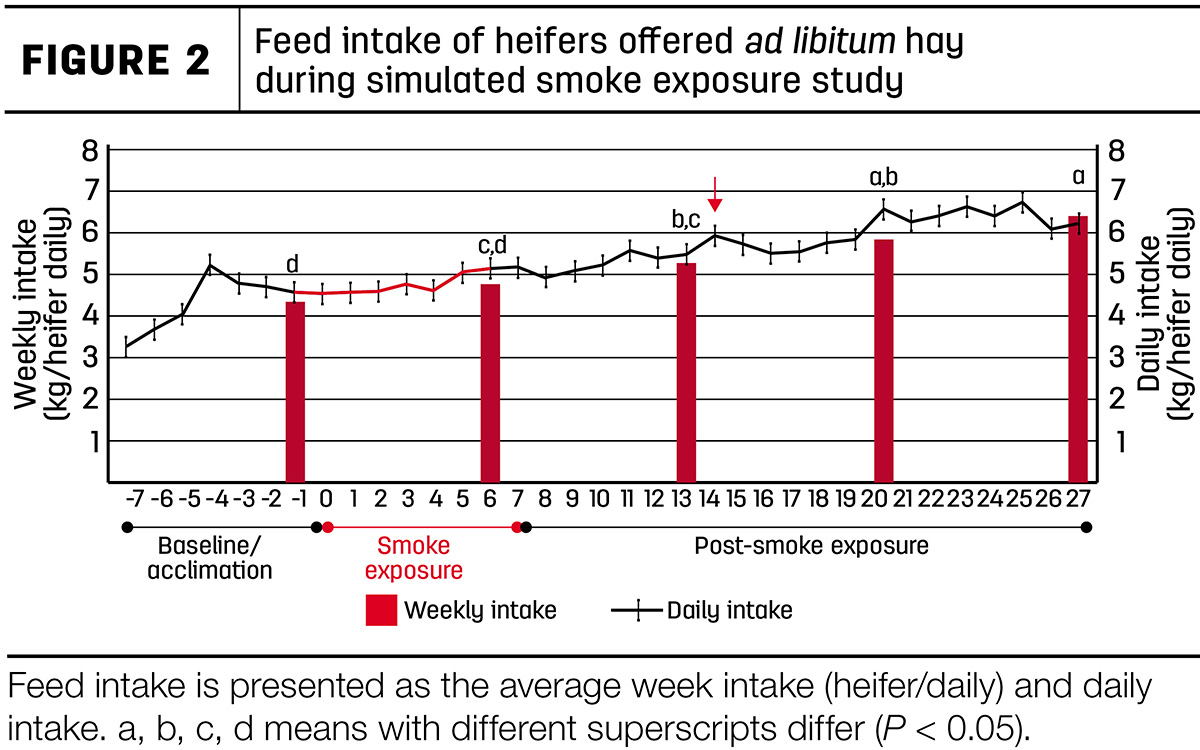
Collectively, these initial findings suggest that wildfire smoke exposure can trigger an immune response, possibly leading to behavioral changes, and consequently negatively impact cattle performance, as observed by the stagnated feed intake in our simulated wildfire smoke exposure study.
Tips for managing cattle during wildfire smoke exposure
Preparedness is key. If you’re in a fire-prone area, take action before wildfire season:
- Create an evacuation plan.
- Make sure cattle are familiar with transport.
- Keep identification records up to date.
- Identify alternative grazing or holding areas.
- If evacuation is not possible, designate a low-risk area with seven to 10 days of feed and water.
Unlike fire, smoke travels great distances, affecting more people and animals than the fire itself. In regions where wildfire smoke is common, long-term exposure can compromise cattle health, particularly their respiratory systems. Based on our findings and guidance from the American Veterinary Medical Association and the EPA, we recommend the following:
- Limit handling and activity. Avoid moving, processing or transporting cattle when smoke is present. Physical exertion increases inhalation of harmful particulates. Delay stressful practices like branding and/or weaning until air quality improves.
- Provide ample clean water. Ensure constant access to fresh water near feeding areas. Hydration helps maintain airway moisture and aids in clearing inhaled particles.
- Reduce dust in the environment. Dust exacerbates the effects of smoke. Use low-dust feed and lightly mist dry pens or alleyways to suppress airborne particles.
- Monitor cattle for signs of respiratory distress. Watch for coughing, nasal discharge, labored breathing or decreased feed intake. Animals with preexisting conditions are more vulnerable. Consult a veterinarian if symptoms persist.
- Allow recovery time. Even after the smoke clears, livestock need time to heal. Allow four to six weeks for full recovery. During this time, minimize stress and avoid strenuous handling.
Final thoughts
Our studies, both observational and experimental, demonstrate that wildfire smoke exposure can lead to significant physiological and behavioral changes in cattle. From increased inflammatory markers to altered feed intake, the consequences of smoke should not be underestimated.
Livestock producers in smoke-prone regions should take proactive steps to protect animal health. By understanding the risks and implementing practical management strategies, producers can reduce the negative impacts of wildfire smoke and maintain herd productivity.
Acknowledgment: The research discussed in this article is supported by the Oregon Dairy Farmers Association (ODFA) and the USDA-NIFA (Award #2023-68008-3917).