We all know that communication is important, especially for healthy relationships, scaling up and a successful transition plan. With that said, why can it be so tough to communicate consistently?

Whenever we visit a new farm, we like to ask three questions.
- What do you talk about?
- How often do you talk about it?
- What do you no longer talk about because you don't want to, you're scared of what may happen or you haven't found a solution, so you avoid it?
Now, what you are not talking about is just a big elephant in the room.
1. We don't want to rock the boat
I think one of the main reasons we don't have tough conversations, especially with family, is that we love and care about each other and don't want to hurt each other's feelings. If things are going well, the family's doing well and everyone's getting along, then let's not upset the calm. Let's not talk about anything that could upset the current peace we are enjoying. And let's face it, we all love peace.
Or what if people don't agree with me? What if I say something in a meeting or bring up a topic other people don't agree with me on? What if it's something I don't want to hear? How am I going to be able to deal with it?
Sometimes, people don't want to bring up tough topics because they just really don't want to hear other people's opinions.
2. We're uncomfortable sharing emotions
Another reason is emotions. We can be uncomfortable sharing things that are close to our hearts or things that make us feel emotional. Maybe we're afraid that we'll tear up or get angry. The other aspect of emotions is that we can be uncomfortable seeing and being around somebody else's emotions. So we avoid conversations that could get emotional.
However, one coach I worked with early on said, "Tim, we have to deal with emotional issues before the emotions are the only issue."
3. We think we need a solution before we can talk
Another reason we avoid tough conversations is because we think we need to come into the discussion with a solution or ideas for a solution. We're problem-solvers. People look to us every day to solve problems. And if we don't have a solution, then why have a discussion? But finding solutions without discussing them with others is not always possible.
We probably underuse collaboration, and I understand why.
Collaboration takes a high level of trust – trust in ourselves and trust in the other people in the room. But it also takes time. And it seems much easier to get the meeting over or not have it at all than to go to the work of collaborating. Because, frankly, most of us would rather be outside doing other work.
4. We don't have the right structure in place for conversations to happen
I believe that sometimes we're not having these difficult conversations because we don't have the right structure. We're just winging it. We lack consistency in how often we meet and how long the meetings take. We lack structure inside the meetings, what we talk about and who facilitates it. We lack notes or a record of what was discussed and decided so we can access it later. But if we do have a regular time and place to bring up issues and troubles, then it doesn't seem as confrontational when they are brought up. It becomes just part of the normal flow.
5. We don't have an agreement on how we behave
Sometimes, we don't have tough conversations because we lack agreement on how we behave. What are everyone's expectations regarding how we talk to each other, how we deal with conflict and all those very soft issues that are very hard?
It is easy to let emotions control our actions unless we're intentional about our communication.
How to make these conversations easier
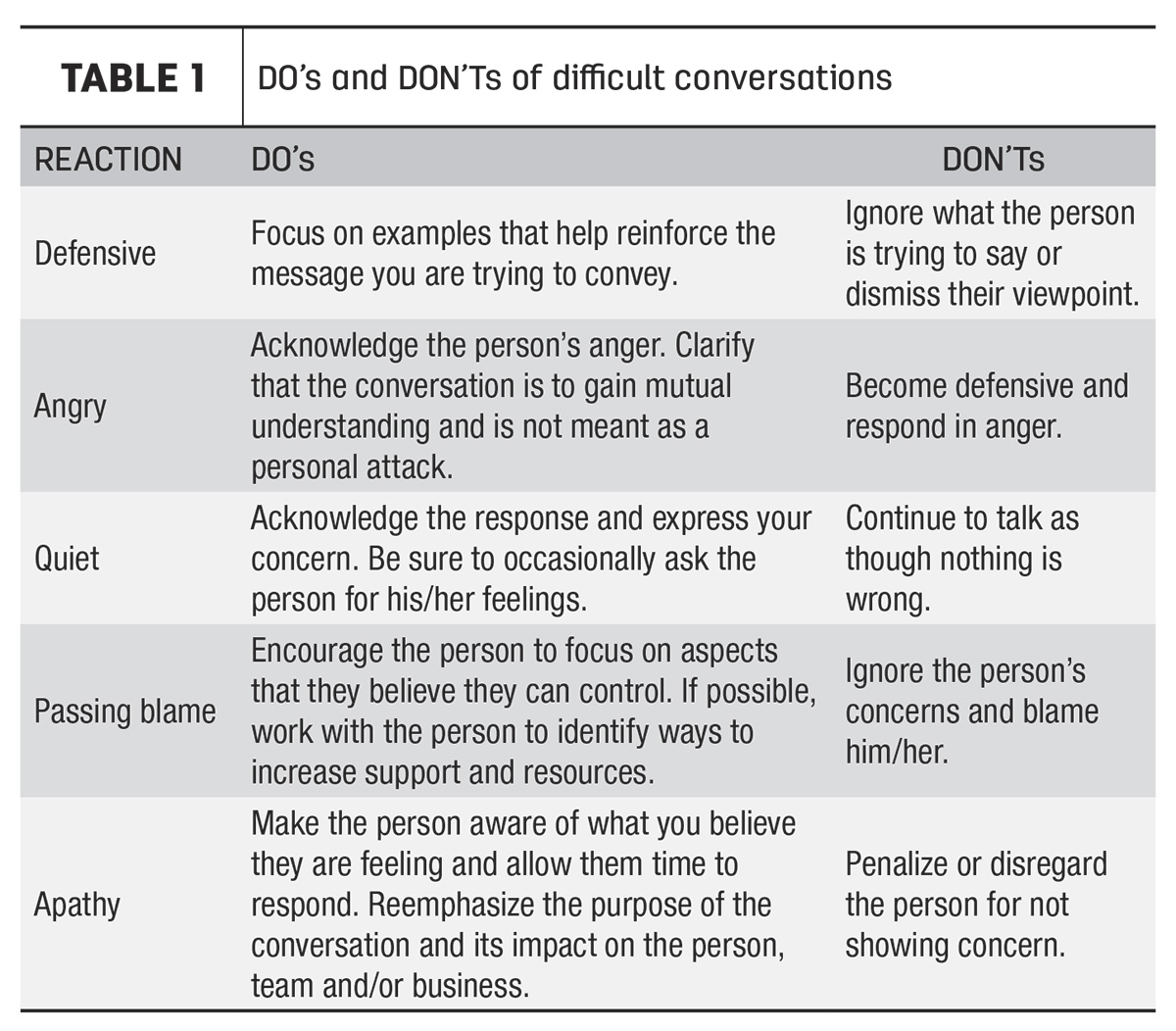
Agreeing to a written Code of Conduct before having tough conversations is best. It might look like this: We listen without interrupting, focus on solutions and do not blame. Another example is this: We treat each other with courtesy and respect, we discuss issues openly and honestly, and if emotions become intense, we call a time-out to allow emotions to settle down before continuing the conversation. Every family will have a slightly different version of this code. It may seem overly formal, but just admitting to each other that conversations are uncomfortable for all and setting guidelines goes a long way to having hard but peaceful conversations later on. A business coach can help a farm with this if this seems too big. See Figure 1 to learn more about conflict styles and Table 1 for tips on how to best respond based on the other person’s reaction.

Choose the right channel
So often, we choose the method of communication we are most comfortable with and ignore alternatives. If there is a dearth of anything on the farm, in all generations, it's face-to-face conversations. It's entirely too easy to hide behind a hastily written text. Critical meaning, voice inflection and body language are all lost when crucial conversations are done via text. In almost every instance, difficult conversations should be face-to-face. Bad news should be face-to-face. Saying thank you should at least be verbal, not text. Communication of difficult topics is only solved with personal connections. So when in doubt, choose the channel that creates the most personal connection.
Increase the cadence
Farms that successfully have difficult conversations about succession plans, expansions or estate planning often have a consistent meeting cadence. Farms with a meeting cadence of weekly (or at least monthly) have a much easier time solving big and deep challenges. The more time we spend with each other, the more comfortable we become and the easier it is to have difficult conversations. Structured, shorter and more frequent meetings go a long way to solving big challenges.
So often, we're not talking because of our internal fears or lack of structure. People get agitated when their problems aren't being addressed. If the issues are ignored and the conversations don't happen, that frustration can build until emotions are the issue. It's the same with family and employees alike.
If you see some of these challenges on your farm, spend time with your team and work through them yourself. You can also reach out to a competent adviser to help you work through it. Either way, don't ignore the elephant in the room, because ignoring him will not make him disappear.