
For generations, managing beef cattle across the vast and rugged landscapes of the American West has relied on traditional stockmanship and an intimate knowledge of the land. Now, new technologies are available to augment these established practices, offering producers a more detailed, real-time view of their herds.

GPS trackers and activity sensors (accelerometers) are being integrated into beef production, with the potential to improve the efficiency, profitability and sustainability of these operations. Attached to cattle primarily via eartags or collars, these devices provide two key streams of data. The GPS component pinpoints an animal’s location, while a built-in accelerometer monitors its movement. This data on location, grazing, travel and resting behavior, often transmitted to a computer or mobile device, provides management insights that were previously difficult to gather on a large scale.
One of the primary advantages is a better understanding of how cattle utilize the landscape. According to research from institutions such as Montana State University, producers can identify which areas of a pasture cattle prefer and which they avoid. This information can inform the strategic placement of water sources or supplements to encourage more uniform grazing, which can help prevent overuse of some areas and underutilization of others. This may lead to improved rangeland health and better forage utilization. Additionally, from a security and logistics standpoint, GPS tracking provides significant advantages. Ranchers can pinpoint the location of the entire herd or individual animals on a digital map, drastically reducing the time and labor required for gathering, especially in rugged or forested terrain. Furthermore, producers can electronically map pasture boundaries and receive immediate alerts if an animal strays, allowing for quick retrieval and preventing loss.
Accelerometers are effective tools for monitoring animal health and general activity. They are currently used quite extensively for human fitness and are being adapted for livestock production systems. A sudden decrease in movement or an animal that remains stationary for an unusually long period can be an early indicator of sickness or injury. This allows for earlier intervention, potentially mitigating the severity of an illness and improving animal welfare. The data can also be applied to reproductive management. Increased activity can signal that a cow is in estrus, which can help optimize breeding programs. Additionally, recent research has demonstrated the potential to detect the onset of calving by analyzing changes in a cow’s activity levels. This data can also be used to parse out animal behavior (grazing, resting, traveling, etc.), which, coupled with GPS data, can provide specific maps of grazing distribution that could be used to inform management decisions.
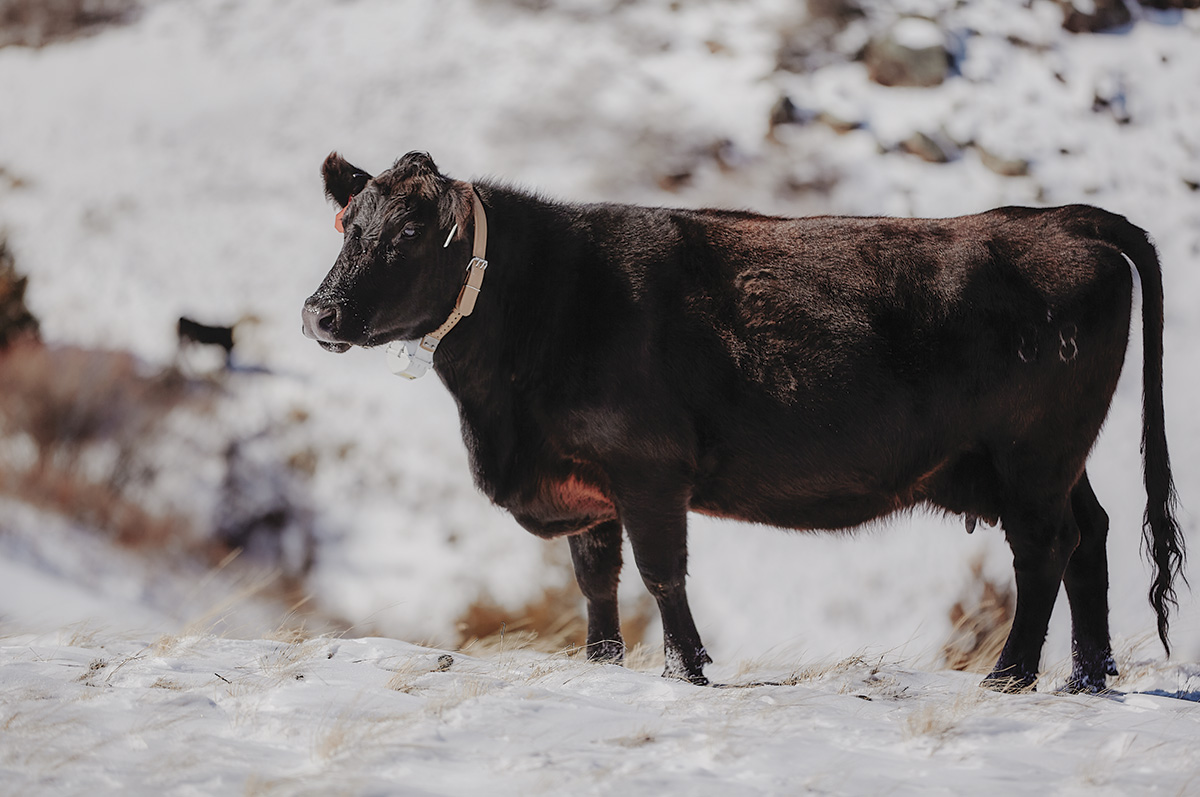
An important reason for using GPS animal-tracking technology is to understand how cattle utilize the landscape, which can inform producers how to best place water and supplement sources. Image by Adrian Sanchez Gonzalez, Montana State University News.
Despite the potential benefits, the adoption of this technology in Western beef operations is not without its challenges. The up-front cost of the devices and the associated data subscription plans can be a significant financial consideration. A key question for any producer is whether the investment will be profitable. The initial cost for GPS with accelerometer tags can range from $50 to more than $100 per head, so outfitting every animal may not be economically feasible, especially for large herds. In these systems, producers may consider only outfitting animals of specific interest, such as bulls or boss cows. Despite that, many cost-benefit analyses have demonstrated a return on investment through improved risk management and operational efficiency; however, these are very situationally dependent and based on how GPS and accelerometer technology can aid in specific ranch goals and objectives.
The rugged and remote nature of many Western ranches also poses a technological hurdle. Cellular service, often required for real-time data transmission, can be inconsistent or unavailable in many areas. While satellite-based systems are an alternative, they typically come with either higher data costs or less frequent updates on animal location. Battery life is another critical factor, as devices must operate for extended periods without needing to be recharged or replaced. Therefore, many vendors have incorporated solar charging to extend the battery life while cattle are out grazing.
The volume of data generated can be substantial, requiring user-friendly software to distill the raw numbers into actionable insights. Furthermore, the hardware itself must be robust enough to withstand the ranching environment – from extreme temperatures and moisture to the physical rigors of herd interaction. The utility of an eartag or collar is entirely dependent on its ability to remain attached and functional throughout the breeding/grazing season.
GPS and accelerometer technology are not a replacement for traditional stockmanship. Rather, it is a tool that, when used strategically, can enhance a producer’s knowledge base and support data-driven management decisions. As technology continues to evolve and becomes better adapted to the unique demands of Western production systems, its value proposition will only increase. A careful analysis of its potential return on investment is a worthwhile step for modern ranch management. For those willing to assess the costs and benefits, this technology offers a means to potentially improve efficiency and profitability in complex Western production environments, especially as ongoing refinements in battery life, tag durability and data transmission for remote areas overcome key implementation challenges.