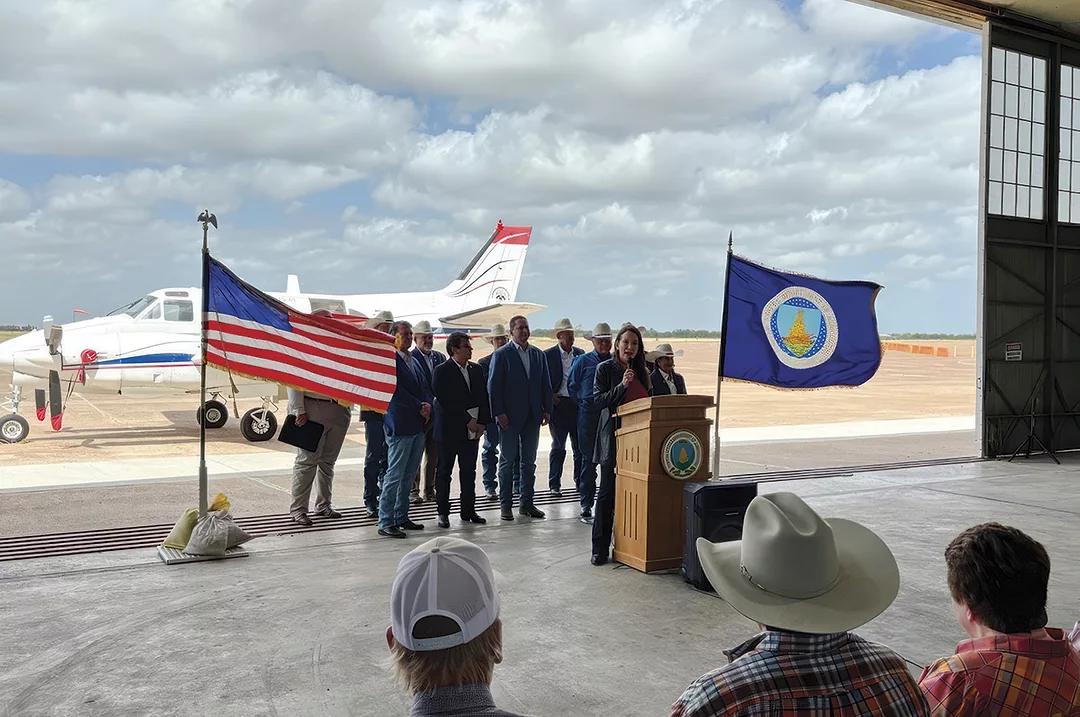
U.S. Secretary of Agriculture Brooke Rollins launched the construction of an $8.5 million sterile fly dispersal facility on June 18 at the Moore Air Base in Edinburg, Texas, and announced a comprehensive five-pronged plan to bolster the USDA’s efforts to control New World screwworm (NWS).

With the invasive parasite now just 700 miles away from the U.S.-Mexico border, many congressmen and agriculture groups are in strong support of the plan. Organizations such as the National Cattlemen’s Beef Association (NCBA), Texas and Southwestern Cattle Raisers Association (TSCRA) and the Texas Cattle Feeders Association (TCFA) have been lobbying for the construction of such a facility since late 2024.
“We do not take lightly the threat NWS poses to our livestock industry, our economy and our food supply chain," Rollins said. “The United States government will use all resources at its disposal to push back NWS, and today’s announcement of a domestic strategy to bolster our border defenses is just the beginning. We have the proven tools, strong domestic and international partnerships, and the grit needed to win this battle.”
“Today's announcement is pivotal in protecting the U.S. cattle industry. Sterile flies are the only known way to stop the reproduction and continued expansion of New World screwworm, and it's assuring to see Secretary Rollins follow through on her early commitments to increasing production of sterile flies domestically,” said TSCRA First Vice President Stephen Diebel in a USDA press release.
"This isn’t going to be easy, and it isn’t going to be quick, but we have to do what is proper and right,” said NCBA President Buck Wehrbein on Beltway Beef, expressing his support for the USDA’s announcement. “I feel like we are in good hands with Secretary Rollins – she understands the importance."
Key facets of the New World Screwworm Domestic Readiness and Response Policy Initiative include:
- Stop the pest from spreading in Mexico and ensure we are full partners in eradication.
- Protect the U.S. border at all costs.
- Maximize our readiness.
- Take the fight to the screwworm.
- Innovate our way to eradication.
The Moore Air Base previously served as a sterile fly dispersal facility during the NWS outbreak of the 1960s and is intended to do the same under the newly unveiled plan. The construction of the dispersal facility is set to be completed by the end of the year. During the announcement, Secretary Rollins also added that the USDA is exploring the possibility of building a sterile fly production facility at the base that could produce almost 300 million flies weekly. The construction of a domestic production facility would take two to three years, however.
The Panama-United States Commission for the Eradication and Prevention of Screwworm (COPEG), located in Pacora, Panama, is currently the only operational sterile fly production facility. COPEG is producing around 117 million sterile flies weekly, but at least 300 million flies are needed to be successful at eradicating the invasive parasite. Between 400 million and 500 million sterile flies were released weekly during the 1960s outbreak to effectively eradicate NWS from the U.S.
COPEG is located south of the current outbreak that is pushing northward. This results in sterile flies nearing the end of their lifespans by the time they reach the infested area. Construction of the dispersal facility in Texas (only 20 miles from the Mexican border), coupled with the renovation of a fruit fly production facility in Metapa, Mexico, will help ease the strain on COPEG. Sterile flies hatched at COPEG and the Metapa facility will be transported to Texas to finish growing closer to the outbreak and be released with more time to mate.
The USDA is working alongside Texas animal health authorities and the Texas Department of Agriculture to not only build a reserve of current treatments but also develop new treatment options and preventative measures. They are also inspecting trucks at the border for signs of pests and disease.
Sid Miller, Texas Agriculture Commissioner, explained that the state is seeking a permit to administer parasiticide through cattle feed. He noted that the Texas Department of Agriculture has invested $250,000 in fly traps to be put along the Rio Grande River.
The USDA’s Animal and Plant Health Inspection Service (APHIS) has deployed cattle fever tick riders along the Rio Grande to inspect animals along the border and prevent the spread of NWS into the U.S. Rollins is set to meet with the tick riders to see firsthand the crucial work they are doing in spotting and combating the parasite.
To get feedback on sterile fly production technology, eradication tools and technologies aside from sterile fly production, the benefits and barriers, including timelines and costs of enhanced domestic versus international sterile fly production, and other innovative ideas, the USDA is planning to hold four public listening sessions in the near future.