The dairy industry is continually evolving, from the Surge Bucket Milker to rotary parlors and automated milking equipment, from pen and paper records to stall-side cow information. And now, with technology advancing further and more quickly, paired with the onset of artificial intelligence (AI), the industry is tasked with the lofty goal of keeping up.

Those who attended the Precision Dairy Conference demonstrated how the industry, on a global scale, is up for the challenge. The conference – hosted by the University of Minnesota Extension and College of Food, Agricultural and Natural Resource Sciences – brought together industry researchers, producers and visionaries to discuss the next level of precision dairying June 17-18 in Bloomington, Minnesota.
“The progress we’ve made (in food production) in a relatively short time has been relatively amazing,” said Aidan Connolly, president of AgriTech Capital. “Yet, as we’re learning more about the genetic biome, what we feed animals, their environment, we’re also realizing the gaps we have in dairy are huge. … But there’s the promise of precision agriculture to bridge those gaps and bring something better to the table.”
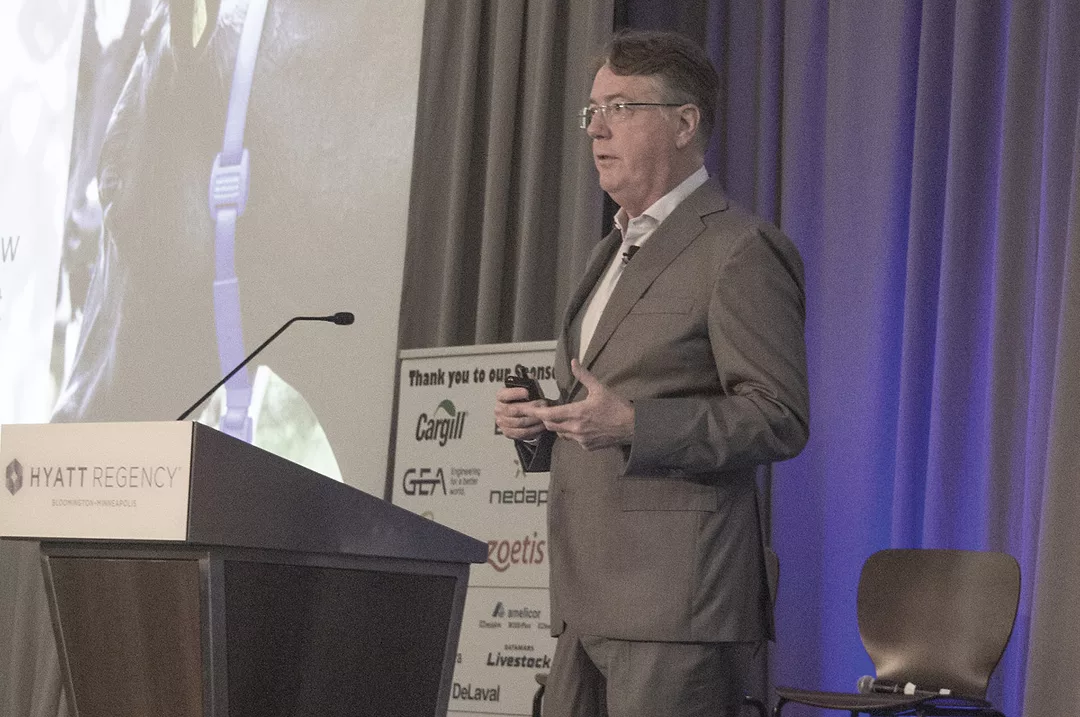
Connolly provided the opening keynote address at the conference. He leaned on his expertise of helping agriculture businesses strategize the use of technology to discuss the advent of AI use in the dairy industry.
The use of AI may be daunting and portrayed as a less-significant challenge for dairy farms to address, but the reality is that without the understanding of and openness to use AI, the spread between truly efficient, progressive farms and those remaining with the status quo will become larger.
“The question is not only, ‘How do we use AI in the dairy industry?’ But also, ‘Are we ready to manage our farms precisely?’” Connolly said. “Think about breeding, housing, nutrition, disease control. The more productive our farms get, the lower their carbon footprint. And I believe AI will play a big part of that to increase production globally and get rid of the lower-producing, less efficient farms.”
Connolly mentioned that the average cow in the U.S. yields about 24,000 pounds of milk. If AI and other technologies could help increase the global yield more closely to that in the U.S., it could eliminate up to 90% of cows – particularly those in areas like India and Africa.
So, how will AI transform food production? Connolly spoke with 40 experts, 20 of whom specialized in AI and 20 in the food and agriculture sector, to find out.
He found that those invested in the technology were more visionary and imagined a quick redesign of the food system. On the contrary, those most familiar with production agriculture were more pragmatic and saw incremental improvements to systems already in place. Similarly, those in the AI world thought the first farm-related jobs to be replaced would be nutritionists, veterinarians and consultants, while agri-people envisioned on-farm labor being more easily replaced.
“This is going to be a leadership challenge, not a technology one,” said Connolly of AI adaptation. “AI will not replace humans, but humans who don’t know how to use AI will be replaced. We’re going to need both types of people on our farms and in our businesses, those who understand the reality of on-farm operations, but those who are also not too slow to change.”
Connolly encouraged producers to audit their data and start a pilot program for AI use on the farm.
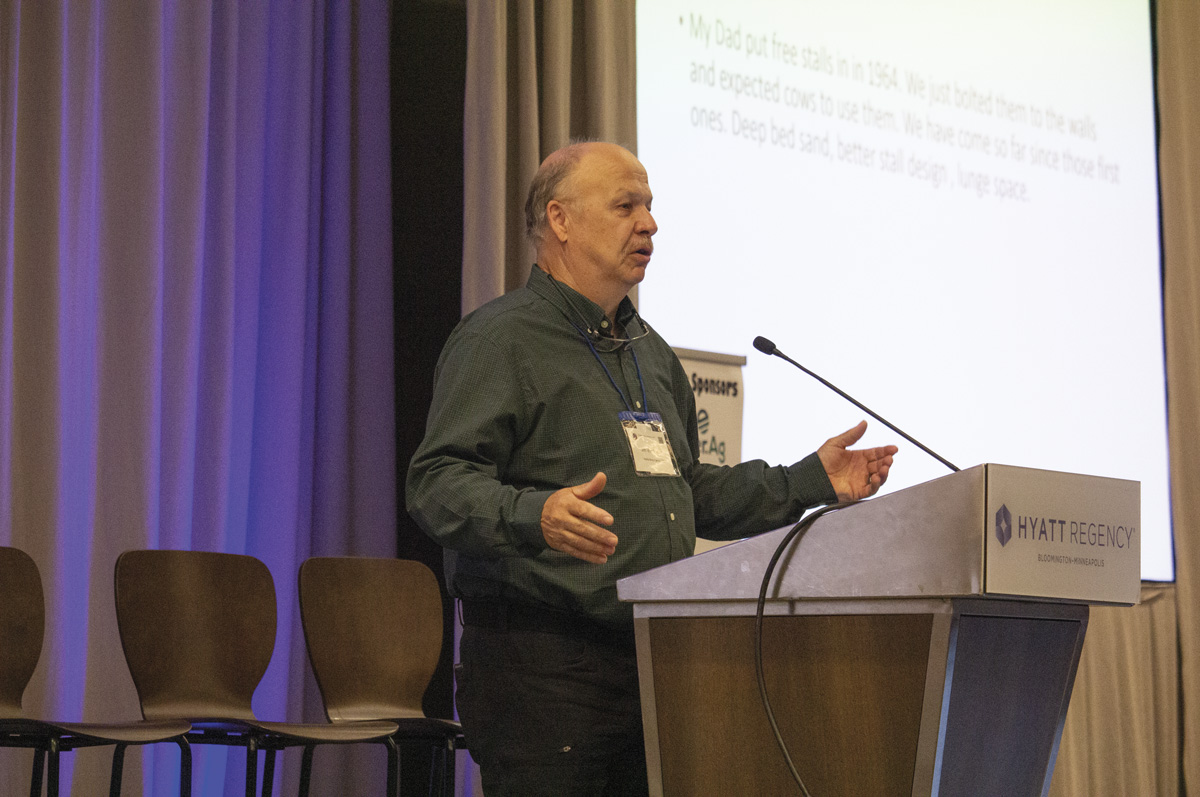
Dairy manager Jim VanPatter talks about the farm he manages in Wisconsin and how they have improved the herd through reproductive and calf health technologies. Image by Jenn Coyne.
Panelists give examples of technology buy-in
Following Connolly’s address, attendees were provided further examples throughout the two-day conference of how the dairy industry could become more precise, more efficient in the years ahead. Dairy producers, farm consultants and allied industry representatives spoke of real-life scenarios where technology adaptation made cow data more attainable and usable, and employees’ work created more value to the larger farm business.
While many admitted technology does not solve every challenge, and certain systems may create larger challenges if not used appropriately, they all agreed that successful technology adaptation is possible with clear expectations, training and communications with all individuals – from laborers to upper management.
“Technology integration and training has gone well and poorly,” said producer Nick Vander Weerd of Pleasant Dutch Dairy in South Dakota. “What’s important is the interface and how employees use it.”
Jacob Twohey of Twohey Dairy in Minnesota agreed.
“We all have the data points,” he said. “How are we going to use it efficiently? Cow-level data is still requiring someone to pick through the data and do something with it.”
For veterinarian Barb Petersen, she likes to see an individual on the farm be appointed for troubleshooting the technology and making decisions based on the data collected.
“Ideally, we want to see employees be a part of the conversation,” said Petersen regarding technology implementation. “And as challenges happen, we want them to speak up. Someone has to be on-farm as the point person and can receive feedback.”
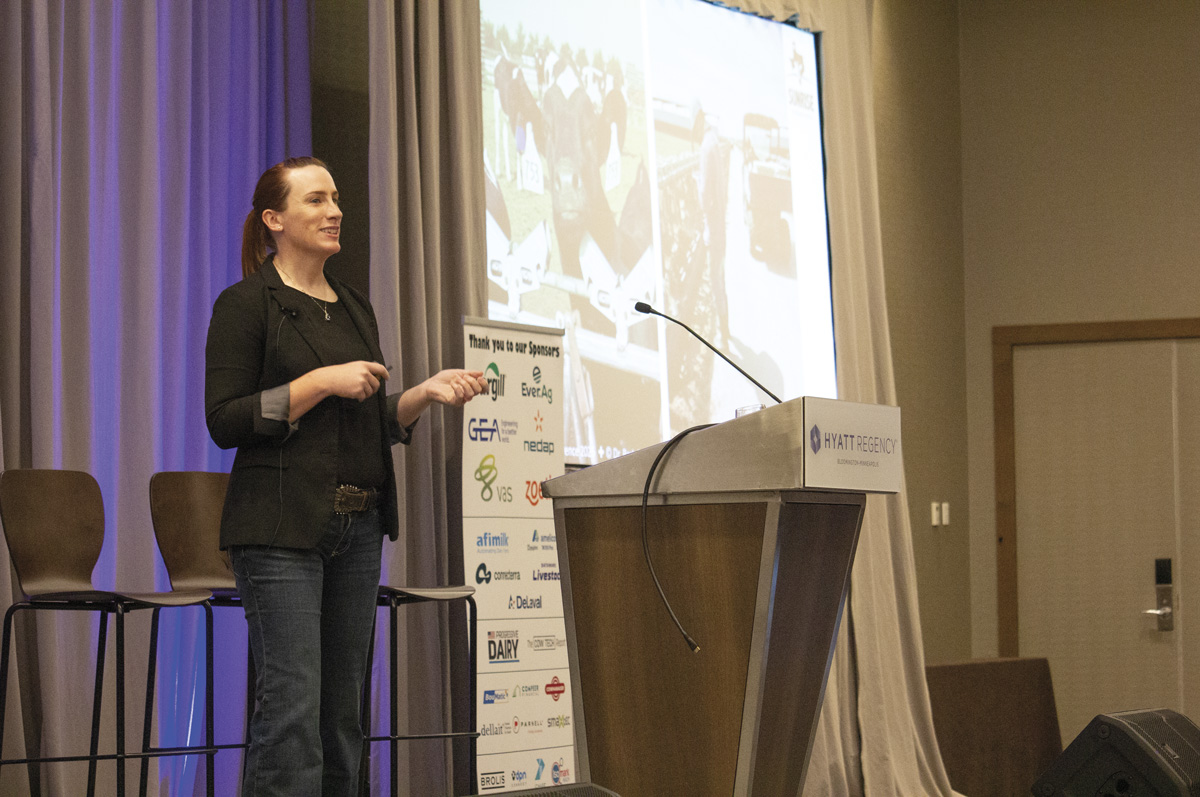
Dr. Barb Petersen speaks of how farms she works with have created a culture of employee buy-in with new technology and more efficient systems on the dairies. Image by Jenn Coyne.
From sort gates to activity collars to milking prep and genetic evaluations, the panelists explained how the use of technology on U.S. farms is rapidly evolving and making daily tasks not only more efficient but also more productive as data leads to decisions that will impact the future of the herd.
New technology, ongoing research highlighted
One study conducted by the University of Wisconsin – Madison (UW – Madison) demonstrated that 86% of dairy farms have already adopted precision technology in the form of wearables and milking parlor advancements. The realm of technology adaptation is continually growing, both with use and type of technology.
Dr. Victor Cabrera with UW – Madison, Dr. Julio Giordano with Cornell University and graduate student Drew Swartz studying at the University of Minnesota shared their research findings and new studies they are conducting related to dairy herd management with improved technologies. Cow comfort, animal welfare and handling, and efficient use of single-cow data were all touched on.

Audience questions allowed Precision Dairy Conference attendees to ask questions for dairy producers, researchers and industry allies during the panel sessions. Image by Jenn Coyne.
The two-day conference also highlighted emerging technologies from startup or established companies with Progressive Dairy Editor Walt Cooley, who is also the founder of The Cow Tech Report. Those included Brolis, Dairy Performance Network, iChase, Isomark, Livestock 3D, Livestock Visibility Solutions and Metha.ai. Representatives of each company shared the concepts of their business models from bird detection and deterrence to measuring the effectiveness of enteric methane reduction via AI modeling. Some concepts are still in the design and testing phases, while others are a part of on-farm pilots, either within the continental U.S. or overseas.
“If you were to take every use case of different technologies, different categories and then add a new space, that’s the mixing bowl of what dairy technology is these days,” Cooley said. “And then we ask the question, ‘How do we mix and match technologies?’ These companies are mixing up different ways to use technology that haven’t been used yet in the dairy space.”
From keynote addresses to producer panels and new product and system highlights, one thing was clear about the Precision Dairy Conference – the opportunity for the global dairy industry to manage farms precisely is achievable. The question is, who is ready to fully lean into that mission?