On June 30, 2025, the USDA announced a plan to implement a phased reopening of the southern border ports for the import of live cattle from Mexico, beginning with the border crossing at Douglas, Arizona, on July 7. However, on July 9, Mexico announced it had detected New World screwworm in Veracruz – 160 miles north of the current sterile fly dispersal grid. The USDA subsequently closed the border, with immediate effect. As such, the July forecasts reflect an assumption that the import ban will remain in place through 2026.
Minor adjustments to the 2025 beef production forecast
The projection for 2025 beef production is lowered less than 1%, or 170 million pounds, from last month to 26.188 billion pounds. The forecast is updated based on actual slaughter data through the last week of June and estimated slaughter through early July. Further, in the third and fourth quarters, production expectations are lowered on a slower anticipated pace of cattle slaughter and slightly lower carcass weights in the second half of 2025. However, the broad view remains that year-over-year production is expected to decline by about 3% from 2024.
2026 beef production slightly higher on adjusted placements
The 2026 beef production forecast is raised by 2%, or 540 million pounds, from last month to 25.815 billion pounds. This change reflects an increase from the previous month in expected feedlot placements in the second half of 2025 and in early 2026, which are likely to be marketed for slaughter in 2026. The increase in feedlot placements is based on a shift in previous expectations for the second quarter of 2025 that was reflected in a larger year-over-year number of cattle outside of feedlots on April 1. Based on the latest USDA National Agricultural Statistics Service (NASS) Cattle on Feed report, feedlot placements in April and May are running at a slower pace than last year, likely due to the slower rate of marketings keeping animals in inventory and improved pasture conditions in many key cow-calf production regions. As a result, some cattle placements are expected to shift to the second half of 2025. In 2026, greater anticipated placements than previously considered last month are based on higher forecast feeder calf prices for early 2026, likely leading some producers to continue selling heifers rather than retaining for cow-herd rebuilding. That said, placements are still expected to be lower year over year in 2026.
The USDA NASS biannual Cattle report will be released on July 25 and provide an indicator of producers’ intentions for heifer retention and potential cow herd expansion plans going into next year. Further, on the same day, the USDA NASS Cattle on Feed report for July 1 will provide an estimate of the number of steers and heifers on feed. These reports will indicate whether large numbers of heifers are still being placed during a period when many breeding decisions are typically made.
Feeder cattle prices projected higher from last month
In June, the weighted average price for feeder steers weighing 750-800 pounds at the Oklahoma City National Stockyards was $310.47 per hundredweight (cwt). This was a $10 increase from May and $47 higher than June 2024. Prior to the July USDA World Agricultural Supply and Demand Estimates (WASDE) release, only June 30 sales data was available, and it reported a record $319.06 per cwt on a relatively small group of 164 head. Accounting for recent price data and continuation of the import ban on Mexican cattle, the 2025 forecast of feeder steer prices at the Oklahoma City National Stockyards is raised by $3.51 to $301.29 per cwt in 2025. Specifically, 2025 third- and fourth-quarter price forecasts are each raised $6 to $312 and $314 per cwt, respectively. This increase was carried over into the 2026 feeder steer price forecast, which is $6 higher from last month at $312.25 per cwt.
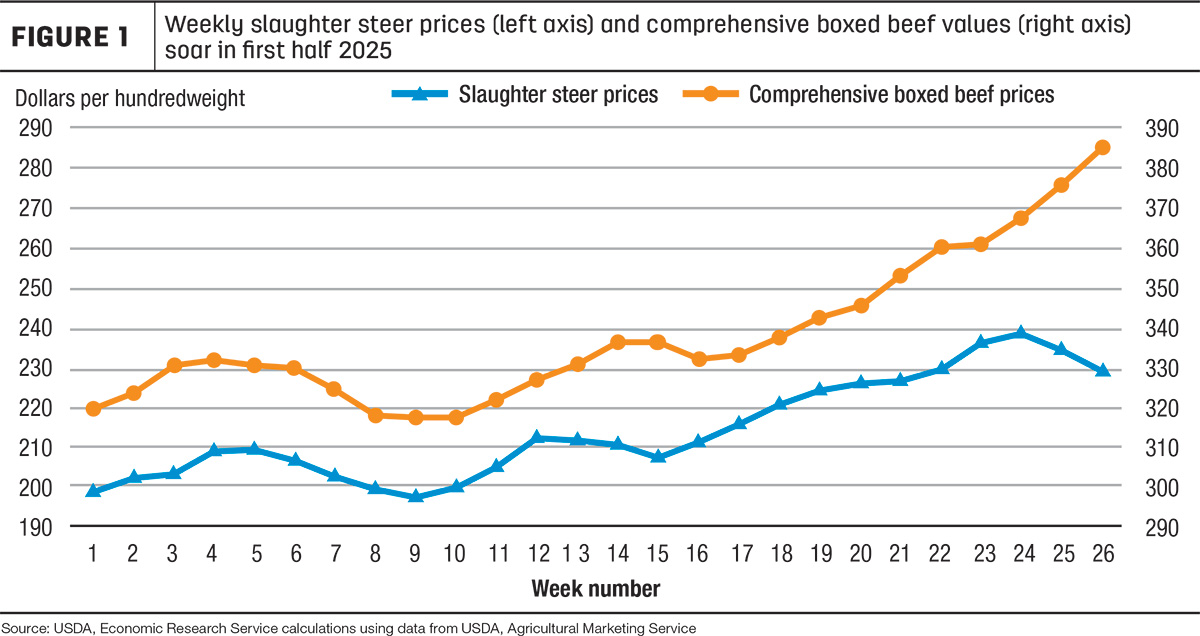
Figure 1 shows that comprehensive wholesale boxed beef values and slaughter steer prices soared 21% and 15%, respectively, from week one to week 26 in the first half of 2025. However, boxed beef prices appear to have peaked in the first week of July, while slaughter steer prices reached their summer peak in mid-June. These moves likely portend typical seasonal declines into the second half of 2025.
The June average price for slaughter steers in the 5-area marketing region was $235.35 per cwt, almost $9 above the record set the prior month and about $42 higher year over year. For the first week of July, slaughter steer prices averaged $229.43 per cwt, a decline of more than $9 from the record price set the week ending June 15. Based on recent price data, the third- and fourth-quarter 2025 slaughter steer price forecasts are unchanged from last month at $226 and $229 per cwt, respectively. The 2026 annual price projection is also unchanged from last month, remaining at $228.50 per cwt.
Beef exports
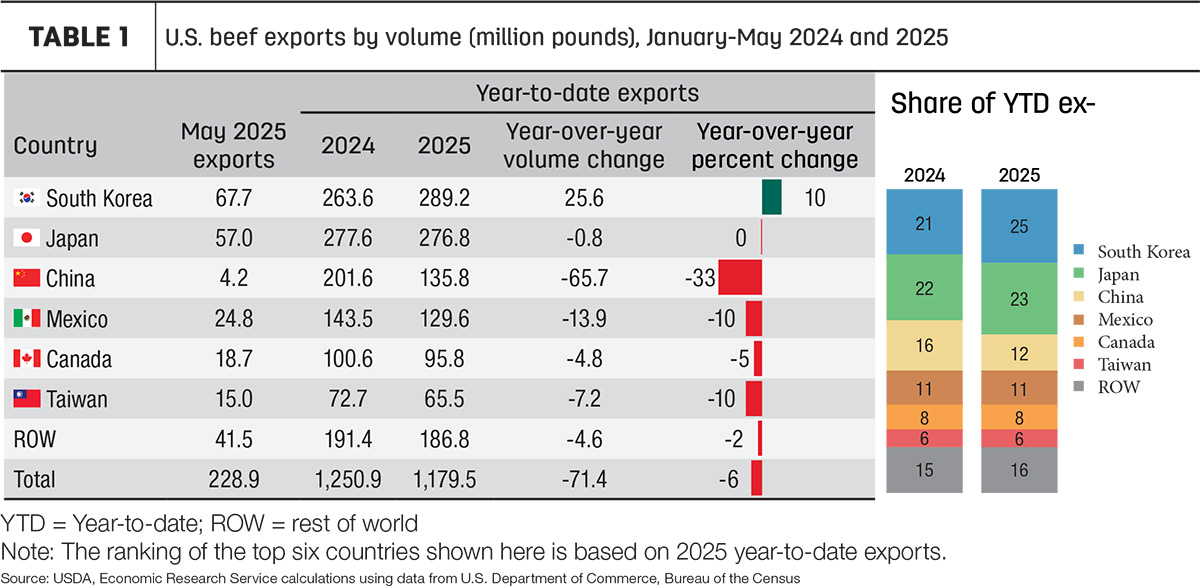
U.S. beef exports in May 2025 totaled 229 million pounds, 11% below a year ago (Table 1). Exports to China were only 4 million pounds, the lowest level since 2020 when the Phase I trade deal paved the way for increased exports to China. The General Administration of Customs of China export registrations for several U.S. beef establishments – which were implemented as part of the Phase I trade deal – were allowed to expire in mid-March this year, effectively cutting off the majority of U.S. beef exports to China. Year-to-date exports to China through May are down 33%.
Despite the drop-off in exports to China, the effect on U.S. beef exports to the world is comparatively muted, with year-to-date exports 6% below the same period last year. Monthly exports to the top two markets, South Korea and Japan, were higher year over year in May by 39% and 3%, respectively. Exports to Hong Kong were also up 28% compared to a year ago. Based on recent data and the pace of exports, the beef export forecast for the second quarter is raised 10 million pounds to 700 million pounds. When combined with the first quarter, first-half 2025 exports are expected to be about 7% below the same period last year. The forecast for the third quarter is also raised 10 million pounds to 660 million. The annual forecast is 2.728 billion pounds, which, if realized, would be about a 9% decrease year over year. Based on higher expected production and sustained global demand for U.S. beef, the 2026 annual export forecast is raised 95 million pounds to 2.565 billion pounds, which would represent about 10% of production.
Beef imports
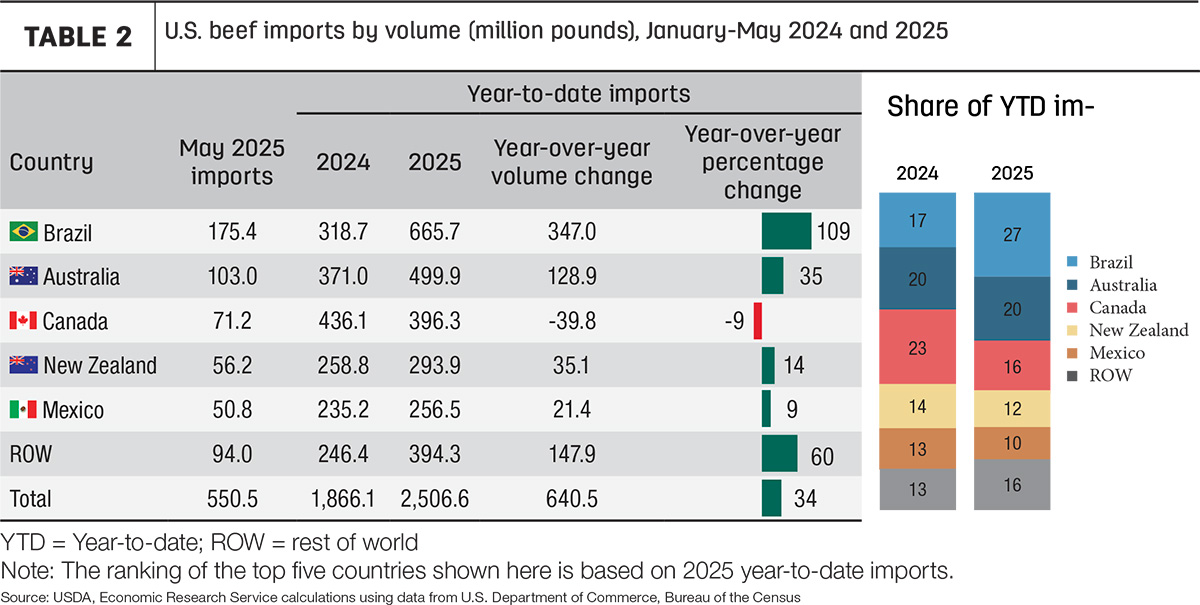
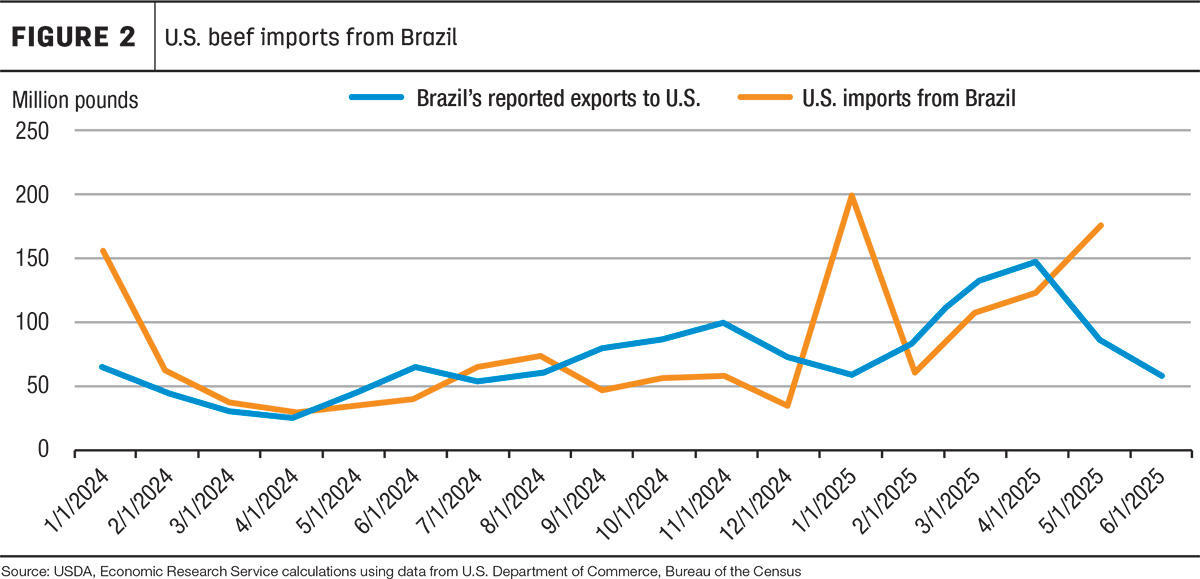
U.S. beef imports in May totaled 550 million pounds, more than 60% higher year over year and the second-highest monthly import total behind January of this year (Table 2). Brazil was the largest contributor to the increase, with imports of 175 million pounds, more than five times the amount imported in May 2024. Year-to-date imports from Brazil are more than double the same period last year. Figure 2 shows beef exports to the U.S. reported by Brazil each month, compared with U.S. data for imports from Brazil. Reported exports from Brazil peaked in April and then fell off. The transit time from Brazil to the U.S., as well as product that is shipped to the U.S. but remains in bonded warehouses, causes a lag between the two data sets. Therefore, U.S. imports from Brazil may begin reflecting the past couple of months’ declining shipments.
Beef imports from Australia also continue to be strong; imports in May alone were up more than 45% year over year. Imports from other countries outside the top five suppliers also account for a significant portion of the year-over-year increase in May. Notably, Uruguay, Argentina and Paraguay together accounted for an additional 39 million pounds year over year. Demand for imported beef trimmings remains high as domestic cow slaughter has been consistently low throughout the year. Based on recent data and the continued strong demand for imports, the 2025 second-quarter import forecast is raised 150 million pounds to 1.475 billion pounds. The third and fourth quarters are also raised 20 million pounds each to 1.24 billion and 1.18 billion pounds, respectively. The annual forecast for 2025 is 5.377 billion pounds. The annual forecast for 2026 is raised 325 million pounds to 5.35 billion pounds, which would be less than 1% lower year over year.