Interacting directly with cows is a necessary part of dairy farming but leads to the risk of human injuries, which can be severe or even fatal. When cows are handled inappropriately, this decreases both their welfare and milk production and can also hurt public perception of dairy farming.

To interact with cows safely and humanely, handlers need to understand their natural behavior and use appropriate animal handling skills. If handlers are not trained properly, they may use negative, counterproductive actions such as raising their voices or striking cows. They can also cause cows to panic by approaching them too quickly or entering their blind spot.
In contrast, working with a cow’s instincts to move away from people by using their flight zone and allowing them to walk at their own pace results in less fear and stress. When cows are calm, their milk yield is greater, and there is less risk of injuries to people and the animals.
INDUSTRY EXPECTATIONS FOR CATTLE HANDLING
Virtually all U.S. dairy farms are evaluated against the expectations of the Farmers Assuring Responsible Management (FARM) Animal Care program. For the last five years, this program has required all farm staff with animal handling roles to have annual continuing education (CE) in appropriate cattle handling techniques. What counts as CE is currently flexible.
The principles for appropriately handling cows are well-established. However, not all handlers understand the benefits of these concepts, know how to translate them into practical skills, or apply them consistently when working with cows. Not all CE is created equal, but no standard currently exists to determine whether resources on cattle handling are effective. Most resources have not been tested scientifically and have limitations.
Many resources on cow handling, such as videos, articles, or books, present good information. However, these formats are examples of passive learning. They do not provide opportunities to apply concepts and practice skills. In classroom settings, educational research has led to increased use of active learning techniques like the use of serious games, which are designed to educate and not just entertain. These can include video games or in-person role play. Learners are more engaged, and they can “learn by doing.”
CHANGING THE GAME WITH MOOVING COWS
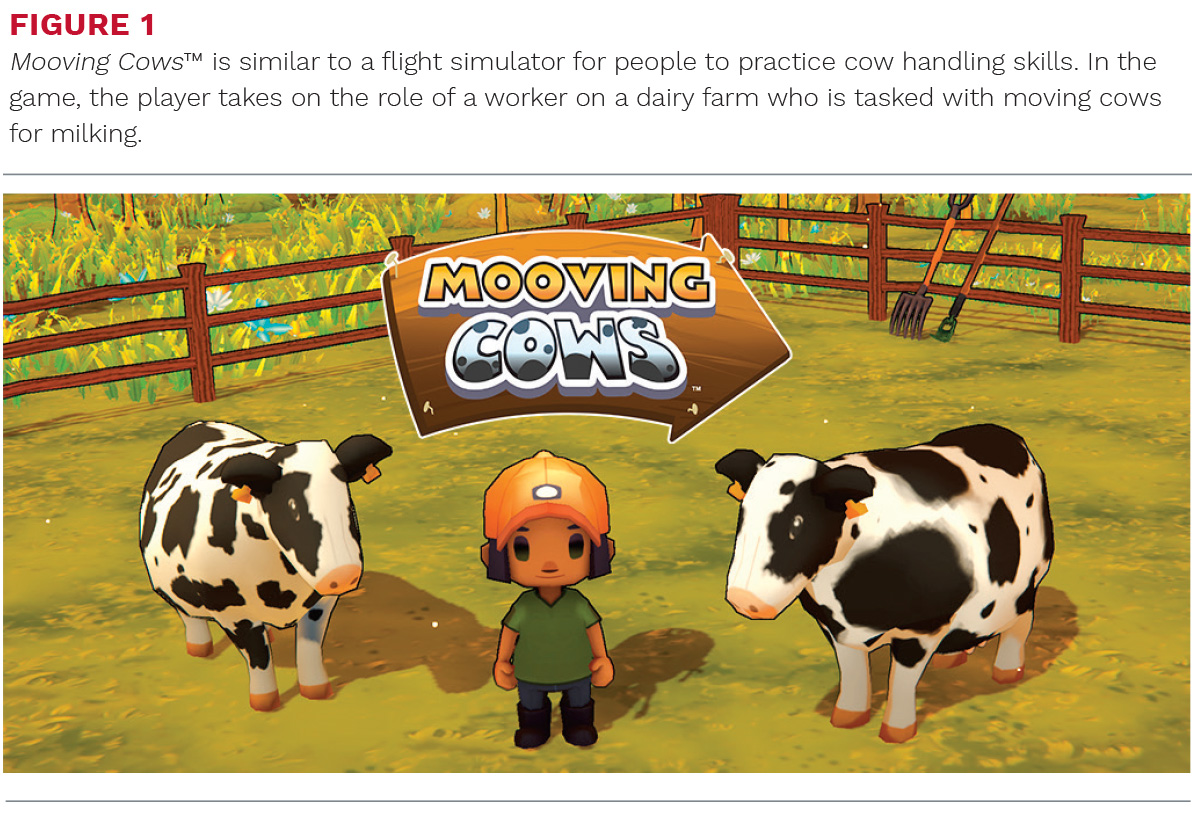
We developed a serious video game, Mooving Cows™, which is like a flight simulator to practice moving cows humanely. Players of Mooving Cows take on the role of a dairy farm worker (Figure 1). They are expected to move cows through routine barn environments such as a freestall pen or the milking parlor (Figure 2).
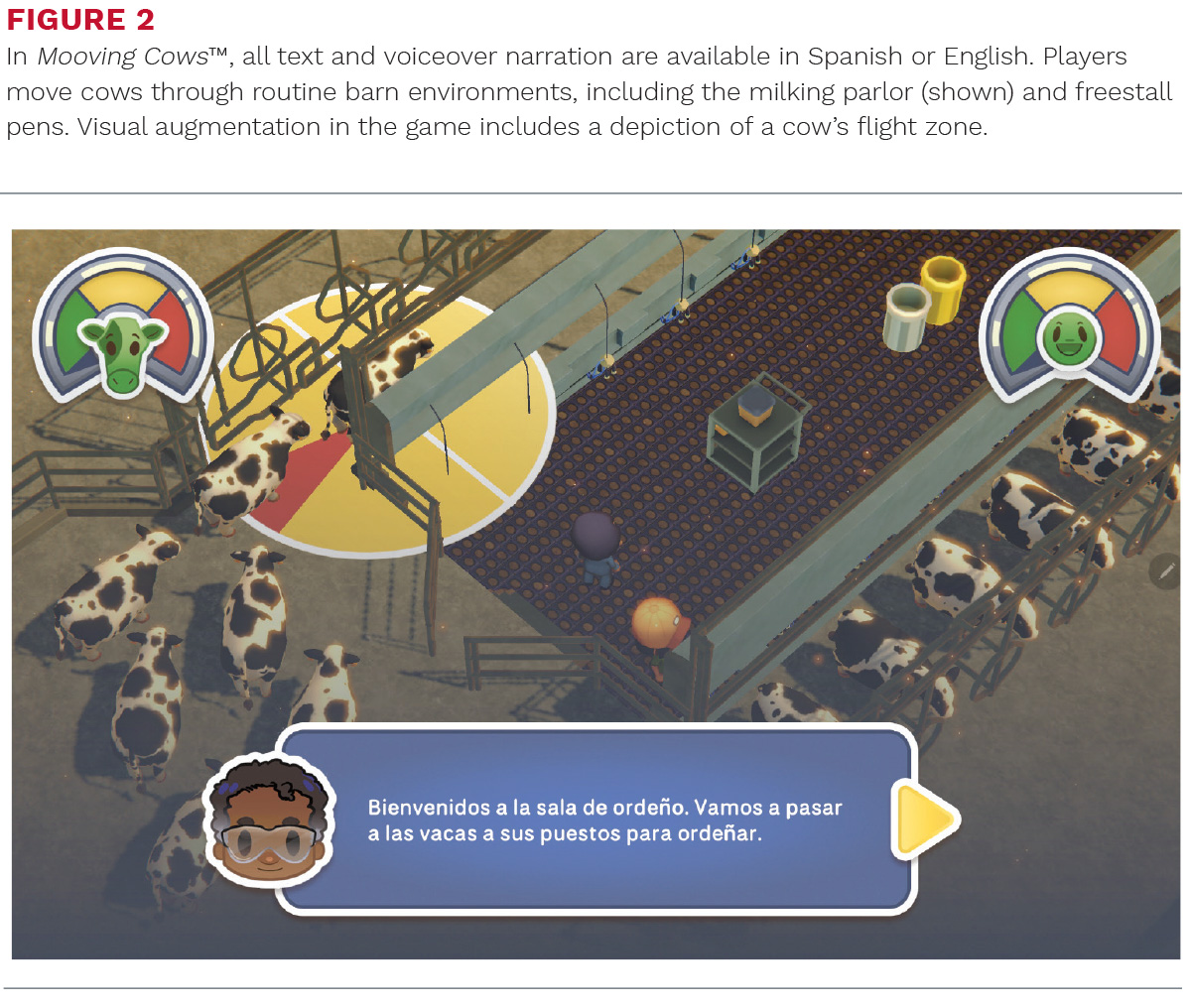
Players are guided by tutorials in Spanish or English. To prepare them to handle real-world situations, players navigate challenges within the game, such as peer pressure and unpredictable or dangerous cow behavior. The game’s learning objectives are to understand how people’s actions affect cow behavior, stress, and productivity, as well as how cattle handling affects worker safety and farm efficiency.
When players successfully complete all eight levels in the game, they earn a certificate of completion. This image file is saved on the player’s mobile device and can be used as documentation of CE to meet the FARM program expectations.
WISCONSIN DAIRY COMMUNITY INVOLVEMENT
When we were initially developing Mooving Cows in 2022, 30 Wisconsin dairy industry professionals played a prototype and gave input to make sure the game would be relevant to farm staff. Although we completed Version 1.0 of the game in early 2023, we kept it private so we could research how well the game improved players’ knowledge of appropriate cow handling practices.
We collected data from 34 Spanish and English-speaking workers from three Wisconsin dairy farms. Before and after playing the game, they completed 10 multiple-choice questions about best practices for dairy cow handling. The order of the questions and response choices were scrambled. The game appeared to improve confidence in knowledge of best practices. Before playing the game, players answered on average 7.6 out of 10 questions correctly, responded “unsure” to 0.6 questions, and answered the remainder incorrectly. After playing the game, they answered 8.3 questions correctly and selected “unsure” for only 0.1 questions on average.
Overall, players found the game enjoyable (mean = 3.7 on a 1 to 5 scale with 1 = very unenjoyable and 5 = very enjoyable) and somewhat easy (mean = 2.6 on a 1 to 5 scale with 1 = very easy and 5 = very challenging). Players thought the game would be useful for people with little to no dairy cow experience to learn how to handle cows, as well as for those who already have cow experience to review handling practices (mean = 3.6 and 3.3, respectively, on a 1 to 5 scale with 1 = not at all useful and 5 = extremely useful).
These results from our research on Version 1.0 of the game demonstrated the proof of concept for Mooving Cows. The game showed potential to be an effective and engaging tool for people to improve their knowledge of appropriate handling techniques.
However, one limitation of Version 1.0 of the game was that it took on average 36 minutes to complete, with a large range between people of 23 to 51 minutes. For the game to work for on-farm CE, we wanted to further improve and streamline it. We refined the game to Version 1.1 by incorporating additional feedback from our play testers. This version of the game was released publicly in early 2024.
It is available for free without ads in both the iOS (Apple) and Google Play (Android) app stores. Most people can finish the current version of the game in under 30 minutes. So far, over 22,000 people have downloaded the game worldwide. In the future, we foresee expanding the game to other challenging cow-handling situations, such as moving non-ambulatory cattle.
 |
This article appeared in PRO-DAIRY's The Manager in August 2025. To learn more about Cornell CALS PRO-DAIRY, visit PRO-DAIRY. |