Pregnancy loss remains one of the most frustrating and costly problems in dairy production. Despite advances in reproduction management, we still grapple with open cows, early embryonic loss and unexplained abortions. Reproductive efficiency is one of the biggest drivers of dairy profitability, and yet, much of what causes early pregnancy failure remains a mystery.

There are many things that need to happen for successful reproduction, including the formation of the placenta. It is easy to think of the placenta as something that just happens during pregnancy, but in reality, it is a biologically complex and incredibly important organ. In cattle, the placenta is responsible for hormone production, nutrient exchange, immune tolerance and fetal support. And most importantly, when pregnancies fail, the placenta can often be the center of the problem.
New technology for better research
Traditionally, we’ve looked at the placenta in terms of structure and anatomy. But what if we could dive deeper into the microscopic layers and identify the cellular and genetic missteps that disrupt pregnancy before the loss actually occurs?
That’s exactly what we’re trying to accomplish through a collaborative effort between the University of Missouri, the University of Wisconsin – Madison and Washington State University by using advanced genetic tools to explore how the bovine placenta forms, functions and sometimes fails. Specifically, we use single-cell “omics” techniques, which allow us to map, in detail, how individual cells behave during normal placental development and how subtle disruptions might explain pregnancy failures. While these technologies are just emerging, what we’re learning from them could shape the future of fertility management.
In the past, tissue samples were blended together, giving us an average picture of gene expression. In reality, pregnancy is driven by specific cells that do specific jobs at specific times. That is where single-cell omics technologies come in. Rather than grinding up a tissue sample and getting a general sense of gene expression, these methods allow us to isolate individual cells and analyze what is happening inside each one. It is like switching from a blurry satellite image to a street-level view.
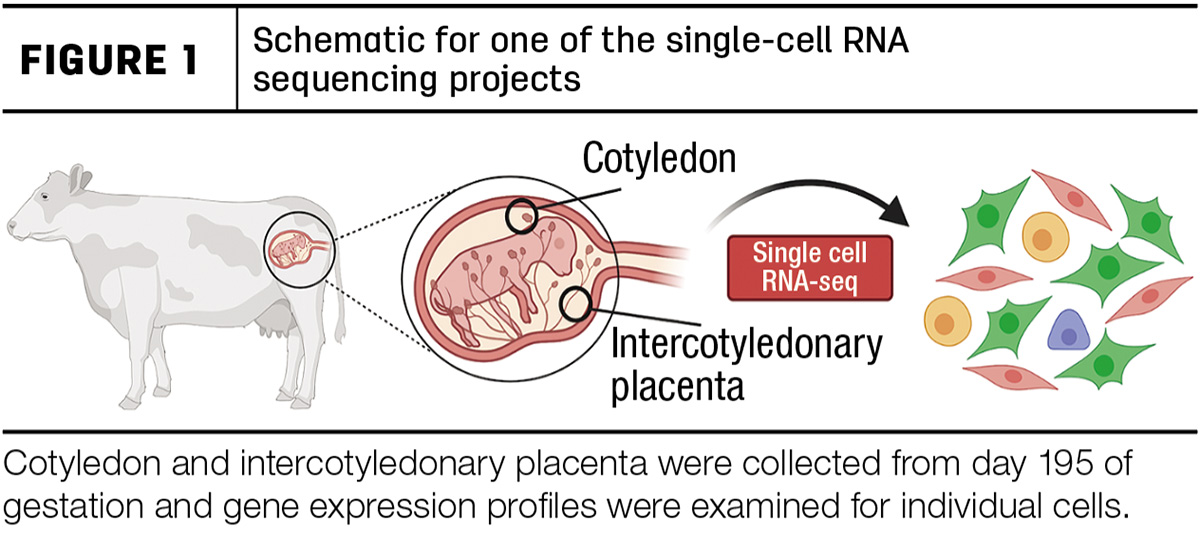
We’ve applied this technology to both mature placentas (days 170 and 195) and developing placentas (days 17, 24, 30, 40 and 50). This gave us a detailed timeline (Figure 1) of how placental cells grow, change and specialize during the most critical windows of pregnancy. We identified several uninucleate trophoblast cell (UNC) and binucleate trophoblast cell (BNC) populations in the placenta based on their gene expression profiles (Figure 2). So far, we’ve published three peer-reviewed scientific articles on the results and have more in preparation.

The biggest takeaways from these research projects were:
- Trophoblast cells, the main cell type of the placenta, exist in different forms and serve diverse functions. We mapped out how these cells grow and change over time in healthy placentas and which genes are involved.
- Transcription factors, or genetic light switches, turn genes on or off at specific times when establishing the placenta. They take advantage of DNA “openness” in regulatory regions and help dictate which genes are being used and when.
- There’s a tight window where gene expression must be precisely regulated. Subtle disruptions during this time could lead to pregnancy failures.
We then took this work a step further and compared our cow placenta data with sheep and human samples. Despite major differences in size and shape, we found striking similarities in how placental cells develop across species. This means we can borrow ideas from biomedical research and apply them to animal agriculture in some instances and vice versa.
Overall, while this research sounds technical, the implications will be practical. By understanding how the placenta forms and functions at the molecular level, we can begin to uncover what goes wrong in compromised pregnancies and develop tools to screen for or even prevent those issues.
What's next on the horizon
We’re only scratching the surface. Our next steps include comparing healthy versus abnormal placental samples, especially from cows that experience late embryonic loss. By building on our detailed cell maps and regulatory networks, we hope to identify early warning signs of compromised pregnancies and ultimately help prevent them.
Right now, if a cow loses a pregnancy, we often don’t know why. Blood tests and an ultrasound can tell us if she is pregnant, but not necessarily whether that pregnancy is on track to succeed. This work is helping build a biological roadmap that could lead to:
- Better diagnostics: If we know which genes are normally active during a healthy pregnancy, we can develop better tools to detect when something is off. This could mean earlier interventions on failing pregnancies or even avoiding breeding cows at high risk of loss.
- New targeted therapies: If we know which parts of the gene network are failing, targeted hormonal or nutritional strategies could be designed to support better placental development.
- Enhanced genetic selection: Fertility traits such as Daughter Pregnancy Rate are moderately heritable. The genes we’ve identified may serve as markers to select for cows more likely to support successful pregnancies.
Looking ahead
Pregnancy loss may never be 100% preventable, but understanding the biology behind it is the first step toward managing it better. The placenta isn’t just a passive support system; it is an active, highly regulated organ that can make or break a pregnancy. The better we understand how it works, the better we can care for our cows and make smarter breeding decisions.
Single-cell technologies are helping us open the black box of pregnancy, and while they’re still mostly research tools today, they’re building the foundation for reproductive solutions. Our goal isn’t to create lab-based tools for the sake of science. It is to lay the groundwork for real, on-farm applications, including ways to reduce reproductive losses, improve genetic decisions and help producers keep more pregnancies on track.
If you’re a producer who has ever scratched your head over a failed pregnancy, just know that researchers like us are working hard to solve the problem. The solution might just come from a single cell.