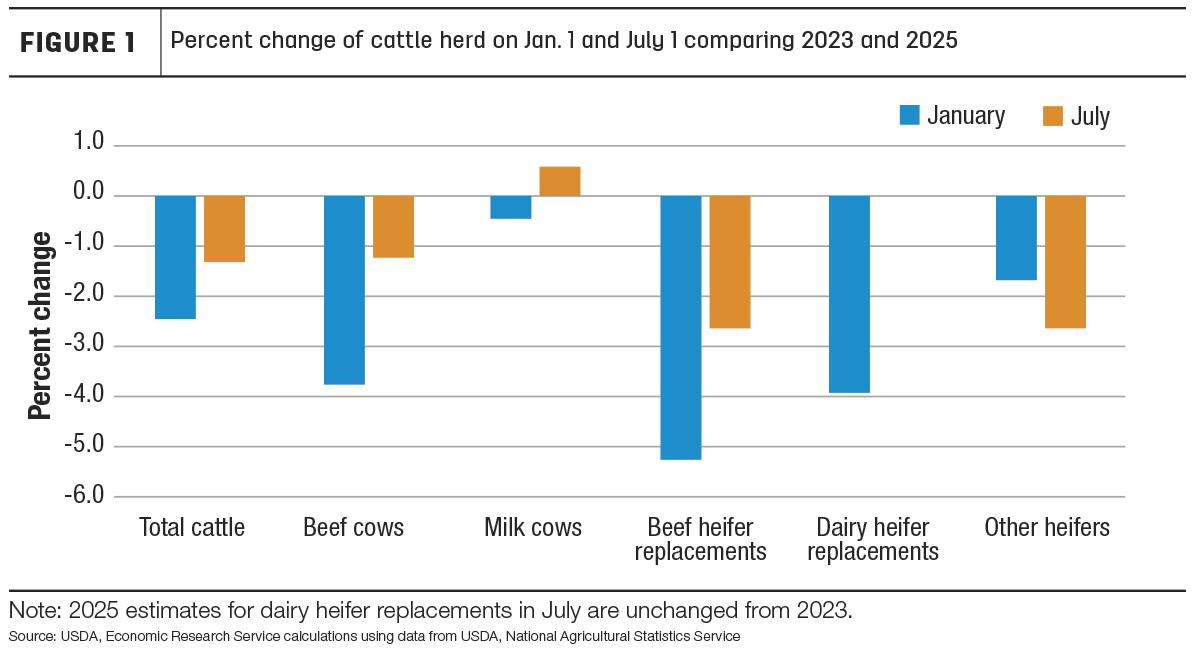
On July 25, the USDA National Agricultural Statistics Service (NASS) released its biannual Cattle report. The previous July edition of the report was released in 2023, as the July Cattle report was not conducted in 2024. According to the report, on July 1, 2025, all cattle and calves were estimated at 94.200 million head, down 1.2 million head, or 1.3%, from July 1, 2023.
With respect to the breeding herd, beef cows declined 1.2% to an estimated 28.65 million head, while heifers retained for beef cow replacements declined 2.6% to 3.7 million head. On the other hand, the number of dairy cows were estimated at 9.45 million head, up 0.5% from July 1, 2023, and heifers retained for dairy cow replacements were estimated at 3.5 million head, unchanged from 2023. The category of “other heifers,” which are likely destined for feedlots, declined 2.6% to 7.4 million head.
For perspective, Figure 1 shows the percent change of total cattle and the female classes on both Jan. 1 and July 1, 2025, compared to their respective estimates in 2023. Typically, these percentage changes in each class stay roughly the same from January to July. However, Figure 1 shows a much smaller decline in the breeding female classes and an increasing decline of “other heifers.” This may suggest improved female retention took place in the first half of 2025 than what was indicated at the beginning of the year.
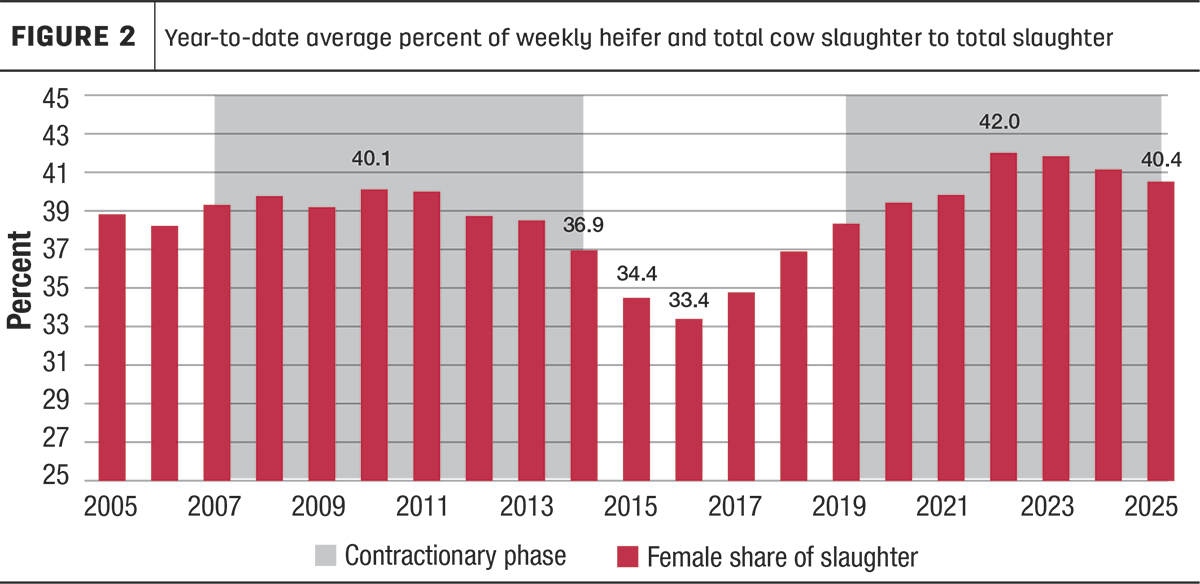
Although Figure 1 suggests a slowdown in herd contraction that has taken place since 2020, weekly heifer and cow slaughter remain at high levels as a portion of total slaughter. Figure 2 shows the average portion of heifers and cows in the slaughter mix through 31 weeks in 2025 and for the previous 25 years. In 2025, the average has dropped nearly 4% from the recent peak in 2022, but it remains slightly above the averages across the entire contractionary phase of the previous cattle cycle (2007-14). Based on inventory estimates and weekly slaughter proportions, indicators are mixed, but it seems that the U.S. cattle herd will be quite slow to begin the expansion phase of a new cycle.
Report shows smaller portion of heifers on feed
The USDA NASS Cattle on Feed report breaks down the number of steers and heifers in feedlots with a capacity of 1,000 head or more on July 1. This can reflect cow-calf producers’ willingness to retain young females for breeding during the first half of the year. Accordingly, it is estimated that on July 1, 6.884 million steers and 4.24 million heifers were on feed, an increase of 1% and a decline of 5%, respectively, from a year ago. The ratio of heifers on feed on July 1 fell for the second consecutive year and is the lowest since July 1, 2018. However, the ratio and volume of heifers on feed remains well above levels during the transition from the prior to the current cattle cycle when the herd was changing from a contractionary to an expansionary phase.
The report further showed a July 1 feedlot inventory of 11.124 million head, 2% below the 11.304 million head last year. Feedlot net placements in June were 8% lower year over year at 1.388 million head. Marketings in June were 1.707 million head, 4% below last year. On July 1, the number of cattle on feed over 150 days was 14% above year-ago levels. Based on weekly slaughter through early August, a slower pace of fed cattle slaughter and favorable feed costs will likely sustain time on feed.
With respect to the future number of placements that might be available in late 2025 and 2026, the USDA NASS provided an initial estimate of the 2025 calf crop in the midyear Cattle report. The 2025 estimate is 33.1 million head, a decline of 1.3% from the 2024 calf crop. The year-over-year decline confirms that a smaller pool of calves will be available for either retention or placement in feedlots in 2025. Based on the smaller size of the 2025 calf crop, the outlook is lowered for feedlot placements for late 2025 and early 2026.
Factors combine to lower 2025 and 2026 production
The outlook for 2025 beef production is lowered 262 million pounds from last month to 25.926 billion pounds for an expected year-over-year decline of 4%. This is the result of slower than previously anticipated pace of cattle slaughter and lower expected carcass weights in the second half of the year. The pace of slaughter in July and early August was much slower than expected and fewer-than-anticipated placements in June lowered expectations for marketings in late 2025. Lastly, cow slaughter for 2025 is adjusted lower.
The 2026 beef production forecast is lowered from last month’s forecast by 345 million pounds to 25.47 billion pounds, representing a 2% year-over-year decline. This change is based on fewer feeder cattle available for placement due to increased heifer retention for breeding, as well as incorporating the initial calf crop estimate for 2025. Further, expectations for cow slaughter in 2026 are lowered.
Cattle prices continue to float higher
Cattle producers and feedlot operators have witnessed robust price increases this year, bolstered by strong gains in wholesale beef prices and tight supplies of calves available for placement in feedlots. After a brief $9 reprieve from the all-time high of $238.91 per hundredweight (cwt) set the week ending June 15, weekly slaughter cattle prices in the 5-area marketing region came roaring back, setting a new record of $243.17 per cwt for the week ending Aug. 3.
As noted, weekly cattle slaughter has slowed dramatically and has resulted in less beef produced. This helped support comprehensive wholesale beef prices set a new all-time high of $388.64 per cwt heading into the July 4 holiday. The high mark was then followed by a typical post-holiday decline. As shown in Figure 3, wholesale beef prices recovered in early August, which are expected to continue to bolster historically high cattle prices.
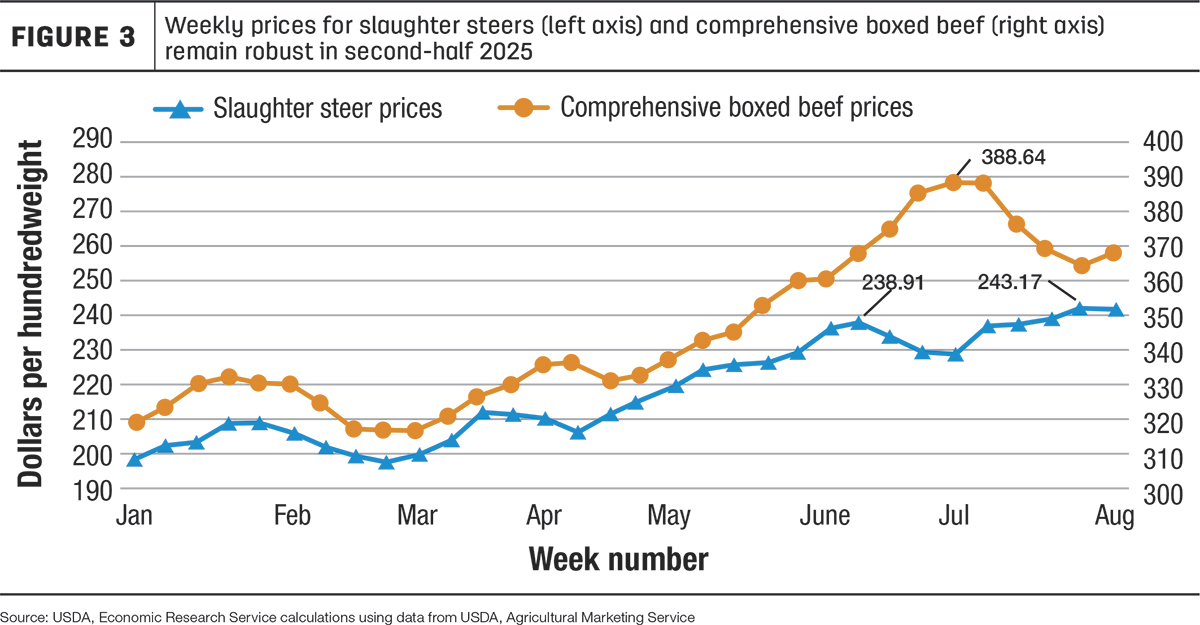
The July average price for slaughter steers in the 5-area marketing region was $237.09 per cwt, a slight increase from June and about $42.27 higher year over year. Based on strong wholesale beef prices, reduced beef production and daily slaughter steer prices in August, the third-quarter 2025 slaughter steer price forecast is raised $12 to $238 per cwt, and the fourth quarter is raised $11 to $240 per cwt. The 2025 average price is forecast at $227.06 per cwt, an increase of 21% from 2024, if realized. Based on the expectation of fewer placements leading to fewer slaughter steers available next year, the price strength was carried over into 2026 with a $15 increase to $243.50 per cwt, a 7% year-over-year increase.
In July, the weighted-average price for feeder steers weighing 750 to 800 pounds at the Oklahoma City National Stockyards was $335.09 per cwt. This was almost $25 above the previous month and $72 higher than July 2024. In the Aug. 4 sale, feeder steers averaged $343.55 per cwt, slightly below the week prior. Accounting for recent price strength, and fewer than previously expected calves available for feedlot placement in late 2025 and early 2026, the third-quarter price forecast for feeder steers is raised $31 to $343 per cwt, and the fourth quarter is raised $31 to $345 per cwt. The 2026 forecast is raised $38 from last month to $350.25 per cwt.
Beef exports
U.S. beef exports in June totaled 217 million pounds, 17% below a year ago (Table 1). Monthly exports to nearly all major markets were lower year over year, with the exception of exports to South Korea, which were up 3% year over year, though down significantly from May. June exports to Canada, while still below a year ago, jumped almost 4 million pounds (nearly 20%) from their average over the last three months.
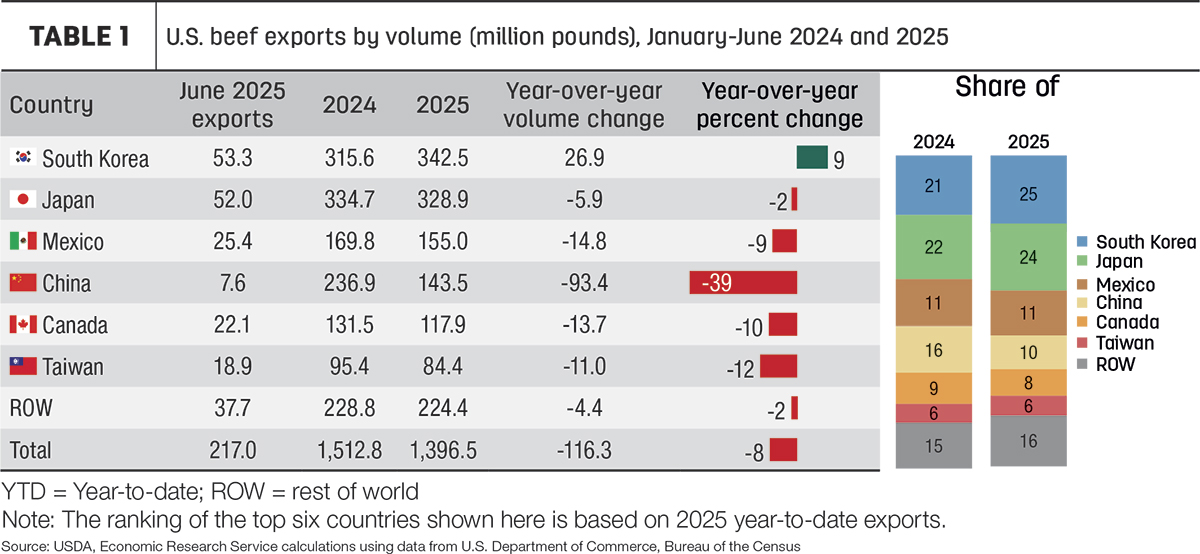
Year-to-date exports through June totaled nearly 1.4 billion pounds, about 8% lower year over year. Total exports to South Korea through June were up 9% compared to the same period last year. Exports to Hong Kong were also up 6 million pounds, or about 16%. However, exports to all other major markets were down year over year, including exports to China, which were down more than 39%. The total value of exports through June was more than 4.7 billion dollars, a year-over-year decline of about 5%.
Exports in the second quarter totaled 683 million pounds. Based on recent data and the pace of exports, the forecasts for third- and fourth-quarter exports are lowered 15 million pounds each to 645 and 640 million pounds, respectively. The annual forecast for 2025 is 2.682 billion pounds which, if realized, would be a year-over-year decline of 11%. The annual forecast for 2026 is lowered 20 million pounds to 2.545 billion pounds.
Beef imports
Beef imports in June totaled 438 million pounds, down from the levels seen over the previous three months, though still 28% higher year over year. Imports from Brazil were down sharply from May, falling nearly 100 million pounds month over month. Imports from Argentina and Uruguay also fell month over month in June. Monthly imports from Australia have remained relatively steady at around 100 million pounds since March.
Year-to-date imports are shown in Table 2. Total imports in the first half of the year were up nearly 737 million pounds from the same period last year, more than 33%. The majority of this increase were imports from Brazil, more than double the same period last year. Year-to-date imports from Brazil have reached more than 740 million pounds in the first six months, already exceeding the 691 million pounds total imported in all of 2024. Imports from Australia were also up significantly, nearly 35% higher. Australia’s reported exports to the U.S. show continued growth through June, signaling higher imports in the next couple of months once those shipments reach the U.S.
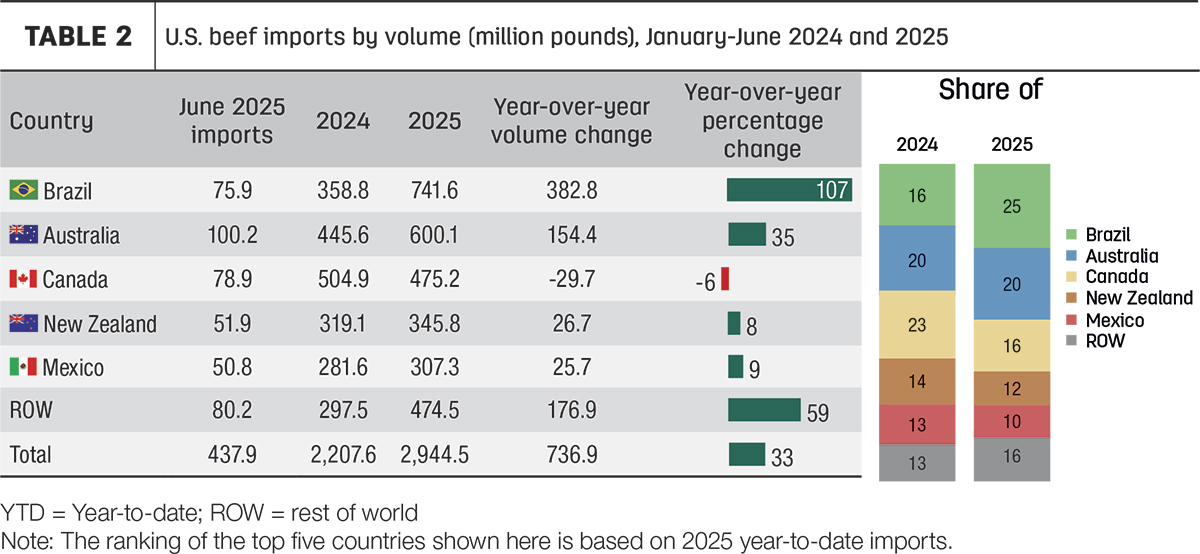
Brazil’s reported beef exports to the U.S. began falling off seasonally in May as expected based on the pattern of previous years. Shipments were already falling prior to the announcement of an additional 50% tariff that took effect on Aug. 6. This additional tariff will bring the total tariff on Brazilian beef imports to 76.4% with the over-quota tariff already in effect through the end of the year. The additional tariffs will make beef imports from Brazil significantly less competitive in the U.S. Limited imports from Brazil may still continue as demand for trimmings is extremely strong; additionally, Brazil is the main foreign supplier of heat-treated (shelf-stable) beef products to the U.S., so some of those imports are likely to continue.
Based on lower expected imports from Brazil partially offset by increased imports from other suppliers, the forecasts for the third and fourth quarters of 2025 are lowered 40 million and 50 million pounds, respectively. The annual 2025 forecast is 5.274 billion pounds, a nearly 14% increase from 2024. The annual 2026 forecast is also lowered based on decreased imports from Brazil, more than offsetting increased imports from other suppliers. The first quarter is lowered 100 million pounds to 1.35 billion. The second-quarter forecast is lowered 125 million pounds to 1.275 billion. The annual 2026 forecast is lowered by a total of 400 million pounds to 4.95 billion pounds, which would be a year-over-year decrease of 6%.